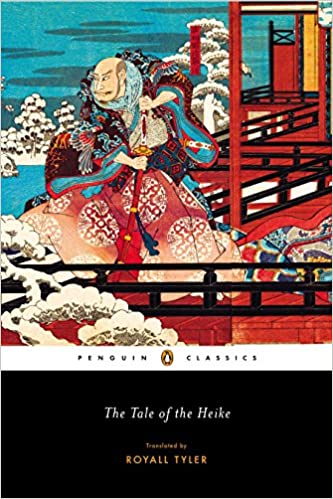
The Tales of Heike (Heike monogatari)

Translated by Royal Tyler


Heike monogatari: An Epic Account of the Genpei War
fgruson@middlebury.edu
       A literary masterpiece, Heike monogatari (1190-1221) is a captivating account of the Genpei War (1180-1185) between the Taira and Minamoto clans. The war between the two clans marked the beginning of the Japanese midlevel period and was the inspiration and basis of the Heike monogatari. The text is said to be written ... read more

       A literary masterpiece, Heike monogatari (1190-1221) is a captivating account of the Genpei War (1180-1185) between the Taira and Minamoto clans. The war between the two clans marked the beginning of the Japanese midlevel period and was the inspiration and basis of the Heike monogatari. The text is said to be written and strongly influenced by Buddhist priests and their teachings. Since certain sects of Buddhism, such as Jōdo, looked to spread their teachings in the early 13th century, additional Buddhist teachings were inserted into the various stories during the revision process of the Heike monogatari. These texts were also memorized and performed in Buddhist temples by a blind priest accompanied by a lute (biwa). Although the narrative focuses on the military houses, especially the defeated, quite a few stories are non-samurai focused, involving women and Buddhist priests. The juxtaposition of Buddhist teachings and the Genpei War in the Heike monogatari allows Kamakura Japan to come alive for the reader.

            A story I was particularly drawn to in the Heike monogatari was the story of “Giō.” The themes of gender, power, religion, and agency were highlighted throughout the story. Giō, a shirabyōshi (a female entertainer) for Kiyomori (Taira clan head), is objectified as a performer whose only task is to please. Giō rejects these constructs by taking agency over her own appearance, such as cutting her hair and abandoning her art. As a result, Giō achieves agency and removal from worldly desires by leading a holy Buddhist life. Like many other stories in the Heike monogatari, Buddhist doctrine is present and serves as an example of Buddhist behavior during the Kamakura Period. Also, another great aspect of stories like the story of “Giō” is the manageable length. In my opinion, none of the stories were too long or context-specific. Rather, they read as real stories that displayed a wide range of themes from death to loyalty.

            As you read the Heike monogatari, one cautionary note is that there are several instances of gory and violent descriptions. Although Buddhism is a central theme in the stories, the reader can not forget that it is a collection of war stories embodying the Samurai spirit. Therefore, as a reader, one should try and notice the ways in which the themes of the tales work together and how they too complicate the text. For example, the Samurai and Heike warriors, who are supposed to set an honorable example, instead at times are exposed in the tales as displaying bad karma (Buddhist concept) through their disgraceful acts.

            In a way, the tales act like a Buddhist sermon at large. The first line of the Heike monogatari is a warning that all things are impermanent, a foundational Buddhist doctrine that is reoccurring throughout the text. Just like any great literary work, the Heike monogatari expands the reader’s world views. It cooperates war and religion in a unique fashion I have never encountered before. I was to use a rating system to rank this text, I would not hesitate to give it a 9/10.


Total Votes : 0 Vote Up Edit Reply


fgruson@middlebury.edu
 In "The Death of Lord Kiso", Lord Kiso says to Tomoe, "I wouldn't want it said that Lord Kiso fought his last battle in the company of a woman!" (372). Although Tomoe is described as a great warrior, Lord Kiso still insists on her fleeing. In light of this statement, my question is in what way did gender influence the stories in Heike monogatari?

pisaboke@middlebury.edu
Drawing from the poems we read in class, we know that the worlds around us is ever changing and often symbolizes the impermanence of nature and life. My question is, how is this idea represented in some of these writing? What differences/similarities do these symbols have, do they hold true to the poems representation of nature and life?

kngai@middlebury.edu
The Tales of the Heike narrate a romanticized "way of the warrior" including qualities that were desired for the most ideal warrior. Compared to warriors of the Genji, are there specific "unwarrior-like" traits of the Heike that ultimately lead to their downfalls? 

aplanting@middlebury.edu
It was surprising to see the sheer power of the patriarchy that appeared in this reading. In contrast to our previous readings, it seemed very intensified because even at points in, for example, Torikaebaya we see the patriarchy yield a bit. I was wondering how this absolute power given to men was challenged. We see Hotoke run away and become a nun, but are there any other ways in which people would escape the grasp of the prime minister?

aubriannaw@middlebury.edu
In the Tale of Giō, we see women defy the oppressive patriarchy and exile themselves from imperial society to become Buddhist nuns. This act of liberation interests me as the tale presents the option to dismantle the stability of hierarchy and leave society if it does not treat you well. Is there any defiance or liberation in spite of society that does not have Buddhist enlightenment intentions? Essentially, is the only reason this defiance is okay in this story is because it's with Buddhist intentions?

pruffolo@middlebury.edu
In the Death of Kiyomori, I was surprised to see Kiyomori die such a painful death as a result of burning an image of Buddha Vairochana. I had always figured bad karma manifested after death, not during life. Was his crime so bad that he immediately lost his life as a human to be reborn as some lower type of life form? Do you think the Hell of Never-Ceasing Torment is perpetual life (b/c life is suffering in Buddhism)? 

nzambranoromero@middlebury.edu
Warrior tales began to shift to read as more of a documentary and would recount the tales of those that went to battle. I know whenever I read about older texts, I'm always compelled to think about their contemporary purpose. When it came to works like the Tale of Genji, the Tale of Ise, and so on we were both largely focused on aristocracy and were used for their poetic style. I wonder if, as time has gone by since then, if it remains the same for warrior tales. What i mean by this is, can the heroes of the tale be commoners? As the reading mentioned, a group of people that wrote these were the warriors themselves, and I am unsure if a commoner would have been both allowed to go into battle and learn to do things like write/read.

aarong@middlebury.edu
What is the significance of Buddhist themes in the work? How did these themes change when stories from the Tales of the Heike were adapted into different performing arts like nō, jōruri, etc.?

jlegido@middlebury.edu

I am very interested in learning more about women’s sex work and how it was viewed from the perspectives of society v. religion? 


axzou@middlebury.edu

While reading "Warrior Tales" one question that I kept wondering about was why the diaries of the Hōgen and Heiji periods were considered to be reliable records of events in the Kamakura period even when many of these warrior chronicles had no identifiable authors and were written by several people. On the other hand, the diaries of the Heian period, specifically "The Diary of Izumi Shikibu" were not considered to have reliable narrators. 


rpessah@middlebury.edu
I found it interesting that the first variants of The Tales of the Heike were initially recorded by writers and priests, and then were recited from memory, accompanied by a lute, to entertain a broad commoner audience. I was curious to know how this transition from written text to oral performance might have influenced the storytelling itself. More specifically, how might this affect the stories credibility and the way audiences perceive historical events?

pauls@middlebury.edu
I was looking at the family tree shown in TJL regarding important figures in the Tales of the Heike, and noticed that Taira no Tokiko, concubine of Taira no Kiyomori, is referred to as the "Nun of the Second Rank". This is obviously due to the fact that she became a nun after the death of her daughter, but why is it the most defining part of her life (her acceptance of impermanence and mujo)? She was also the mother of Taira no Munemori, who became head of the Taira clan, and grandmother of Emperor Antoku. All these are notable achievements, but her life has been characterized by the title "Nun of the Second Rank". I wonder who created this chart and why they chose to refer to her this way. Perhaps it's because all the literature calls her "Nun of the Second Rank"?

lmcnamara@middlebury.edu
 

While reading "Warrior Tales," I was intrigued by our last class discussion about impermanence and its role in Japan during this time. One thing that stuck out to me was The Tales of the Heike, which opened with the line, "The bells of the Gion monastery in India echo with the warning that all things are impermanent. The blossoms of the sala trees teach us through their hues that what flourishes must fade. The proud do not prevail for long but vanish like a spring night. The mighty too in time succumb: all are dust before the wind.”Correct me if I'm wrong, but is this the first time impermanence has been specifically cited in a text? What is the significance of the bells, and how does it set the reader up to understand the broader message of the text?


as5@middlebury.edu
After reading Elizabeth Oyler's and TJL's depiction of Giō, it was interesting to see the small differences or things that were left out on Oyler's account. For example, I really enjoyed reading how the mother, Toji, felt about this entire situation and didn't budge when it came to insisting Giō to perform for Kiyomori. There is a small mention of living in the countryside that is mentioned by Toji, and she claims, "Just the thought of living in some strange place in the countryside fills me with despair." It made me wonder, to what extent or how bad are the living situations in the countryside that make Toji feel this way? Is it more about her not wanting to abandon this "lavish" lifestyle that makes her feel this way, or is it that the countryside is so impoverished or other reasons that make it unsuitable or not preferred to live in? Both maybe?

sgosnell@middlebury.edu
After reading Gio, something that stuck out to me was the paradox that Buddhism seems to create in relation to gender. In Gio essentially being forced to return to the prime minister after being dismissed, it seemed that the role of the subservient woman was produced by and through Buddhism– the mother even says that “the ties that bind man and woman are decreed from a past experience– they do not originate in this life alone.” And yet, the only way for Gio to be emancipated was to turn entirely to Buddhism, because to commit suicide and in turn “induc[e] a parent to carry out such an act before the destined time for death has come” would be “commiting one of the Five Deadly Sins.” Was this “dual truth” paradox something that was common in Buddhism? Although in the early Heian period we saw women starting to speak up for themselves, especially in poetry, how did Buddhism in the Kamakura period impact the perception of female roles and influence their voice in society?


fgruson@middlebury.edu

The Influence of Buddhism on Heike monogatari


a. Joseph, Herbert S. “The ‘Heike Monogatari’: Buddhist Ethics and the Code of the Samurai.” Folklore 87, no. 1 (1976): 96–104. http://www.jstor.org/stable/1259504.


In Herbert Joseph’s “Buddhist Ethics and Code of the Samurai”, he analyzes the role of Buddhist doctrine and heroic Samurai spirit in the Heike monogatari. The author argues that the tales act as a Buddhist sermon. The first line of the Heike monogatari is a warning that all things are impermanent, a foundational Buddhist doctrine. The immoral actions of the Heike throughout the tales serve as examples unacceptance actions in Buddhism. While Joseph’s argument about the role of Buddhism in the Heike monogatari are clear, they would be strengthened if he references the stories in the actual text more to support his argument. However, the author does a stellar job of explaining the role of major Buddhist concepts in the tales. For example, the author includes the significance of understanding the role of karma, which determines in what status the person will be reborn into. The Samurai and Heike warriors, who are supposed to set an honorable example, instead are exposed in the tales as displaying bad karma through their disgraceful acts.


b. Oyler, Elizabeth. “Giō: Women and Performance in the ‘Heike Monogatari.’” Harvard Journal of Asiatic Studies 64, no. 2 (2004): 341–65. https://doi.org/10.2307/25066745.


Elizabeth Olyer’s “Giō: Women and Performance in the Heike monogatari sheds light on the intersection of gender, power, religion, and agency in the episode of Giō of Heike monogatari. Although the author clouds her argument by providing a little too much context and summary of the story, she effectively analyses the gendered power dynamics between Kiyomori vs. Giō and Hotoke. Therefore, I tended to trust Olyer’s arguments because she clearly analyzing the role of  Buddhism in Giõ’s defiance of the patriarchy. The author argues that Giō achieves her agency and removal from worldly desires by leading a holy Buddhist life. In being a shirabyōshi (a female entertainer) for Kiyomori, Giō’s life is objectified as a performer whose only task is to please. Giō rejects these constructs by taking agency over her own appearance, such as cutting her hair and abandoning her art. At the end, the author argues that performance serves as a metaphor for which Giō and Hotoke are able to achieve a complete release from earthly desires through Buddhist enlightenment.


c. Hasegawa, Tadashi. “The Early Stages of the Heike Monogatari.” Monumenta Nipponica 22, no. 1/2 (1967): 65–81. https://doi.org/10.2307/2383223.


Since Hasegawa Tadashi’s article is very long and context specific, I chose to focused on the author’s argument in the first two chapters: “The authorship of Heike monogatari” and “The Heike monogatari and the Biwa Hōshi.” Although the authors of The Tales of the Heike are unknown, I agree with Tadashi’s argument that the tales were compiled by Buddhist monks. The evidence the author provides for this claim is in how rooted religious matters and Buddhist themes are throughout Heike monogatari. For example, there are several references to the Enryaku monetary, the headquarters of a major sect of Buddhism in Japan. The author then transitions into analyzing the significance of the performance of Heike monogatari through biwa hōshi. Biwa hōshi, performed by people (tended to be blind) accompanied by a lute, were most popular in Buddhist temples for religious services. Tadashi’s article, through analyzing the performance of the tales, sheds light the influence of Heike monogatari on Buddhist teachings. Even after the wars, the overarching messages conveyed in the Heike monogatari serves as teachings of both acceptable and unacceptable Buddhist actions.


d. Butler, Kenneth Dean. “The Textual Evolution of The Heike Monogatari.” Harvard Journal of Asiatic Studies 26 (1966): 5–51. https://doi.org/10.2307/2718459.


Kenneth Dean Butler argues that the Heike monogatari should be considered a true epic of major proportions. Like many other articles about the Heike monogatari, the author stresses the unique aspect of how the Heike monogatari is read and recited. However, what the author does most effectively is analyze the evolution of the story and the role Buddhism plays into the evolution. Due to the nature of how the stories in the Heike monogatari were collected (several authors and stories passed down orally), Butler argues that additional Buddhist teachings were inserted into the various stories during the revision process of the Heike monogatari. The evidence the author provides is that certain sects of Buddhism, such as Jōdo, looked to spread their teachings in the early 13th century. To do so, they added Buddhist teachings to the original Heike monogatari.


axzou@middlebury.edu

Women in the Heike monogatari

a.  Brown, Steven T. 1998. “From Woman Warrior to Peripatetic Entertainer: The Multiple Histories of Tomoe.” Harvard Journal of Asiatic Studies 58 (1): 183–99. https://doi.org/10.2307/2652649.

Steven Brown examines how Tomoe Gozen’s story has been reshaped through historical, cultural, and gendered lenses. Tomoe Gozen is the legendary female warrior from the Heike monogatari (The Tales of the Heike), a medieval Japanese epic that recounts the struggle between the Taira (Heike) and Minamoto clans for control of Japan during the Genpei War (1180-1185). Through an analysis of medieval texts, including the Kakuichibon and Nantobon, Brown illustrates how Tomoe’s image—while consistently highlighting her military prowess—becomes increasingly entangled with gendered expectations. Over time, she is reinterpreted in various roles, such as a lover, an entertainer, and even a religious figure. The article also examines the tensions surrounding Kiso Yoshinaka (1154–1184), a samurai lord and member of the Minamoto clan, who commands Tomoe to withdraw from battle, revealing how different accounts interpret his motivations.

Brown holds an M.A. in East Asian Studies and a Ph.D. in Comparative Literature from Stanford University. His educational background lends credibility to his article, which offers a fresh perspective on Tomoe’s transformation, particularly his theory that her name is more closely associated with female performers than with nobility. This article is valuable for those interested in the intersection of gender, history, and literature in medieval Japan, providing new insights into how women’s roles, especially those that defy gender norms, are continually redefined within cultural and social expectations. However, the article’s references to Noh theater may be challenging to understand for readers unfamiliar with these works (Brown 1998).


b. Kansai Gadai: Asian Studies Program. n.d. “Tomoe Gozen.” Tomoe Gozen. Accessed November 23, 2024. http://tomoegozenkg.weebly.com/.

This webpage offers valuable insights for readers interested in understanding who Tomoe Gozen was, both as a historical figure and a legendary character in Japanese culture. It explores her legacy after the Genpei War (1180–1185), examining various legends, artworks, and modern depictions inspired by her story. While her role in the Heike monogatari is brief, she is portrayed as one of Kiso Yoshinaka’s (1154–1184) most formidable warriors, and the webpage traces Tomoe's appearances in literature and art, offering a deeper understanding of how her identity as a warrior has been celebrated over time, with a particular focus on her gender. The author of the webpage argues that Tomoe’s gender is key to her enduring legacy, as her story challenges traditional gender roles in warfare and how her image as a “mounted warrior” reinforces her mythic status.

The content on this webpage is easy to understand, with both textual analysis and visual resources, making it a useful tool for readers interested in Japanese literature, history, or gender studies. However, while it is published by Kansai Gadai’s Asian Studies Program, an accredited private university with a focus on foreign language studies, readers should exercise caution, as the content may not be fully fact-checked (Kansai Gadai: Asian Studies Program, n.d.).


c. Omar, Hebatalla. 2022. “Binary Opposition and Gender Representation in The Tale of the Heike.” Asian Culture and History 14 (2): p57. https://doi.org/10.5539/ach.v14n2p57.

Hebatalla Omar offers a compelling analysis of the portrayal of female characters in the Heike monogatari. Omar argues that women in the text often serve as tools to advance the stories of male characters, reflecting broader societal issues such as class discrimination and gender inequality. She draws a parallel between the narrative structure of the Heike monogatari and modern media, highlighting how female characters are often used to evoke sympathy from the audience and are manipulated as instruments of power. Omar notes that the closer a female character is to the ruler, the less agency she has in representing herself. Nine out of thirteen female characters are connected to Kiyomori (1118–1181), the head of the Heike clan, and their stories ultimately serve to illuminate his character and actions.

While the article seems primarily aimed at scholars, students, and readers interested in Japanese literature and gender studies, it also appeals to anyone seeking a deeper understanding of the Heike monogatari and its cultural significance. Omar provides a brief background on each female character, exploring how they are depicted in the text, and categorizing them according to the roles they fulfill within society. This approach makes the arguments clear, accessible, and easy to follow. Additionally, since this article is published in the Canadian Center of Science and Education, a reputable peer-reviewed journal, I trust Omar's analysis is credible and well-founded (Omar 2022).


d. Oyler, Elizabeth. 2004. “Giō: Women and Performance in the Heike monogatari.” Harvard Journal of Asiatic Studies 64 (2): 341–65. https://doi.org/10.2307/25066745.

Elizabeth Oyler examines the complex roles of female characters in Giō, one of the most famous episodes of the Heike monogatari. Focusing on the performance scenes of the shirabyōshi—female singers and dancers dressed in male clothing—Oyler explores themes of female agency, objectification, and identity within a patriarchal framework. Although constrained by male figures like Taira no Kiyomori (1118–1181), the prime minister of the Taira clan, female characters such as Giō, Kiyomori’s favorite shirabyōshi, assert their subjectivity through performance. Oyler investigates how these performances offer a space for women to express agency and challenge social norms that restrict them in a male-dominated society.

As an associate professor of Premodern Japanese Literature and Performance at the University of Pittsburg, I trust Oyler has a deep understanding of the Heike monogatari. Before delving into her analysis, she effectively summarizes the key events, providing readers with context that enhances their understanding of her arguments. While her intended audience appears to be readers of the Heike monogatari, her clear and accessible writing ensures that even a general audience can follow her analysis without much difficulty (Oyler 2004).

mgamez@middlebury.edu

The reconstruction of female figures in Medieval Japan:


Marra, Michele. "The Buddhist Mythmaking of Defilement: Sacred Courtesans in Medieval Japan." The Journal of Asian Studies 52, no. 1 (February 1993): 49–65.


An analysis of how medieval Japanese Buddhism combined ideas of defilement, particularly surrounding women, into its religious teachings and rituals. Marra looks at how sacred courtesans were simultaneously seen as impure yet had the capacity of being spiritually enlightened, displaying a broader societal and religious dynamic. The article sheds light on the paradoxical view of women in both keeping alive and resolving the fears of impurity within Buddhist ideology. It looks at this “conquest over the ‘pollution’ of the female body” as a “restoration of order” (51). By reinterpreting courtesans as potential bodhisattvas, Buddhist narratives both marginalized and elevated women, using their perceived impurity as a tool for moral and spiritual teaching. This displays a theme in Medieval Japan (specifically during the Heian and Kamakura periods, 794–1333) of restructuring female figures into more socially and culturally acceptable figures.


Brown, Steven T. "From Woman Warrior to Peripatetic Entertainer: The Multiple Histories of Tomoe." Harvard Journal of Asiatic Studies 58, no. 1 (June 1998): 183–199.


An Exploration of the shifting historical and cultural representations of Tomoe Gozen who was a legendary female warrior of the Heike Monogatari (ca. 13th century). Steven Brown analyzes how Tomoe's identity evolved through various roles from warrior to entertainer, reflecting the gender politics and performative practices of medieval Japan (1185–1333). This article traces her transformation from a celebrated combatant with great skill, into roles that align with the cultural representation and expectation of women at the time. These shifts highlight the differences between historical memory and cultural narrative. Tomoe’s strength and power is eventually overshadowed throughout time, turning her into a maiden or other culturally accepted female figure. The article underscores the ways in which storytelling and performance reshaped Tomoe's legacy, linking it to broader themes of gender and power. Thus again, we are struck with the theme of reconstructing the female image in Medieval Japan in order to fit with expectations, and comfortable norms of the time.


Kajiyama, Yuichi. "Women in Buddhism." The Eastern Buddhist 15, no. 2 (1982): 53–70.


This article is an examination into the evolving roles and perceptions of women within Buddhist culture, starting with early equality under Gautama Buddha (ca. 5th–4th century BCE) to the later discrimination within Buddhism especially during the medieval Japanese period (12th–14th centuries). Kajiyama traces how the belief that women could not achieve Buddhahood emerged as a response to the societal and belief shifts within the development of Buddhist schools. This article also focuses on Mahāyāna Buddhism’s attempt to combat the discrimination through new philosophical thought and ideas, such as the beliefs of emptiness, an idea that emphasized the spiritual equality of every living being. This article provides a thoughtful analysis of the intersection between religious belief, gender roles, and societal influences on the history of Buddhism, showing how this restructuring of the female image happened. This shows how Buddhist ideology perpetuated and challenged the societal norms of the time.


Minamoto, Junko, and Hank Glassman (translator). "Buddhism and the Historical Construction of Sexuality in Japan." U.S.-Japan Women’s Journal, English Supplement, no. 5 (1993): 87–115.


An analysis of how Buddhism shifted Japanese sexual culture by mixing ideas of impurity with the patriarchal norms of the time, particularly in its treatment of women. Minamoto looks at how doctrines such as the Five Obstructions and karmic retribution portrayed women as inherently sinful beings, strengthening the Medieval societal hierarchies during the Kamakura period (1185–1333). The article highlights the paradox of how Buddhism simultaneously rejects sexuality while playing a role in systemizing Medieval Japan’s patriarchal ideals. This frames women’s bodies as not solely ‘polluted’, but also having the potential for salvation. By linking subordination to spiritual salvation, Buddhism both marginalizes women and justifies the patriarchal cultural practices. This shows the broader theme of restructuring ideas of women and gender roles to contribute to, and align with the religious and societal ideas. This demonstrates how Buddhism leveraged gender norms both to maintain societal frameworks and to allow women into the spiritual framework with the idea of salvation.


Spann, Susan. “The Forgotten Roles of Women in Medieval Japan.” Seventh Street Books Blog. Accessed December 14, 2024.


This article looks at the diverse and oftentimes overlooked roles that women held in medieval Japan. These women held roles such as active samurai (onna-bugeisha), ninja assassins (kunoichi), business owners, and more. This insight challenges the modern assumptions of their societal limitations. The piece addresses common misconceptions, such as the portrayal of geisha as prostitutes, explaining their role as skilled entertainers. This article complements the theme of reconstructing female figures by showing how women contributed to medieval society, providing a broader cultural context for understanding how women’s roles were shaped and reinterpreted in medieval Japan.