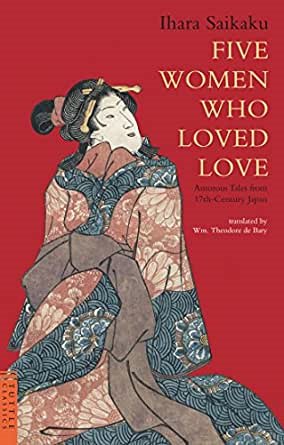
Five Women Who Loved Love
Ihara Saikaku
In the Koshoku gonin excerpts, I noticed that this was one of our few readings with visual representations of the text included as well. In regards more specifically to the drawings in "The teahouses which had not heard of gold pieces," how do they bring in a new element to the story that is not explained through writing?
In “The Greengrocer’s Daughter,” Kichisaburo's friends made several attempts to save his life, and his "sworn friend" eventually persuaded him to become a priest instead of dying with his lover. A footnote suggests Kichisaburo and his elder sworn brother might have been in a homosexual relationship before he broke his oath and fell in love with Oshichi. Oshichi, on the other hand, was helped by a maid and a cook when she tried to reach Kichisaburo's room. In what ways is the friendship between women portrayed differently in this story compared to the friendship between men?
In “The Greengrocer’s Daughter with a Bundle of Love” excerpt of Five Women Who Loved, there were a handful of areas that touched upon masculinity at the time. At one point in the story, Oshichi's parents say that "If [Kichisaburo] is a man at all, he could never live on after hearing the news" (189), and later, Kichisaburo says, "But people would call it unmanly for me to bite off my tongue or strangle myself" (193). What do these two lines share about what "manliness" was perceived to be at that time? What does it share about how they were expected to deal with pain or suffering?
Content warning: My post will focus on the story of a character dying by suicide. Please engage however feels right for you.
“4. Farewell to the Cherry Blossom” -- “To some inquisitive souls, however, it seemed strange that Oshichi’s lover had not tried to follow her in death.” (188) I am intrigued by the social norm of dying for one’s love. A striking quote was, “if he is a man at all, he could never live on after hearing the news” (189). This suggests that masculinity and male gender norms dictate that one must love so deeply that they refuse to live in a world without their love and if they choose to, they are emasculated. Does this mean that dying for one’s love was seen more as a masculine decision rather than a non-gender norm? It seems Oschichi decided not to live in a world where she could not see her love so I am curious about framing that decision in a masculine light?
A lot of the readings today reflect a huge shift of typical women's role in society and beauty standards, what changed? For example, when the lord was looking for a concubine he had very specific standards and what struck me the most was wanting straight white teeth. As well as several references to young girls engaging in seduction, sex work, and early marriage while reminiscing of the past "Today's girls". Most of the women were forced to turn to prostitution or becoming a beggar to survive was this the reality and treatment of non court women? Or did Japan culture transition into sexualizing women more explicitly than previously?
What was the “process” of becoming a prostitute? What was society’s point of view on this topic? Was it common for people to turn to prostitution as a means of financial stability?
While reading the excerpts from Koshoku Gonin Onna ("Five Women Who Loved Love") by Ihara Saikaku, I found it striking how differently these women are portrayed compared to some of the other works we've read. In many of the texts we've looked at, women’s desires or passions are either repressed, constrained, or punished, but in Saikaku’s work, the women actively pursue their own romantic and sexual desires, which defy the social and moral limitations of their time. However, this agency is a double-edged sword, as it often leads to tragic consequences. The women in Saikaku's stories are depicted not simply as passive victims of their circumstances, but instead, they are portrayed as complex individuals who take ownership of their desires, even when those desires ultimately result in hardship or loss. This makes me wonder: Does their tragic fate ultimately reflect the dangers of pursuing personal freedom in a society that actively restricts it? One quote that particularly stood out to me was: "Just a little further on we shall come to the village of some people I know. There we can forget all our misery, indulge our heart's desire with pillows side by side, and talk again of love! When she heard this, Osan felt better right away" (p. 143).
It was really interesting to read the different stories of The Life of an Amorous Woman which explores themes of desire and love through social expectations. How does the portrayal of the protagonist’s romantic and sexual pursuits challenge or reinforce the societal norms of the Edo period? The protagonist leaves us with a thought-provoking question: “I may have lived in this world by selling my body, but is my heart itself polluted?” How does this question invite us to reflect on the intersection of personal identity, morality, and societal judgment?
In The Life of an Amorous Woman, I found it interesting when the narrator mentions how "a group of maidens in the capital studied this art with a view to make a living from it" (126). In our class discussions, particularly about Nō Theatre, we saw that only men performed. It’s interesting to me that, in this case, women were the ones studying and using performance as a way to make a living. I was curious to know, how easy was it for women to gain acceptance in roles traditionally reserved for men, such as in the performance arts?
How does Saikaku use relationships among the chōnin class to comment on social values in Tokugawa Japan? I’m curious about how Saikaku’s stories reflect or critique the values of chōnin society, especially given their unconventional relationships and the rewards or consequences they face!
I found today's reading pretty interesting. It was interesting that we are introduced to the different type of women are given an insight to their desires and passions and how their were punished as well. What stood out to me the most was how more direct these women were when it came to expressing their feelings. A question that I had after reading the scene where Oschichi sets a fire to see Kichiasburo is how extreme were people willing to be to see someone or express their feelings?
In Koshoku Gonin Onna, Ihara Saikaku depicts women who challenge societal norms by actively pursuing their desires, contrasting sharply with the expected passivity found in traditional Japanese literature. I found these characters daring and assertive, which differs from some of the previous texts we covered. Saikaku's portrayal highlights the complexity of their choices, illustrating them as neither solely victims nor rebels but as individuals who embrace life’s fleeting pleasures despite the accompanying risks. This makes me wonder: do their fates ultimately condemn or commend their pursuit of love and autonomy in their extremely conformist world?
This weeks reading gave us another story that faces sexual desires with societal expectations. It seems like Saikaku uses these themes to explore the limitations placed on women and the consequences of defying social norms, especially in a rigid society like Edo-period Japan. I found it interesting how the characters Osan and Moemon are portrayed in this story as protagonists. I wonder if this story is supposed to be read as a cautionary tale, or a tale that shows and notices this intersections between desires and rules.
I'm left wondering about the purpose of this text. On one hand, I thought it was meant to be a comedy of sorts, poking fun at these rich young men with nothing better to do than look at and rate women on their appearances and demeanors. They shame a woman with a scar, and one missing a tooth, but then they also shame a very beautiful woman who seems to neglect her children, which made me think that perhaps it was also a sort of tale meant to demonstrate proper to women. At the end of it all, Osan and her lover are executed, which seems pretty harsh for a comedy, so perhaps it's warning against 'sinful' behavior. This seems to be supported by the second section, where Oshichi starts a fire out of her desire to see Kichisaburo, where she is then again put to death. I also thought this reading was much more direct/explicit than previous readings have been, especially in regards to sexual encounters.
"Ihara Saikaku." In Encyclopedia Britannica, September 5, 2021. https://www.britannica.com/biography/Ihara-Saikaku.
This encyclopedia entry rather than focusing on Ihara Saikaku’s work, Five Women Who Loved Love, focuses more on Saikuku as an author. The article goes on to explain the manner in which Saikaku was able to attract readers through his exceptional writing style. Saikaku is described within this article as able to produce an elliptic, swift, and allusive style of writing which draws most readers in and keeps them reading until the end of the story. Readers are given a glimpse into Saikau’s other works, such as samurai stories which are considered inferior when compared to his erotic works. Essentially this article is perfect for anyone who wishes to understand the author and their reasoning for writing the way they do: their motivations and their inspiration. The author of this entry does well to explain how Saikaku’s character influences his work. Overall, this article is a good read for anyone interested in gaining a deeper understanding of Saikaku’s works.
“Five Women Who Loved Love Analysis - 1192 Words.” 2021. Cram.com. https://www.cram.com/essay/Five-Women-Who-Loved-Love-Analysis/F3GGHV53GY3W.
This article gives readers a brief yet non-spoiling review of Five Women Who Loved Love. It is a good way for readers to get a general understanding of what kind of stories they are going to be reading. Aside from the summary the article goes on to give a brief biography of Saikaku, and how he came about becoming a writer: this gives readers a great understanding of the author and his mindset or motivators for writing in the way that he does. Aswell as a brief biography the article details how the individual relationships of the five women and their lovers work, primarily how the women seem to be more dominant in their love dynamics. Generally, this article would be a great read for anyone who wishes to understand the time period in which these stories take place, get a better understanding of Saikaku, and grasp the general dynamic of these five women.
Johnson, Jeffrey. “Saikaku and the Narrative Turnabout.” Journal of Japanese Studies 27, no.2 (2001): 323–45. https://doi.org/10.2307/3591969.
This article takes a very detailed view of Tokugawa society in the specific aspect of Ihara Saikaku’s comedic writing tropes. It does well to add context to some of the broader themes within Five Women Who Loved Love. The added context provides a much more clearer understanding of some elements that one may not understand due to the fact that this is literature based around a culture that may be unfamiliar to readers outside of this culture. Within this article the manner in which Saikaku engages with both elite and lower social classes is also examined, because more often than not these stories revolve around people in elite social classes. Overall, the article does well to contextualize Saikaku’s themes within Tokugawa society and offer insight to cultural events that may not be understood by many readers.
Murray, Chris. 2010. “Five Women Who Loved Love, by Ihara Saikaku.” Poethead. https://poethead.wordpress.com/2010/08/15/five-women-who-loved-love-by-ihara-saikaku/.
This article essentially is a personal review by the author. The author talks about the manner in which he consumed the book: he went in with a positive mindset. Saikaku’s themes of morality lore are addressed in this article, primarily the fact that you must sometimes dig to find these themes because it can be hard to spot at times that this is the idea being presented. Mainly the articles sheds light on the mentalities of the characters: the women views on love, and their love interest's ways of dealing with the matter. One of the main points of this article is elaborating the types of worlds that these characters inhabit: giving readers a sense of what type of world they are immersing themselves in. Overall, I recommend reading this article for a deeper understanding of how these characters function, the deeper themes within themes, and how their worlds are structured.
Liu, Miranda. 2012. Through the Looking Glass: Reflections of Differences in Samurai and Kabuki-Prostitute Male-Male Relations in Ihara Saikaku's The Great Mirror of Male Love. Undergraduate thesis, Haverford College.
Liu’s work is well described by its title, as her thesis argues that Ihara Saikaku’s The Great Mirror of Male Love uses literary devices to highlight the contrasting styles of nanshoku (idealized and character-driven male-male love among the samurai)—idealistic and character-driven among the samurai versus commercial and anecdotal among the chōnin—while explaining the structured societal rules that governed homosexual relationships during the Tokugawa period (1603–1867). One of the unique features of her work that I appreciate is its detailed discussion of cultural markers, as Liu breaks down terms like nanshoku and shudō (the “way of youth,” or mentor-pupil relationships between an older man and a younger man) for readers to understand the context. She also highlights traditions, such as the genbuku (coming of age) ceremony and maegami hairstyles, which marked a youth’s role until adulthood changed their societal standing. This then sets the stage for her discussion of Saikaku’s text, where she argues that the samurai stories serve as moral guides, with characters like Jinnosuke praised as “a model for future generations,” embodying loyalty and honor (22). In contrast, the kabuki tales focus on entertainment and gossip, showing how nanshoku (male-male sexual relationships) among the chōnin prioritized amusement over samurai ideals. This analysis connects to questions discussed in class, such as how writers like Saikaku explore societal norms through their portrayals of romantic and sexual pursuits, and whether these depictions challenge or reinforce the expectations of their time.
Revisiting Saikaku’s work, this dissertation examines the evolution of popular fiction during Japan's Early Modern period (1600–1868), focusing on Ihara Saikaku’s The Sensuality of Five Women (1686). Kanesaka argues that Saikaku’s fiction was deeply influenced by performing and visual arts, marking a turning point in his career and illustrating the connections between popular fiction and other artistic genres of the era. I think that this source provides an exciting way to approach the text, as it looks beyond the language and literary devices in the chapters to also explore the visual art of the woodblock prints. It reminded me of our class discussions where we explored visual elements like clothing, adding new perspectives to how we understood relationships and themes in the works we read. This dissertation’s strength lies in its ability to cater to readers unfamiliar with Saikaku by offering a detailed analysis that bridges literature, art, and performance.
-
Griswold, Susan. “Sexuality, Textuality, and the Definition of the ‘Feminine’ in Late Eighteenth-Century Japan.” U.S.-Japan Women’s Journal. English Supplement, no. 9, 1995, pp. 59–76. JSTOR, http://www.jstor.org/stable/42772085.
The article journal explores femininity during the Tokugawa period(1603-1868) through discussions of sexuality in the pleasure quarters. Griswold analyzes the sharebon genre, which details the events within these quarters, to illustrate how women were dehumanized. For instance, the “nightless city” (Griswold, 1995, pg. 65), a site of prostitution, is described as a single gated entrance and exit, symbolizing the restriction and control imposed on women. Additionally, Griswold points out “ that femininity in sharebon was created by men to be consumed by men“(Griswold, 1995, pg.69). Men were dominant figures who controlled situations, forcing women to remain obedient and conform to the system and therefore, highlighting how femininity was commodified to serve male desires and reinforce social hierarchies.
-
Bae, Catherine. “Seducing Mind and Body in the World of Commerce, Theater and Literacy.” Impressions, no. 37, 2016, pp. 168–85. JSTOR, http://www.jstor.org/stable/24869131.
The article provides insight into the culture of Edo-period Japan(1603-1868), particularly through its entertainment scene and kabuki theater. Bae examines various artworks, such as Courtesans Promenading under Blossoming Cherry (Bae, 2016, pg. 180), to highlight the cultural trends of the period. By analyzing kimono, paintings, handscrolls, and other artifacts, the article shows how these objects reflect societal aesthetics while offering an understanding of their symbolic meanings.
-
Stanley, Amy. “Adultery, Punishment, and Reconciliation in Tokugawa Japan.” Journal of Japanese Studies, vol. 33, no. 2, 2007, pp. 309–35. JSTOR, http://www.jstor.org/stable/25064722.
The work examines Tokugawa bakufu’s laws, societal gender bias, and moral perceptions of adultery. The term bakufu, also known as shonugate, refers to Japan’s
military government which was responsible for both ruling the country and managing its military affairs. As the governing authority, the bakufu enforced societal regulations, including laws that mandated punishment for committing adultery. Stanley emphasizes that this crime often resulted in death, as shown in stories like “ Chikamatsu's plays and Saikaku's stories” (Stanley, 2007, pg. 310). However, these laws disproportionately impacted women. Stanley interprets these laws as a “metaphor for the relationship between governors and governed” (Stanley, 2007, pg. 311), reinforcing the idea of social hierarchies. However, this idea of maintaining social order was not always maintained among the peasants, who often resolved disputes through other practices.
-
Linfamy, “The CRAZY Ways Japanese Courtesans Dealt With Pregnancies”. YouTube, 2021. https://youtu.be/eKBNLBZWquc?feature=shared.
In the YouTube video, Linfamy explores the contraceptive methods of courtesans in the pleasure quarters during the Edo Period (1603-1868) and examines the impact pregnancy took on their health. If a courtesan became pregnant, various practices were employed, such as holding “a seahorse during labor, drinking medicine from a seashell”(Linfamy, 2021, YouTube). High-ranking courtesans, known as yūjō, had the privilege of staying in hospitals to rest and recover from childbirth. However, this care was not extended to lower-ranking courtesans. Decisions regarding pregnancies were made by the brothel owners, who frequently resorted to terminating unwanted pregnancies. In some cases, abortions were performed under harsh conditions, with courtesans being “laid down, tied up, and gagged”(Linfamy, 2021, YouTube). The loss of a child during pregnancy was more socially accepted during this time and was preferred over raising a child who would be sold into the brothel system.
Stanley, Amy. “Adultery, Punishment, and Reconciliation in Tokugawa Japan.” The Journal of Japanese Studies 33, no. 2 (June 2007): 309–35. https://doi.org/10.1353/jjs.2007.0083.
Amy Stanley’s article, “Adultery, Punishment, and Reconciliation in Tokugawa Japan.” examines the development of adultery laws during the Tokugawa period (1603-1867), which criminalized adultery as a form of treason and compares them to local village practices. Stanley argues that the Bakufu’s harsh laws on adultery, which focused on punishment, were not universally accepted and contrasted with rural practices where reconciliation, compromise, and reintegration into the family were emphasized. Amy Stanley is a historian of modern and early Japan and her article is intended for an academic audience such as other historians and scholars in Japanese studies. Her references require readers to be familiar with Japanese customs and legal systems. Stanley demonstrates the contrast between urban and rural practices by using real examples of resolutions to adultery, strengthening her argument and providing historical context. She also uses real examples to connect concepts in the adultery laws to patriarchal values at the time and the symbolism of treason in adultery. This source is highly relevant to marriage in the Edo period because it shows gender, familial, and political values and dynamics regarding marriage at the time.
Yonemoto, Marcia. “The Perils of the ‘Unpolished Jewel’: Defining Women’s Roles in Household Management in Early Modern Japan.” U.S.-Japan Women’s Journal, no. 39 (2010): 38–62. http://www.jstor.org/stable/42771853.
Marcia Yonemoto’s article, “The Perils of the ‘Unpolished Jewel’: Defining Women's Roles in Household Management in Early Modern Japan” analyzes instructional manuals for women published between the late 17th and early 19th centuries. She examines the roles and responsibilities of women in Tokugawa Japan which were emphasized through these texts and Confucian ideals. Yonemoto specifically focuses on how women’s household management was critical to maintaining social and political order and how these expectations empowered and restricted women. This article is meant for an academic audience such as historians and scholars in Japanese or gender studies because it requires some familiarity with Japanese history and Confucian values. A notable strength and special feature of this source is its analysis of primary sources such as the instructional manuals which offer direct insight into gender norms at the time. These primary sources also provide insight into how women viewed these norms and how they navigated them. This source is highly relevant to the topic of marriage in the Edo period because it explores the role of women in the household, which the article states was a foundational aspect of marriage and a woman’s value at the time.
Hamano, Kiyoshi. “Marriage Patterns and the Demographic System of Late Tokugawa Japan: Based on Two Case Studies of Contemporary Demographic Registers.” Japan Review, no. 11 (1999): 129–43. http://www.jstor.org/stable/25791039.
Kiyoshi Hamano’s paper, “Marriage Patterns and the Demographic System of Late Tokugawa Japan: Based on Two Case Studies of Contemporary Demographic Registers.” explores marriage patterns during the Tokugawa period, their relationship to economic and demographic factors, and the role of inheritance in shaping marriage behaviors. This paper aims to highlight the uniqueness of Tokugawa marriage patterns and how they compare to European and other Asian patterns. Hamano supports his argument by using case studies from demographic registers, which offer first-hand insight into marriage patterns and population statistics across Tokugawa villages. Hamano’s use of historical records and statistical evidence gives his claims credibility. However, his data has a limited scope and only comes from specific regions, so his findings may not represent marriage patterns for the entirety of Japan, as he claims. This source is relevant to the topic of marriage in the Edo period because it analyzes marriage patterns based on demographic data at the time and how these patterns were affected by social and economic factors, such as inheritance and labor needs. It also contextualizes Tokugawa Japan’s marriage patterns within global marriage patterns which highlights its unique features.
Bincsik, Monika. “Japanese Weddings in the Edo Period (1615–1868): Essay: The Metropolitan Museum of Art: Heilbrunn Timeline of Art History.” The Met’s Heilbrunn Timeline of Art History, March 2009. https://www.metmuseum.org/toah/hd/jwed/hd_jwed.htm.
Monika Bincsik’s article, “Japanese Weddings in the Edo Period (1615–1868)” details how Edo period marriages were arranged to solidify political alliances among Daimyo families, who were powerful provincial leaders. It describes the significance of trousseaus for mainly wealthy Daimyo families, but also commoners in symbolizing wealth and social status, along with their preparation process, items included, and their role in preserving cultural history. This article aims to offer insights into the social and cultural dynamics of Japanese marriage in the Edo period and the intricacies of wedding trousseaus, especially in high-ranking families. This article is meant for a general or casual audience because of its short length, easily accessible webpage, and it is easily readable for readers with little to no prior knowledge of Japanese culture. Bincsik is also a curator, scholar, and historian of Japanese art which increases this source’s credibility despite it not being an academic source. Bincsik offers rich descriptions of specific trousseau items which helps the reader conceptualize what these dowries consisted of and the cultural significance of these objects and practices. However, this text mainly focuses on higher-ranking customs and leaves out details regarding commoners and broader society.