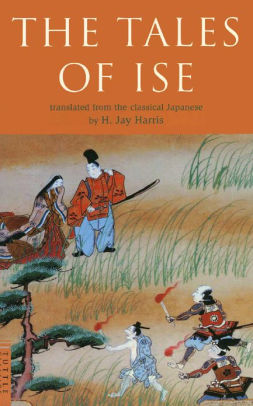
Ise monogatari (The Tales of Ise)
Tales of Ise: A Journey Through Poetic Disappointment
In "The Tales of Ise" assigned to us for reading in the TJL, I noticed a connection strong link between love and weeping. In "The Imperial Huntsman (69)," the link between dreams and romantic relationships shows up as it has in several poems we have read throughout this course. However, the nature of the couple's situation leads the male protagonist of the story to start weeping on several occasions, usually triggered by poems written by the female. Since the man in the story is portrayed as a strong imperial hunter, I found it odd that he would show vulnerability by crying (this is based on the modern-day societal norms for men). Did men crying signify something different from when women would cry?
In the Journey to the Eastern Provinces, there are several references to leaving the capital. The natural scenery the travellers see along their way (e.g. Mt. Fuji, the capital bird) remind them of how far they've gone and how they are now separated from their lovers in the capital. In the Shade of Wisteria Blooms, the poet cleverly expresses sarcastic comments on the Fujiwara hegemony in a way his audience couldn't "find fault with his answer." How to understand individuals' resistance to dominating social norms in these poems of forbidden love?
The Diary of Izumi Shikibu and “The Imperial Huntsman (69)” from The Tales of Ise are both stories about "forbidden love" to an extent. Are there any similarities or differences between these stories, whether in the language/imagery of the poems written or the characters present in each story? How do these similarities and differences help one better understand the "forbidden love" narrative during this time?
In the "Nagisa-no-in" section of the Tales of Ise reading, Prince Koretaka and his entourage journey to Minase to drink, compose poetry, and admire the fleeting cherry blossoms. On the eleventh day of the month, the moon begins to sink behind the mountains and the director of the stables writes, “How can the moon hide itself before we are satisfied? I wish the mountain rim would flee so the moon might stay in view.” Composed out of wistfulness, what does this poem signify about the concept of impermanence?
Both "The Imperial Huntsman" and "The Izumi Shikibu Diary" are stories that depict forbidden love. How are these narratives similar in how they show this forbidden love? Moreover, both the diary and Tales of Ise have poems mentioning the sleeves being drenched. In the diary, the lady mentions that “only my sleeves are drenched,” while the daughter of the high priestess stated that “shallow as waters that do not wet the hem of a traveler’s robes…” Why is this motif mentioned repeatedly throughout poems? What is it implying?
The poems in The Tales of Ise link feelings of love and longing to the surrounding natural landscapes. As discussed in class, the description and connection to the scenery—such as rivers, mountains, and seasonal changes—help me picture the Heian period while illustrating how nature mirrors emotions. For instance, when Narihira observes the snow on Mount Fuji, he states, “What season does it take this to be that the falling snow should dapple it like a fawn.” I was curious to understand how do these descriptions of nature say about the complexities of love and loss?
Questions from Five Portraits of Male Friendship in Ise monogatari
-
Have you ever disliked someone when you first met them but eventually became very close to them? How do you think this came to be?
-
What makes someone a friend?
-
If you haven’t seen someone in a long time, has the relationship between you and them also begun to change?
When reading the Diary of Izumi Shikibu, I found it very interesting as this is the first time we see a love story being unraveled through both poetry and lines of context. I really liked the beginning with the part where the Prince and Izumi are having a spell of unfortunate events where it came off as if she was being cold towards the Prince such as the part where the Prince described how it was it was like talking to someone but having the person not even be there. Or how he came one night and knocked only to be answered by darkness and quiet and assume the worst of her. My question is how did her writing impact future writers? Especially towards the female audition who I believe enjoy reading stories similar to these where it includes two potential lovers with detailed events as if they were also there watching kind of like a third person view.
1. Cartwright, Mark. “Heian Period.” World History Encyclopedia. Published May 5, 2021. Accessed November 29, 2021. https://www.worldhistory.org/Heian_Period/.
This website article broadly discusses the Heian period (794-1185), which is the period when the Ise monogatari was written. Of the topics discussed, the sections on Heian government, religion, and culture are most relevant to crafting a deeper understanding of the tale. The Heian government section shares information on how the government was structured, the role of authority figures, the distribution of public land, the importance of the Fujiwara clan, and their strategies for staying in power. This information can be useful for better contextualizing events and roles of different characters in the tale. The Heian religion section sheds light on the dominance of Buddhism and the Heian culture section briefly discusses the importance of art and the relationship between gender and literature. These two sections provide more context to the reader and a better sense of direction when it comes to analyzing the text. While this article does not directly analyze aspects of the Ise monogatari, it does provide relevant cultural and historical information needed to contextualize events and better understand the meanings behind poems, relationships between characters, or societal roles of characters in the tale.
2. MacMillan, Peter. “A Talk with Peter MacMillan, Part 4: Ise Monogatari.” Japan Up Close. March 12, 2019. Video, 7:52. https://www.youtube.com/watch?v=PoSSImFN7zU.
In this interview, Peter MacMillan, a prize-winning Japanese translator and professor specialized in Japanese poetry, talks about the beauty and importance of the Ise monogatari. Through his brief but detailed analysis of specific lines in “The Heart of Spring,” he stresses that the chapter celebrates the fragility and impermanence of life through the beauty of the cherry blossoms. He continues his interview by talking about the role of women in the Ise monogatari. He also more closely discusses this notion of crying and its relationship with emotions and strength. He closes the interview by talking about the relevance of Ise monogatari today. He shares that it is not just a key to understanding Japanese sensibility, aesthetics, and the people of the Heian period, but it is also a form of art that enriches one's spirituality and sensibility. While this very brief interview with MacMillan only includes one close reading of a section/episode in the tale, he provides very valuable insight on the meaning behind different acts or images that reappear throughout the text. He provides the viewer with a place to start when it comes to analyzing the stories and reminds them of the tale’s cultural and historical significance.
3. Marra, Michele. “A Lesson to the Leaders: Ise Monogatari and the Code of Miyabi.” In The Aesthetics of Discontent: Politics and Reclusion in Medieval Japanese Literature. Honolulu: University of Honolulu Press, 1991.
In this book chapter, Michele Marra reads the Ise monogatari emphasizing the aesthetics of courtliness or miyabi. He does this with the understanding that a majority of the tale is based on the speculated author's (Narihira) life and its compilers were motivated to express political dissatisfaction with the government dominated by the Fujiwara. He provides the reader with a textual history of the text, explaining how it was written, arranged, and modified over time. By analyzing a handful of chapters (dan) from the perspective of sexual transgression, he concludes that this aspect is charged with deep political meaning. The author also explores various dan to showcase Narihara’s discontent with the Fujiwara rule. When he analyzes these dan, he dives deeply into the historical and political context of characters as well as the meaning behind certain symbols in them. To better follow the author’s discussion of the historical relationships between characters, he includes genealogical charts that lay out familial relations. Ultimately, this book chapter by Marra encourages one to read the Ise monogatari from a more political and historical point of view.
4. Schalow, Paul Gordon. “Five Portraits of Male Friendship in the Ise monogatari.” Harvard Journal of Asiatic Studies 60, no. 2 (2000): 445–88. https://doi.org/10.2307/2652632.
Paul Schalow argues that the Ise monogatari does not feature stories of homosexuality but instead of male friendship. Schalow defends his argument by closely analyzing the timing and usage of specific character names, the usage of the words tomo and tomodachi, which mean friend, and episodes 16, 38, 46, 82, and 83 respectively. When analyzing these episodes, Schalow carefully examines their potential relationship with other episodes, phrases that embody their themes, and the events that occur throughout them. When presenting his interpretation, he also acknowledges that it may align with or challenge other scholars' views on the material. Through his argument, he concludes that male friendship in the Ise is focused on both solace and avowals of affection. Ultimately, through his acknowledgment of the relationship between his and other scholars’ arguments and his close analysis of particular words, phrases, and actions in these episodes, Schalow provides a very convincing and unique argument for why these five particular episodes of the Ise monogatari can be interpreted as portraits of male friendship.
Hix, Lisa. “Sex and Suffering: The Tragic Life of the Courtesan in Japan’s Floating World.” Collectors Weekly, March 23, 2015. https://www.collectorsweekly.com/articles/the-tragic-life-of-the-courtesan-in-japans-floating-world/.
This article gives a fascinating and focused look at the realities of courtesan life in the Edo period (1603-1868). It provides plenty of context to understand the era, touching on politics, fashion, gender roles, and societal expectations. At first glance, courtesans might seem better off than women in farming villages because they were well-fed, well-dressed, and often highly educated. However, the article explains how these privileges were part of an idealized illusion of the floating world (a form of escapism fostered by the entertainment districts in the Edo period, featuring courtesans, actors, musicians, and more), created and maintained by men who worked hard to promote it. Hix does a great job breaking down the layers of this illusion by showing how courtesans were celebrated for their education, ability to fake emotions, and cultural influence as fashion icons. But behind the glamour, they faced immense pressure to meet the expectations of the brothels and society, revealing the burden and suffering they carried. This article is easy to follow and doesn’t require much background knowledge to understand, which makes it perfect for anyone wanting to learn more about courtesan life during this period. While a lot of what’s covered overlaps with what we’ve discussed in class, I enjoyed how it used courtesan life as a lens to touch on so many different topics, from fashion to morality to gender roles. It’s a great read for anyone looking to explore the Edo period from this unique perspective.