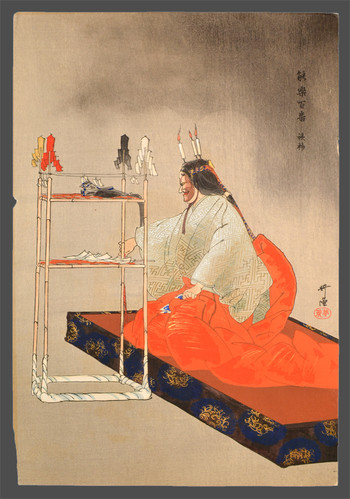
Kanawa (The Iron Crown)

Zeami Motokiyo


The Iron Crown - A Review
aarong@middlebury.edu
  “The Iron Crown.” Translated by Eileen Kato. In Twenty Plays of the Nō Theatre, edited by Donald Keene, 193-205. New York: Columbia University Press, 1970.               The Japanese performance art of noh, practiced since the 14th century, remains an engaging site of cultural expression, even in modern times. The Iron Crown, a play ... read more


"The Iron Crown." Translated by Eileen Kato. In Twenty Plays of the Nō Theatre, edited by Donald Keene, 193-205. New York: Columbia University Press, 1970.


            The Japanese performance art of noh, practiced since the 14th century, remains an engaging site of cultural expression, even in modern times. The Iron Crown, a play attributed to one of the most renowned noh playwrights, Zeami, is an example of the theater's lasting contribution to Japanese literary and performance culture. Through the play, the reader can gain insight into the significant aspects of noh drama, its character roles and themes, its use of movement, props, and space, and its engagement with the broader world of historical Japanese literature.

            The plot of The Iron Crown is based on a story from the Heike Monogatari, a war epic from the 13th century. The focus of the piece is a jealous and vengeful noblewoman, who is portrayed by the shite role in the noh retelling. There are two key elements to take away from this. The first is that noh drama often makes use of well-known works of Japanese literature. This means that plays from the Muromachi Period are not isolated pieces, but are connected to and part of larger developments in the literary history of Japan. They demonstrate the impact of stories from earlier periods, such as the Heian, on works later on. Not only do these plays provide similarities and connections between disparate time periods, but they can also allow for interesting analysis of temporal differences. How do the portrayals of these stories change as time passes? How do they change as their medium of expression changes from more straightforwardly literary works to theater and performance art? This is of particular importance for historical and literary scholars interested in Japan, but the average reader can still benefit from examining the implications of this interconnectedness. The other element of note here is that these stories are adapted to the specific character conventions of noh theater. The jealous woman in The Iron Crown occupies the role of the shite, the main protagonist, who is set opposite from the role of the waki. Noh plays often center on the deeds of the shite, conveyed to the audience through the shite's interaction with the waki, and involve a jumbling of present and past events. Reading The Iron Crown, then, gives insight into some characteristics of noh drama.

            Some of the most significant aspects of noh that can be illuminated by reading an example work involve its nature as a piece that is performed. Throughout The Iron Crown we see several examples of the highly ritualized symbolic movements and gestures that take place on the noh stage. The jealous woman's movement around the space of the stage and her positions on it take on specific meaning in the piece. The scarcity of props is also characteristic of noh, and the main performers' interaction with the limited set is crucial to moving the story forward. One of the clear benefits of reading a work like The Iron Crown is that it demonstrates this distinct style of performance, which can be an intriguing experience for someone unfamiliar with different kinds of theater.

            Overall, The Iron Crown can be an enjoyable work for the expert and the average reader alike. For those interested in performance art or literary adaptations, the piece is a fascinating example of the distinctiveness of noh theater.


Total Votes : 0 Vote Up Edit Reply


jenglish@middlebury.edu
Here's a brief passage that struck me:
"The wheel has turned and I have lost; / I must wait until it comes full circle. / Then my turn may come again" (30).
Is this referencing the idea of rebirth/the wheels we have seen before discussing rebirth? More broadly, how do we see the idea of rebirth manifest itself in The Iron Crown and the other plays we read?

aplanting@middlebury.edu

In this play, the woman is jealous of the man who has divorced her, and her jealous spirit haunts the man. I was wondering if the roles are ever reversed in noh plays, meaning would the man be jealous of the woman and would his spirit haunt her?


ryin@middlebury.edu

It was quite interesting that in The Iron Crown, the jealous woman became a demon through praying to a god. Was this kind of transformation normal? Did gods typically encourage sinful behavior (jealousy) as long as they were moved by someone's prayers? Does this mean that Japanese gods don't view things in black and white?


jcruzmendez@middlebury.edu
 

While reading The Iron Crown, I was wondering why the gods would grant the woman's wish and then later have the thirty deities rebuke her?


ipentony@middlebury.edu
It is very interesting to now read a new literary form besides poetry and prose through these plays. While fun and relatively easy to read, I wonder how much of the story is lost by reading these plays instead of watching them being performed. How much do the actions of the actors and the costumes and masks that they wear help enhance the story? Was it common during the time period to read the plays, or were the stories only communicated through performance?

dennisl@middlebury.edu
I noticed in most of the stories there were minimal stage directions (mainly just moving around and looking in different directions) and there weren't any set changes mentioned. I was wondering if this simplistic approach is reflected in all or most Nō dramas and if so is the appeal of this genre mainly in the dialogue?


aarong@middlebury.edu


Hirakawa, Sukehiro. "The 'Divine Comedy' and the Nô Plays of Japan: An Attempt at a Reciprocal Elucidation." Comparative Literature Studies 33, no. 1 (1996): 35-58.


This article is a comparative look at Dante's "Divine Comedy" and noh plays. The author aims to find similar themes and conventions in the works of noh playwrights and Dante. Hirakawa highlights several similarities, including the roles of the main characters, religious themes of salvation, and links between the worlds of the living and the dead. By examining these two works in conjunction with each other, we can see aspects of "The Divine Comedy" through the dynamics of noh plays, and vice versa. It can be helpful for those studying noh to see it through a different lens, and this analysis is a great example of some of the illuminating results of comparative literary study. Additionally, the article demonstrates the extent to which Japanese plays have had an impact on literature in "the West", such as the work of W. B. Yeats.


Ishii, Mikiko. "The Noh Theater: Mirror, Mask, and Madness." Comparative Drama 28, no. 1 (1994): 43-66.


            This article takes a look at noh theater through three themes: mirrors, masks, and madness. The author argues for the contemporary relevance of noh, and aims to elucidate what she believes are its significant characteristics. Ishii gives some background on noh history, and then examines the motif of the mirror both in the playwright Zeami's writing about noh and in the physical dynamics of noh performance. After a discussion of the implications of noh masks on ideas about human emotions, the article concludes with a look at noh and madness. Overall Ishii uses these themes to try to get at the significance of noh theater, and the article is a good exploration of both the particular and the universal when it comes to human expression.


Kadowaki, Yukie. "Noh Drama and the Samurai." Bulletin of the Detroit Institute of Arts 88, no. 1 (2014): 104-113.


This article is a good overview of the history and development of noh. It covers the genre's roots in other performance art forms, and its progression under the patronage of different political figures. There is also discussion of the characteristics and varieties of noh masks. One of the strengths of the text is how well it conveys how the history of noh was deeply interwoven with changing political dynamics.


Tyler, Royall. "Buddhism in Noh." Japanese Journal of Religious Studies 14, no. 1 (1987): 19-52.


This article aims to analyze and describe the Buddhist themes that permeate noh plays. The author wants to examine the characteristics of Buddhism in noh, asking what type, style, or sect of Buddhism is typical of the theater. He looks at the importance of place and landscape, the Lotus Sutra, ideas of duality and non-duality, and salvation. The connections between different Buddhist groups and traditions, aspects of Shinto beliefs, and important spiritual motifs are teased apart. Tyler ultimately concludes that the Buddhism in noh is not representative of a specific doctrine or sect, but is rather of a syncretic nature. The religious themes of noh plays reflect the well-established beliefs of their time period, which were a combination of motifs and practices from various social and historical origins. Most importantly, the article excels at demonstrating how deeply embedded these themes are in noh, and provides a good overall look at the religious dynamics of the theater.