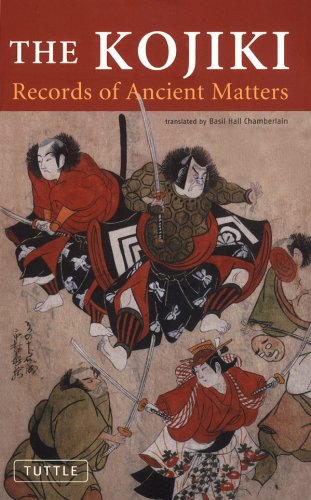
The Kojiki- Records of Ancient Matters
Ō no Yasumaro
Japan's Creation Myth: Kojiki
The term "rebirth" immediately makes me think of religion, specifically Buddhism where rebirth is something that is considered painful and is something to be liberated from, in comparison to Murakami's essay, where rebirth in Kojiki is desired and achieved through the acceptance of eternal life and includes incestuous relationships, something that many religions, such as Buddhism, prohibit. This poses my questions of what the prevailing religion was and if its beliefs have changed over the years? In what ways did the religion's beliefs influence the ideas mentioned in this essay? If this essay were to be written in modern times, how different would it be?
There was a recurring image of violence against women's genitals. For example, Amaterasu died due to her genitals being struck and Izanami died shortly after her genitals were burned. Both of them died shortly after giving birth. Why would this be included in the Kojiki? Would there be a difference in how each gender in an incestuous relationship may be perceived? Would this violence against women's genitals perhaps try to convey that women were at fault for these incestuous relationships and thus should suffer?
While reading "Incest and Rebirth in Kojiki" it was really interesting to read about how brother-sister unions purify the rebirth of parent's souls by preserving the bloodline of their parents in the bodies of the brother and sister as a cyclical process. Additionally, the incentive of obtaining eternal life through housing an ancestral soul leads me to this question: are these brother-sister unions primarily intended to pass down the family lineage, or is their purpose more aligned with the spiritual goal of achieving immortality through the preservation of ancestral souls? While these two come hand in hand, I wonder how the differences in the final objectives affect these brother-sister unions.
When reading Incest and Rebirth in Kojiki, I was perplexed by how in "love" some of the siblings would be for one another. That they were willing to commit suicide just so they can "be with" one another. This being said, with the four main themes being "incest, sacred birth, death, and rebirth," with the whole point of having incest so their parents and be rebirth in their children, why do you think they are willing to end not only their reincarnation but also their "parents" by killing themselves since they aren't allowed to be with one another?
When reading "The Beginning of Japanese Literature" I found that in the story, the offspring of Izanagi and Izanami is deformed only when Izanami speaks first, putting an emphasis on early societal norms through a warning story.
I also found the pacing of the story extremely fast/forward. When Amaterasu asked why she should find Susano'os heart pure, he responded by essentially saying, "let's swear on it and make babies". Similarly, the way that some characters suddenly died was also paced weirdly.
One other thing I noticed was when Izanami and Izanagi split with the boulder between them and how they began complete opposites of each other, one vowing to kill 1000 people a day and the other vowing to birth 1500 people a day. This leaves me wondering whether or not opposites or contrasting ideologies is a big theme throughout Japanese literature and relating to sex and death within Japanese literature.
-
Ellwood, Robert S. Review of A New Translation of the “Kojiki,” by Donald L. Philippi. History of Religions 8, no. 4 (1969): 355–59. http://www.jstor.org/stable/1062021.
The author delves into the Kojiki, a book that contains many literary riches for the Japanese community; it holds early Japanese chronicles of myths, legends, hymns, and oral traditions to name a few. The book is broken down into three parts: the Kamitsumaki (upper volume), the Nakatsumaki (middle volume), and the Shimotsuki (lower volume); it's also important to note that the term Kojiki translates to “records of ancient matters'', and has been translated to english by various authors. With that being said, these English translations of Kojiki play a substantial contribution to Japanese studies as well as the history of religions, targeting Western comparativists(355). As the oldest Japanese book, it contains the oldest examples of word usages, poetic forms, and historiography(356). The book holds an intrinsic religious meaning, and is more than merely a recapitulation of the archaic lore of Japan; it is the product of a particular axial moment in Japanese history, it is a statement of myth and history designed to consolidate Shinto religious experience and the position of imperial lineage (356).
-
ANDASSOVA, Maral. “Emperor Jinmu in the <em>Kojiki</Em>.” Japan Review, no. 32 (2019): 5–16. https://www.jstor.org/stable/26652947.
This journal highlights and interprets the narratives of Emperor Jimmu within the Kojiki and the Nihon shoki as separate myths. The two books are often mentioned together because they are the two oldest written documents that chronicle the history of the country and serve as sources to research classical history for historians. When Shinto was established as a national ritual system and the rule of the emperor was emphasized as sacred, imperial authority was linked to the world of deities beginning with Amaterasu and then falling on the first Emperor Jinmu. In both books, Emperor Jimmu is portrayed differently. In Kojiki, the emperor experiences the fierce power of Ōmononushi, a deity, and marries his daughter, and through this marriage, the unruly power of Yamato (province) is transformed into sacred power and becomes a place where a new state is born. This differs from Nihon shoki where Yamato is portrayed as a place where a deity obedient to the emperor’s ancestors resides (13). The analysis described in this journal entry portrays the dynamic process through which the emperor deals with the land of Yamato and begins worshiping its unruly deities, eventually asserting control(14). Due to this, from the shamanic experience of Emperor Jimmu, Yamato cannot be seen as a sacred center; he himself did not conquer Yamato, rather he confronted Yamato as a shaman.
-
“Histories Built on Legends: Creating the Japanese State.” nippon.com, May 30, 2020. https://www.nippon.com/en/japan-topics/g00709/.
The following article discusses the highest deity in Japanese mythology known as Amaterasu, and serves as a preliminary basis for readers to gain basic knowledge on an important deity and book. In the Kojiki, the goddess Izanami and god Izanagi created the islands of Japan. Izanami gives birth to a host of deities of natural phenomena such as the sea; however, when giving birth to the fire deity, Kagutsuchi, she burns her genitals and dies from the injuries. Izanagi is then left alone with his grief, leading him to seek for her in the realm of the dead, Yomi. When he arrives there, he finds Izanami to be rotting and covered in maggots, causing him to flee Yomi and return to Ashihara no Nakatsukuni (our world) where he ritually purifies himself at the river mouth of Tachibana in Himuka. As he is washing his face, three deities appear, one of which is Amaterasu as he washed his left eye. According to the second volume of Kojiki, Tachibana takes its name from an evergreen tree with brightly colored citrus fruit; it is the opposite of the depressing land of the dead and the ideal location for purification which is why the three deities came into existence. Izanagi was so overjoyed at their birth and then placed Amaterasu as ruler of the heavenly plain.
-
Google. Google. Accessed December 21, 2021. https://www.google.com/?client=safari&channel=iphone_bm.
The following article describes the Nihon shoki book and is a great resource for a wide range of audience, whether one is just commencing their journey in Japanese culture or whether one is a deep enthusiast. Nihon shoki translates to “Chronicles of Japan '' and covers the period from its mythical origins to A.D. 697, thus comprising the oldest history of Japan. The book consists of 30 chapters, the first part dealing with myths/legends of Japan and is an important source for Shinto thought. The later chapters contain records of several politically powerful clans and the imperial family; the introduction of Buddhism is also described. Lastly, it is important to note that the Nihon shoki is written in Chinese and reflects the influence of Chinese civilization on Japan.
A Tale For Mythology Fans
An Analysis of The Kojiki
Paul Shen
JAPN 0221
Professor Otilia Milutin
12/14/24
As someone who loves tales of ancient mythos, reading about the earliest written record of the Japanese pantheon is a must. If you love gods, creation myths, and the birth of entire worlds, I’d highly recommend an adaptation of the Kojiki. It is best read in its native language, a proto-Japanese-Chinese mix, an issue which I will address later in this review, but as far as translations go, Donald Philippi did a great job. Written over a thousand years ago in 712 AD, the Kojiki is Japan's oldest chronicle, offering a window into the origins of not only the Japanese islands but also its people, its gods, and, most importantly, its emperors. If you’re a fan of Norse legends, Greek epics, or even the works of the Bible, as I am, the Kojiki provides a creation story that is just as rich, mysterious, and beautiful.
Imagine a book where the gods are almost human-like, full of flaws, emotions, and complexities, much like those in other mythic traditions around the world. The Kojiki begins with Izanagi and Izanami, the divine duo who give birth to not just the Japanese islands but a whole pantheon of deities. Then there's Amaterasu, the sun goddess, as every mythos must have a sun god, who is revered as the ancestor of the imperial family, and Susano-o, the unruly storm god who reflects the fickle nature of man. There are the tales of Izanagi and Izanami in the Land of the Yomi, Amaterasu trapping herself in a cave and plunging Japan into darkness, and of Susano-o slaying the Eight-Tailed Serpent. This interplay between gods and demons, order and chaos, good and evil is a major theme throughout the Kojiki.
In this course, we look at sex and death, which are more forces in constant turmoil. Our Furamaki1 reading details the incest between the siblings Izanagi and Izanami, Amaterasu and Susano-o, and Oshi-ho-mimi and Toyo-aki-tsu-shi-hime, in order to enable the rebirth of their parents in their children. While this was a truly fascinating lens through which to explore the dawn of Japan’s divine beings, I believe that it takes too narrow of a focus on the whole story. It may seem crass, but I am here for the story. But the Kojiki is not only about gods. In its second and third parts, Ō no Yasumaro recounts the history of real Japanese emperors, claiming their descendance from Amaterasu.
This is the true beauty of the Kojiki and sets it apart from more fantastical mythologies. It flawlessly weaves together myth and what we could loosely call "history." The first section delves deep into the creation of the world and the heavenly realms, but as you move forward, the text transitions to the story of Emperor Jimmu, the first human emperor of Japan who is, of course, divinely descended. It contains records all the way to Empress Suiko, the thirty third ruler of Japan. The book provides the basis for the claim of the imperial family's divine lineage, a key concept in Japanese culture and politics that we have been studying.
One big problem I have found with this version of the text and the others we have read this semester is the crude translations. I recognize that many scholars have dedicated their lives to bringing these ancient Japanese legends to the masses of today (thanks, Donald Philippi!), but I am a staunch believer that any translation loses much of the original complexity. The Kojiki was originally written in a mix of Classical Chinese and Old Japanese, so of course, English will barely cut it. The text uses an archaic writing style with characters serving double duty, sometimes conveying meaning, sometimes conveying sound. Even in modern Japanese, the Kojiki does not read in a native tongue. The classical grammar and vocabulary just aren't what you'd find in everyday conversation. The nuances of the original can get lost or simplified, and certain expressive elements, like wordplay or rhythm, may not come through as strongly. This is especially prevalent as we move to more poem-heavy readings, where stylistic elements have a more significant impact in how a literary work is read. Additionally, some words may have had very distinct meanings in Old Japanese, but directly translate to similar words in English (like Prince and Heir Apparent). While I may like to complain about translation struggles, it’s an inevitable part of reading any ancient text. What’s most important for a creation tale like the Kojiki are the gods, heroes, and adventures.
Despite the hurdles of translation, the Kojiki is a must-read for anyone who loves mythic storytelling. Sure, you might need a little patience and maybe even some background reading to fully appreciate all the details, but it's a journey that's incredibly rewarding. Along the way, you’ll learn about the birth of an entire race of people and their gods, through stories packed with drama, humor, and profound insight into the human condition. So, if you’re a lover of ancient stories and want to explore a world where gods journey to the underworld, islands are born from divine words, and emperors trace their lineage back to the sun itself, pick up the Kojiki.
References
Murakami, Fuminobu. “Incest and Rebirth in Kojiki”. Monumenta Nipponica, Vol. 43, No. 4 (Winter, 1988), pp. 455-463. Sophia University, http://www.jstor.org/stable/2384797. Accessed: 6 October 2024.
Palmer, Edwina. Harima Fudoki: A Record of Ancient Japan Reinterpreted, Translated, Annotated, and with Commentary. Brill’s Japanese Studies Library, vol. 51, Brill, 2016, pp. 55–64. E-book, ISBN 9789004269378.
This section of the translation is a disclaimer from the author, Edwina Palmer, detailing her work in the orthography of the translation of the Harima Fudoki, an account of the people, places, natural resources and stories in the Harima region of western Japa, written in 714 AD. Even though we didn’t read the Fudoki in class, I thought this would be an interesting source. Palmer’s discussion of her translation of Harima Fudoki reveals her approach to balancing accuracy with readability. She emphasizes the importance of situating the myths and legends within their spatial and temporal contexts, arguing that this is essential for understanding the interplay between myth and history in ancient Japanese culture. Palmer acknowledges the provisional nature of any interpretation of Japan’s prehistory, highlighting how ongoing archaeological and anthropological discoveries continually reshape our understanding. This recognition of the text’s evolving context informs her cautious yet insightful approach. She also critiques the historical neglect of the Fudoki texts, noting that they have been overshadowed by more prominent works like the Kojiki and Nihon Shoki. She attributes this marginalization to the complex linguistic style of the Fudoki, written in a hybrid form of kanbun (a Chinese based Japanese character system) that blends classical Chinese and phonetic Japanese elements. This style, while daunting, captures nuanced meanings and connections, making the texts both rich and challenging to translate. Her translation prioritizes retaining the phonetic elements of Old Japanese (OJ), especially in place name puns central to the text. She navigates the complexities of OJ phonology and differing scholarly interpretations by striving to preserve the contemporaneous phonetic representations. She also mentions Romanization and linguistic intricacies, which reflects her broader goal: to illuminate the cultural and historical significance of the Fudoki for modern readers while staying true to the text’s original context. I think this ‘author’s note’, created with a focus on her thoughts during the translation of the text, is a powerful tool to understand how Japanese literature is read today.