Citation 1:
Lippit, Noriko Mizuta. "The Dispute Over Socialist Realism in Japan ." JSTOR, Asian Studies Center, Michigan State University, 1992, www.jstor.org/stable/40874119.
With the idea of literature, art, and politics being a prime question during the proletarian literature movement in Japan, there were many obstacles that socialist, communist, and potential radical writers had to overcome or potentially face the consequences of. This article describes the effects that soviet realism had on the shifting Japanese ideologies as the proletarian literature movement was dissolving. Japan's history was aided by the unification of the working-class people against an aggressive government and enforcement agencies; however, with the new age of soviet realism in the 1930s, there was a growing sentiment to justify non-ideological proletarian writing. While this text is not essential to understand Sata Ineko's "Prayer" because there is more information about the failing shift of socialist realism in Japan, there are minor comments that give the reader context as to some problems facing proletarian writing about labor, such as the statement that "most of the proletarian writers were intellectuals, and there was a great gap between workers and farmers." Readers should take caution with some of the comments made when using this text to analyze "Prayer" since Sata Ineko was a writer who came from a working-class, poor background with no higher education rather than from a family that was well connected and financially stable.
Citation 2:
Hitoshi, Yamakawa. Trans. by Hrannar Baldvinsson. "A Change of Course for the Proletarian Movement." Revolutionary Thought in Japan: Marxism in Japan, Marxists.org, 1922, www.marxists.org/subject/japan/yamakawa/change.htm.
Translated by: Hrannar Baldvinsson
Despite the multiple mentions of union workers, security, religion, and capitalism in "Prayer," there is a still common thread: the rise of proletarianism in Japan. With this letter from Yamakawa Hitoshi, we understand how there was a shift in reasoning in Japan to form the Japanese Communist Party. Essentially this letter is written to persuade the public entities fighting for more rights, such as union representatives, to follow the trend of proletarians and warn against the growing threat of capitalism. I include this source as a reference to connect the dots of a fictional story by Sata Ineko. As a proletarian literature movement advocate, Sata represents real struggles such as labor rights through the fictional characters, capitalistic greed through the factories, and government intervention through the security guards. However, this text provides the context for the violence in the story. While Sata Ineko is an advocate through writing, actual change happens through revolutionaries and unification. This letter provides a context through the points that Hitoshi highlights: grouping the socialist party and labor unions and establishing that the movement's next and final goal is to mobilize the masses. I would consider this a reliable source, bypassing its English translation, because the writer is the leader and founder of the JCP and a key figure in the movement's progress through the years.
Citation 3:
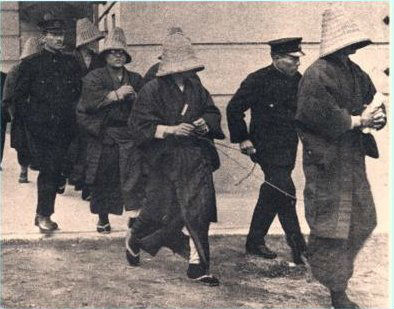
“About the Second Constitutional Movement by the Three Constitutionalists.” Taisho Era Worldwide, https://www.worldwide-transition.info/taisyo/kantosinsai/gokensanpa.html.
https://www.worldwide-transition.info/img/tianiti1007.jpg
This photograph represents the arrest and future prosecution of communist activists. There was a growing sentiment of anti-communist and socialist principles in Japan after the defeat of the Russian Revolution; however, the revolution inspired the rise of a new ideology. The idea that emerged was that there should not just be one elite and that everyone should be treated fairly and just in the workplace. Despite its growing popularity, the Japanese government outlawed the Communist party and created a nationwide search for known members and advocates, which can be seen in this photo. Despite being considered illegal, they were many literary advocates, including Sata Ineko, that progressed the proletarian literature movement in Japan. This photo is helpful in understanding "Prayer" because of its connection to Sata Ineko's story. "Prayer" connects to more people because Sata herself faced prosecution due to her writing. She is relatable and was able to progress worker reform by appealing to more people. There are some cautious alerts with this picture. While I could not find the original source, an accredited professor used it in a lecture presentation. However, through historical facts, countless secondary sources, and the knowledge that there were arrests made based on political ideology, there is a high chance that this photo is credible.
Citation 4:
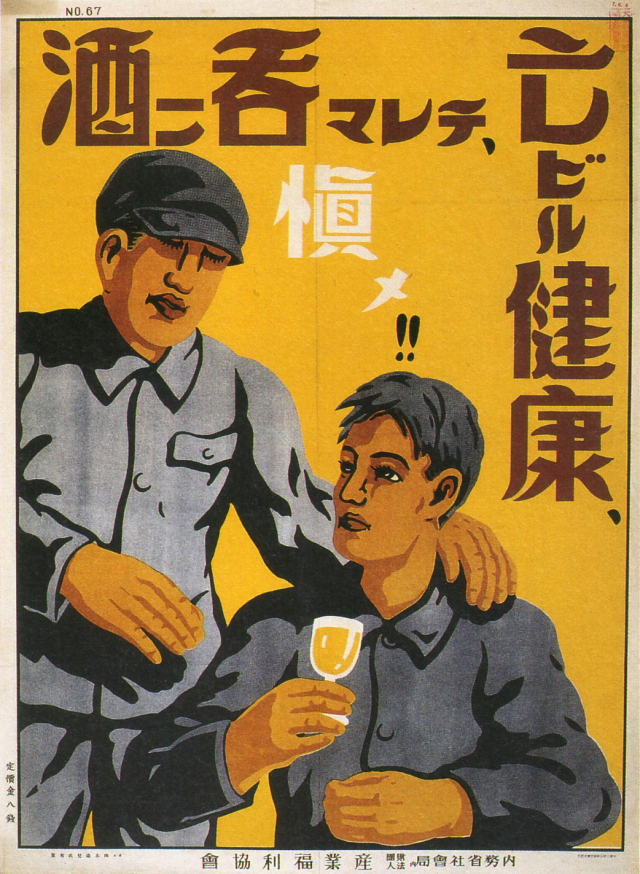
Indulging in Alcohol Ruins Your Health. 1932, http://pinktentacle.com/2010/07/proletarian-posters-from-1930s-japan/
http://pinktentacle.com/images/10/30s_poster_9.jpg
The limitation of this cartoon is that there is a language barrier. Those who are not literate in the present language will have to solely use context clues and writer analysis to dissect the poster and connect it to the primary reading. In this case, the poster is used as supporting evidence to the primary cause that Sata Ineko is writing about, the Communist and Proletarian movement evolving in Japan. As we look through the poster, the vibrant yellow background hints at the hammer and sickle of the communist flag. Combine the color with the workers in the iconic blue-collar uniform to signify the working class that Sata Ineko is advocating for; we can grasp the idea that the writing on the poster is an advertisement for the promotion of workers' rights. However, those who understand the writing will read how the poster is discouraging workers from overindulging in alcohol. This is attributed to the communist movement progression of also being involved in social issues like alcoholism. Which supports the communist movement as it is trying to make life better for the working class. This type of media would mainly be targeted towards the grass root supports, like factory workers and farmworkers. The light amount of intense literature and the simple portrayal of the more profound meaning combined with the inexpensive medium make this ad the perfect form of mass propaganda.
Citation 5:
Flax, Bill. “Do Marxism and Christianity Have Anything in Common?” Forbes, Forbes Magazine, 12 May 2011, https://www.forbes.com/sites/billflax/2011/05/12/do-marxism-and-christianity-have-anything-in-common/?sh=4527e4f46877.
"Prayer" is a story that combines the growing sentiment of Christianity with the present idea of socialism and communism in Japan. Since Marxism was a significant starting point for the continued movement of the Proletarian Era in Japan, I used this article to understand how it relates to Christian values. This article elaborates on Sata Ineko's idea when writing "Prayer." There was an aggressive revolt against the Christian workers because Marxist ideology states that Christianity creates a barrier to a utopic society. There can never be pressure to change the systems at play because Christian values will always put the higher institution over self-desires. You see this play out in the short story, as the main character starts to contemplate what actual progress is made by staying loyal to their religion. While this article is valuable in comparing two ideas, its drawback is that it approaches the idea from a general standpoint and does not go into specifics of the Proletarian movement in Japan. Its target audience is individuals who have just started their research into Marxism or Christianity, making this article a great reference as a starting point to analyze more specialized work in the Japanese Proletarian Movement.