Brown, Janice. "Ôba Minako - Telling the Untellable." Japan Quarterly 45, no. 3 (1998): 50-59. Accessed April 18, 2022. Periodicals Archive Online.
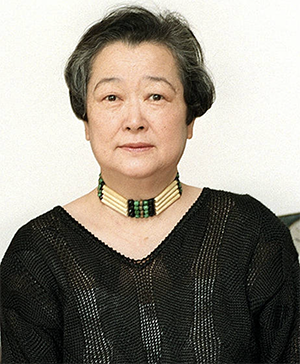
Janice Brown, a teacher at the University of Alberta, Canada, analyzes fantasy and horror themes in Oba Minako’s writing (1930-2007). This distinctive writing style stems from Oba’s childhood during World War II.
Oba uses these themes to create new narratives that are difficult to discuss. Janice Brown states that “the production of horror and death has resulted in unmaking of new meanings and new stories, ones which are ultimately as difficult and as 'untellable' as the traumatic memories of the past” (p. 50). These themes are evident in Oba’s early poems.
In 1986, Oba received the Akutagawa Prize and Gunzo Prize for New Writers for “The Three Crabs.” “The Three Crabs” tells the story of Yuri fleeing a bridge party, meeting a man in a pink shirt, and having sex with him in a motel parking lot called the “Three Crabs.” Janice Brown states that “the Remote, foreign setting and the bleakness of human relationships depicted by Oba in this story serve to underline the impossible situation of a woman who is isolated in a kind of ultima Thule of self-loathing and disgust” (p. 56). This story gives readers a glimpse into the internal struggles of women that are difficult to explain.
According to Brown, Oba’s use of the human psyche transforms the aesthetically ugly human emotions that are otherwise impossible to comprehend. Horrific and fantastic memories create new stories but trauma is not erased or replaced nor is it transcended (p.59). Oba creates narratives that remind individuals of what they want to forget from the past and present.
This article gives readers an insight into Oba Minako’s interest in writing dark/mature themes within her literature. The simple language allows readers of all educational levels to effectively understand Oba Minako and her work on a deeper level.
Chambers, Marian E. "Oba Minako: Rebirth in Alaska." Japan Quarterly 38, no. 4 (1991): 474- 483. Accessed April 18, 2022. Proquest Central.
Marian E. Chambers talks about Oba Minako’s "Fireweed" as an untraditional fairytale. Oba spent her teenage years taking care of A-Bomb victims in the aftermath of Hiroshima. Despite her rocky adolescence, she was able to continue to higher education. In 1961, she left with her husband for Sitka, Alaska, where she discovered a different style of writing.
“Fireweed” is a story about a Tlingit chief's dead daughter. In “Fireweed,” Chambers claims there are “two opposing forces set of traits” that differ from your traditional fairytale (p. 477). In classic fairytales, the hero is rewarded for their selflessness and obtains a happy ending. Yet, in “Fireweed,” we see the opposite. There is no true hero or happy ending. Additionally, by means of the five senses, Oba creates a narrative focusing on the importance of imagery. According to Chambers, “in ‘Fireweed,’ the woman is likened to the flowering plant’s external traits- the showy, proliferative, enticing side” (p. 481). Through this use of imagery, “Fireweed” is labeled as an “antithesis to rebirth” (p. 481). Oba’s imagery allows readers to recognize the significant details of a story as a whole.
Chambers believes that Oba wrote “Fireweed” this way because she was still beginning to find her own style as this work is different from previous works (p. 482). Through “Fireweed,” Oba expressed her experiences and emotions outside of societal pressures through Sitka cultural milieu.
This article tells readers about one of the many beginning works of Oba Minako. Readers are shown the beginning of Oba Minako’s journey to her writing style that was not influenced by Japanese Literature. The simple language allows readers of all educational levels to effectively understand Oba Minako’s journey to her signature writing style.
Lennikov, Mikhail A. “‘Naughty Girls,’ ‘Bad Wives’ and ‘Unwise Mothers’: Early Stories by Oba Minako in the Literary-Social Context of Japan in the 1960s.” MA thesis, University of British Columbia, 2002. https://dx.doi.org/10.14288/1.0099689.
Mikhail A. Lennikov discusses Oba’s philosophy on the subordinate status of women and how female fiction highlighted or agreed with these issues.
Until the end of World War 2, Lennikov says the concept of “good wife, wise mother” (ryosai kenbo) was the “official doctrine of the Japanese ruling” (p. 8). The control over gender is due to the dependency on the martial-familial system, which allowed women few opportunities for individual growth. Once the Pacific War ended, Japan rejected the feudal patriarchal doctrine and accepted Western-style laws and social organizations. This allowed women to have new social and private lives. The traditional standards for women in Japanese society are still used as a basis for societal standards, but they do not have a strong influence as they did during the Meiji period (1868-1912).
Oba’s works went against the standards of patriarchal structures of familial status. Lennikov believes that Oba’s ability to write challenged the “political and economic foundations of the society” (p. 19). The popularity of “The Three Crabs” encouraged Oba to publish more literature. “Niji to ukihashi” (“The Rainbow and a Floating Bridge”) and “Kozu no nai e” (“Picture with No Composition”) launched her writing career, thus allowing her to share her unorthodox opinion of women. In “The Three Crabs,” “Niji to ukihashi,” and “Kozu no nai e,” Oba tells the stories of women who go against the traditional standards. Lennikov agrees that these stories attempted to change the social expectations of women through their radical message, which influenced the golden era of Japanese literature because Japanese women authors began to create characters who questioned traditional views.
This article gives readers the historical background needed to understand the significance of Oba’s writing. Her writing went against the societal construct that has been ingrained in Japanese history. In that context, the themes written in her literature were considered taboo. This dissertation gives non-specialized readers background information, but having some background knowledge of Oba Minako’s work would be helpful.
Orbaugh, Sharalyn. "Ôba Minako and the Paternity of Maternalism." In The Father-Daughter Plot: Japanese Literary Women and the Law of the Father, edited by Rebecca L. Copeland and Esperanza Ramirez-Christensen, 265 - 291. University of Hawai’i Press, 2001.
In Oba Minako’s works, the mother’s voice is highlighted in a perspective that is for the reader to comprehend, instead of a basis for comprehension. Oba’s mother-centric perspectives can be classified as women's literature, but Orbaugh questions what is considered male literature in Japan? In this article, Orbaugh investigates the paternity of Oba’s maternalist discourse (p. 268).
These themes are evident in “The Three Crabs” through the experience of Yuri and Rie’s relationship. Orbaugh identifies paternity, external and internal literature in “The Three Crabs.” According to Orbaugh, the literary paternity figures are the traditional, cultural fathers that inspired, influenced, and introduced Oba to the Japanese literary world. External paternity refers to the production of “fatherhood” created in Oba’s works. Internal paternity is the role of fatherhood represented within her characters’ roles of fatherhood.
These themes are evident in “The Three Crabs” through the experience of Yuri and Rie’s relationship. Orbaugh says that literary paternity can be seen when Yuri's husband interrupts a conversation between Yuri and Rie. This interruption is intended to protect Rie because the construct of fatherhood is meant to protect their children from what is deemed 'bad' (p. 278). External paternity can be seen when Rie shares sympathy with her father because of Yuri’s behavior. Orbaugh says through this uncomfortable situation, due to Takeshi's fatherhood within the book, creates Yuri’s motherhood (pg 280). Orbaugh identifies internal paternity when Rie rejects Yuri’s ‘motherliness’ and accepts Takeshi’s ‘fatherliness’ (pg. 279-280). Takeshi’s fatherliness is represented based on Oba’s influence and personal perception of fathers. This creates specified motherhood for Yuri based on Takeshi’s fatherhood.
This article allows readers to understand how the constructs of motherhood and fatherhood influence Oba’s work and how her writing creates its own standards of parenthood. Readers should research further background knowledge of Oba Minako and her works to gain a better understanding of this article.