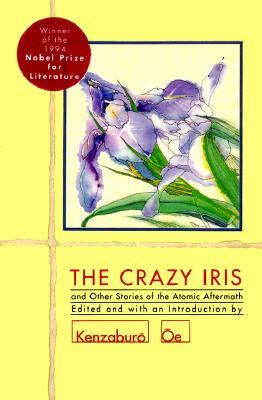
*The novel, The Crazy Iris (1994), by Kenzaburō Ōe (1935-) is a compilation of stories from survivors of the atomic bombings in Hiroshima and Nagasaki on August 6, 1945. My book review focuses on one of the stories, “The Land of Heart’s Desire.” This story was written by Hara Tamiki six years after the calamity. ...
read more
*The novel, The Crazy Iris (1994), by Kenzaburō Ōe (1935-) is a compilation of stories from survivors of the atomic bombings in Hiroshima and Nagasaki on August 6, 1945. My book review focuses on one of the stories, “The Land of Heart’s Desire.” This story was written by Hara Tamiki six years after the calamity.
“The Land of Heart’s Desire” is a short story written by a Japanese hibakusha writer, Hara Tamiki (1905-1951), who is both the main character and narrator. Throughout the story, he appears to be more than distraught by the effects of the bombing in Hiroshima. The entire story focuses on his sensory input and is written in a way that seems like a daydream. The blur of emotions and senses throw him from one thought to another. Because he jumps from one idea of feeling and memory to another, the style of writing conveys the message in a distraught manner—almost as if the reader is experiencing dizziness. Furthermore, Hara’s story reveals an interesting artistic development, which may be seen as one that coevolves with his intensifying struggle to deal with the psychological after-effects of the Hiroshima experience. The bomb experience, in fact, plays a central role in the course followed by Hara’s life—his suicide by lying in the path of an oncoming train near Kichijō Station in Tokyo.
Although his death is often attributed to depression over the outbreak of the Korean War, Hara’s later writings clearly reveal a mind that feels increasingly threatened by insanity. This threat of insanity is partly the result of a sense of severe isolation. Hara writes that he has “reached the depths of human loneliness. There is no longer a scrap of straw to cling to in this world” (56). There is no doubt this frightening sense of isolation was enhanced, if not created, by his obsessive memory of the Hiroshima experience; Hara clearly portrays a profound link between his suicide and the experience of the atomic bomb.
I especially enjoyed how Hara used temperature to convey this stress in an engaging way. The short story begins with him describing the chirping of the birds and how receptive they would be to his presence if he were to join them in his next life. Since this is in relation to the aftermath of the bomb, I infer that such thoughts of reincarnation are hope that his passed loved ones are in a safe space now; perhaps he wants to connect with them and speak to them. This supposed hope, however, is barely hopeful in tone and presentation.
The narrator proceeds to explain how nature would take his place. “The stars in the night sky that hang so unconcernedly canopied over my head, and the forms of the trees standing so aloof from me here below, as though eventually to take my place” (56). The negative connotation is present throughout. The irrelevance of his life, and how attention is drawn to how life will continue without him, unfortunately, ends the work on a sad note. However, I found it a bit difficult to clearly discern whether or not the narrator wants to give up on life and become a part of nature.
All in all, I would highly recommend “The Land of Heart’s Desire” to anyone interested in reading a different perspective of the atomic bombings in Japan—one that is not akin to the U.S.-centric position we often gain exposure to. In just eight pages, I think Hara well-conveyed his sudden confusion of purpose, along with the feeling of potentially being victimized by the bombing that occurred years before. While the final impression of the story is of utter tranquility, of death as a release, it was interesting to see Hara’s death as an illumination that he himself cast on his writings. The death he freely chose becomes one of the finishing touches to his work. I would definitely read it again, as I regard it as one of the most hauntingly beautiful works of modern Japanese literature, albeit the most difficult to stomach.