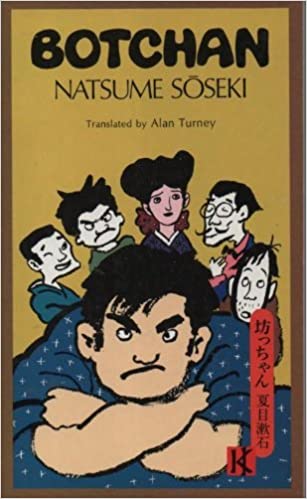
Botchan: The Childish Master of Morality
To be called “Botchan” as an adult is insulting. Though the literal translation is “young master,” the term serves to characterize a grown man as immature, childish, and juvenile. The protagonist in Natsume Sōseki’s Botchan, however, voluntarily keeps this nickname for himself. Initially called Botchan by his childhood housemaid Kiyo (he is the “young master” she serves), this once-insult takes on an endearing connotation. These two meanings encompass Botchan’s character perfectly: he is childishly stubborn, short-tempered, and quick to make impolite observations. At the same time, he values moral purity and justice, qualities shaped by his relationship with Kiyo. Botchan’s opinionated nature and sarcasm thus provide a refreshing perspective of social conventions during Japan’s Meiji period, making this Japanese classic highly enjoyable for all readers.
With deceased parents and a working brother, the story begins with Botchan and Kiyo cohabiting in Meiji-era Tokyo: Japan’s hub of modernization and westernization. This Tokyo-ite identity is a source of pride for Botchan, and we come to see how this identity clashes with the rural town-dwellers of Matsuyama where Botchan begins his first job as a middle school mathematics teacher.
Botchan uses a critical and sarcastic tone throughout the piece. We quickly discover that “Botchan” is not the only nickname in the story, for every character besides Kiyo is renamed. Botchan calls the middle school principal “Badger,” with “scant mustache, dark-skin, and big-eyes,” and the headteacher “Red Shirt,” for his “strange affliction” of wearing a red, flannel shirt all year round (Chapter 2, Botchan). Each character is never again referred to by their real names, defined instead by Botchan’s perceptions of them. This childish practice of nicknaming is just one example of Botchan’s candid and comedic narration. A favorite line of mine describing his art-teaching colleague reads: “I heartily despise Hanger-on. It would be beneficial for Japan if such a fellow were tied to a quern-stone and dumped into the sea.”
Alongside “Hanger-on,” the aforementioned “Red Shirt” also becomes an antagonist, representing moral corruption, deceit, and elitism. Aside from his sarcastic nature, Botchan’s primary character trait is his moral groundedness. He describes himself as a “simple-hearted fellow,” and this characteristic contributes to his resolve in advocating for the mistreated and punishing the corrupt. Despite being a grown man in late-1800s Japan, his worldview can resonate even with teenagers. “As it would not look well if I failed, I did not try,” he remarks in one moment, a quote I highlight because it reminded me of my own competitive nature. Though Botchan may not be a warm, sweet character, the humor in his honest narration is certainly entertaining. Botchan is thus an easy character to love and root for because of his moral purity, ability to self-critique, and humor.
On top of its entertainment value, the novel also has much to offer for anyone interested in Japanese history. For one, his observations reveal much about Japan’s budding relationship with the West. We see small morsels of western culture pop up throughout this countryside setting – beef-eating, military parades, and European-style pants to name a few. The subtle blend of western and Japanese customs is sprinkled throughout, with men in kimono described sitting next to men in western suits. This book uniquely provides a layman’s account of gradual westernization, which was valuable to me as someone unfamiliar with the day-to-day consequences of western influence. Even more, Botchan is a fantastic example of the emerging popularity of the “watakushi-shosetsu” (the “I” novel) in Japan, which describes the lives of individuals in intimate detail.
Botchan’s descriptions of rural life are also indicative of the Tokyo-ite mindset during this period. From hobbies to dress to dialects, he regularly criticizes the behaviors of the country-dwellers, even going so far as to argue that there is “nothing more degrading” than to remain in the countryside for the entirety of one’s life. This belief in the superiority of the city over the countryside helps us understand how the varying degrees of modernization throughout Japan contributed to city vs. country tensions.
My only complaint about Botchan is that it ends too abruptly, the resolution lasting just a short chapter. It lacks the flowery, beautiful ending one might find in other literature or film. This made it a somewhat unsatisfying conclusion, but the story itself is entertaining and provides insights into Japanese culture, values, and western influence during the Meiji period. This novel is thus a worthwhile read for those looking for a funny (yet informative) and short (yet rich) read.