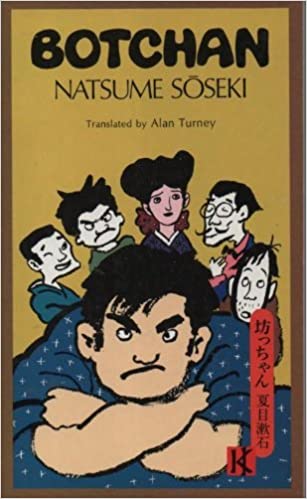
Botchan

Natsume Sōseki


Botchan: The Childish Master of Morality
rherman@middlebury.edu
To be called “Botchan” as an adult is insulting. Though the literal translation is “young master,” the term serves to characterize a grown man as immature, childish, and juvenile. The protagonist in Natsume Sōseki’s Botchan, however, voluntarily keeps this nickname for himself. Initially called Botchan by his childhood housemaid Kiyo (he is the “young master” ... read more

To be called “Botchan” as an adult is insulting. Though the literal translation is “young master,” the term serves to characterize a grown man as immature, childish, and juvenile. The protagonist in Natsume Sōseki’s Botchan, however, voluntarily keeps this nickname for himself. Initially called Botchan by his childhood housemaid Kiyo (he is the “young master” she serves), this once-insult takes on an endearing connotation. These two meanings encompass Botchan’s character perfectly: he is childishly stubborn, short-tempered, and quick to make impolite observations. At the same time, he values moral purity and justice, qualities shaped by his relationship with Kiyo. Botchan’s opinionated nature and sarcasm thus provide a refreshing perspective of social conventions during Japan’s Meiji period, making this Japanese classic highly enjoyable for all readers.

With deceased parents and a working brother, the story begins with Botchan and Kiyo cohabiting in Meiji-era Tokyo: Japan’s hub of modernization and westernization. This Tokyo-ite identity is a source of pride for Botchan, and we come to see how this identity clashes with the rural town-dwellers of Matsuyama where Botchan begins his first job as a middle school mathematics teacher. 

Botchan uses a critical and sarcastic tone throughout the piece. We quickly discover that “Botchan” is not the only nickname in the story, for every character besides Kiyo is renamed. Botchan calls the middle school principal “Badger,” with “scant mustache, dark-skin, and big-eyes,” and the headteacher “Red Shirt,” for his “strange affliction” of wearing a red, flannel shirt all year round (Chapter 2, Botchan). Each character is never again referred to by their real names, defined instead by Botchan’s perceptions of them. This childish practice of nicknaming is just one example of Botchan’s candid and comedic narration. A favorite line of mine describing his art-teaching colleague reads: “I heartily despise Hanger-on. It would be beneficial for Japan if such a fellow were tied to a quern-stone and dumped into the sea.” 

Alongside “Hanger-on,” the aforementioned “Red Shirt” also becomes an antagonist, representing moral corruption, deceit, and elitism. Aside from his sarcastic nature, Botchan’s primary character trait is his moral groundedness. He describes himself as a “simple-hearted fellow,” and this characteristic contributes to his resolve in advocating for the mistreated and punishing the corrupt. Despite being a grown man in late-1800s Japan, his worldview can resonate even with teenagers. “As it would not look well if I failed, I did not try,” he remarks in one moment, a quote I highlight because it reminded me of my own competitive nature. Though Botchan may not be a warm, sweet character, the humor in his honest narration is certainly entertaining. Botchan is thus an easy character to love and root for because of his moral purity, ability to self-critique, and humor. 

On top of its entertainment value, the novel also has much to offer for anyone interested in Japanese history. For one, his observations reveal much about Japan’s budding relationship with the West. We see small morsels of western culture pop up throughout this countryside setting – beef-eating, military parades, and European-style pants to name a few. The subtle blend of western and Japanese customs is sprinkled throughout, with men in kimono described sitting next to men in western suits. This book uniquely provides a layman’s account of gradual westernization, which was valuable to me as someone unfamiliar with the day-to-day consequences of western influence. Even more, Botchan is a fantastic example of the emerging popularity of the  “watakushi-shosetsu” (the “I” novel) in Japan, which describes the lives of individuals in intimate detail. 

Botchan’s descriptions of rural life are also indicative of the Tokyo-ite mindset during this period. From hobbies to dress to dialects, he regularly criticizes the behaviors of the country-dwellers, even going so far as to argue that there is “nothing more degrading” than to remain in the countryside for the entirety of one’s life. This belief in the superiority of the city over the countryside helps us understand how the varying degrees of modernization throughout Japan contributed to city vs. country tensions.

My only complaint about Botchan is that it ends too abruptly, the resolution lasting just a short chapter. It lacks the flowery, beautiful ending one might find in other literature or film. This made it a somewhat unsatisfying conclusion, but the story itself is entertaining and provides insights into Japanese culture, values, and western influence during the Meiji period. This novel is thus a worthwhile read for those looking for a funny (yet informative) and short (yet rich) read.

Total Votes : 1 Vote Up Edit Reply

nyoshida@middlebury.edu
Do you think that Botchan’s value of justice and purity as well as his other qualities might be more to do with the morality of traditional Japan, his childlike view of the world, or the values of the city vs the countryside? I feel that it was more to show his agreement with both the ... read more

Do you think that Botchan's value of justice and purity as well as his other qualities might be more to do with the morality of traditional Japan, his childlike view of the world, or the values of the city vs the countryside? I feel that it was more to show his agreement with both the values of traditional japan but also that he is meant to epitomize everything that we as people want for justice and forthrightness but that we rarely see.


jhtorres@middlebury.edu
Botchan Question: The schoolchildren frequently use the phrae "na moshi" (a phrase in the Iyo dialect meaning "isnt it" or "you know") when referring to Botchan, out of a lack of respect. The phrase serves as a reminder of the tension between modern and more urban population centres and rural, traditional ones explored in the text (due to the rise of modernisation). By not showing respect to their superior and elder, do the schoolchildren inadvertently partake in the modernity that makes them Botchan?

rherman@middlebury.edu
Botchan is very candid – and at times, offensive – with his descriptions and criticisms of those around him. How does this openness reflect the growing acceptability of taboo subjects in literature during the Meiji Period?

rherman@middlebury.edu
To what extent do we see European practices embraced (or subdued) in Matsuyama? What does this say about the impact of European influence in the countryside of Japan during the Meiji period?

zhengqianl@middlebury.edu
Do the Badger, the Redshirt, and the Hanger represent certain types of people in real-life during the Meiji period? If so, what about Botchan? Can we see him as a character representing a type in real-life? Why or why not? (note: Sōseki's character Botchan does model on a real person to a certain degree. He was Sōseki's colleague when they both taught at a middle school.)

zhengqianl@middlebury.edu
After finishing the story and looking back specifically at Botchan and Kiyo's relationship, I found that, quite surprisingly, their relationship is certainly beyond that between a master and a servant, even something more than a relationship between a mother and a son. It might even have an erotic aspect, psychologically. In his conversation with the landlady, Botchan acquiesced to her judgment, though jokingly that he already has a life and that’s the reason why he is “aching to get a letter from Tokyo” (78). I’m wondering if anyone has the same feeling or a different take on this relationship between Botchan and Kiyo?

nyoshida@middlebury.edu
Botchan Question 1: What is the significance of education and intelligence in Botchan and the way both represent a type of class and status for each character in the countryside school? What does "Botchan" try to express about tradition vs modernity through the main character's time in the countryside and at a school?
Botchan Question 2: What is the significance of the ending of Botchan? The return to culture (Edo) and the return to Kiyo (purity)? Most importantly, since Kiyo represents purity and tradition, what is the significance of her death and her last wish?

efelix@middlebury.edu
Q1: Botchan stands firm on his moral grounds, he values honesty above all else and demands the same from the people around him, thus how important are people's own morals during the Meiji period and is the spectrum of morality represented or exaggerated by Redshirt, Porcupine, Badger and other characters? Do masculinity and moral code tie to one another during the Meiji period more strongly for men as the role of the samurai diminishes?
Q2: In what ways are the relationship between Botchan and Porcupine and Redshirt and Hanger-On the same or different? Are either relationships representative of the traditional vs modern way of dealing with conflict?

ejkim@middlebury.edu
At the time Botchan was published (1906), Japan was in the midst of the Meiji era—a period in which Japan was accelerating westernization and modernization. Therefore, traditional Japanese values and way of life were disappearing. Taking into consideration the time in which the book was written, do we see any elements/aspects of westernization/modernization? If so, do they clash with the traditional culture and customs of Japan prior to the Meiji era?

ejkim@middlebury.edu
Throughout the story, we can see from the actions of Badger, Red Shirt, Hanger-On, the students (and so on) the trend of misbehaving/acting dishonestly and not being pure-hearted. In other words, it seems like kids are taught/encouraged to be bad to get somewhere in the world. What does this kind of attitude tell us about the educational institutions during the Meiji Era? The Western idea of "individualism" seems to have had a great influence on the culture of Japanese society during this period. Do you think Soseki was trying to underscore such selfishness/emphasis on individuality by contrasting it with the honest, pure-hearted Botchan?

xiyaoh@middlebury.edu
1. There is always a sense of clumsiness accompanying Botchan’s boldness. What does his lack of wit as well as deficiency of expression about his figure, and how is such character reflected in the society?  While Botchan is depicted as candid, straightforward and passionate, it seems that in the end, he had to adapt to the craftiness and guile of the society while countering Redshirt. Does this fact embody any implications, for example, the transformative power of a disruptive environment?
2. What does the journey of migration suggest about Soseki’s view about individual’s position in an Edo period society?

agclay@middlebury.edu
To phrase this in an overly meta-manner, does it feel like Soseki is critical of modernity being critical of tradition? As I read, it felt more and more like the protagonist represented the stereotype of what I consider to be a "modern" person, and he looks down on what modern people stereotypically distain–such as marrying earlier in life (he thinks 24 is early), etc.

Liu Yunzhi
1. Botchan the narrator / character seems to be an outlier of his times. Yet the popularity of this outspoken, irreverent, and childish character may be somewhat telling. In what kind of society can this kind of character be widely admired, either publicly or privately, and maybe even secretly treated as role models? (Also just out of curiosity, so far, do you find Botchan a likable character or not?) 2. Looking at Botchan and Porcupine's confrontation against the entire school and how could only release their anger through violence and by keeping a physical distance from the school, what can we learn about the education system in Meiji Japan? Or, Soseki's stand on it?

jenglish@middlebury.edu
Does Botchan change as an individual throughout the story? As the story progresses, we get insight into how he thinks/feels, particularly about those around him and how they should act. In what ways, though, do we see Botchan introspect and change himself?

jenglish@middlebury.edu
To what extent is Botchan an unreliable narrator? Is the sense that the school employees and townspeople are conspiring against him invented, or does there seem to be truth to it?

cdramos@middlebury.edu
What does the national holiday depicted in Chapter 10 say about militarization and modernity? Does a modern country have to be an imperialist war machine?

mkemmer@middlebury.edu
Throughout the novel, Kiyo’s influence on Botchan remained noticeable even though the two were separated. In the end, what is the significance of their relationship and how has it shaped Botchan’s actions/worldview throughout the novel?