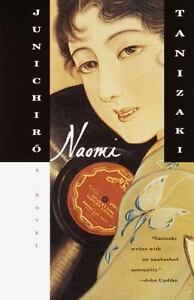
Naomi
Tanizaki Jun’ichirō
Reading Naomi is in no way comfortable, and yet it manages to be deeply enthralling nonetheless. Like watching a train wreck in slow motion or the 2020 presidential debate, no matter how appalled I became, I couldn’t pull my eyes away. I believe works that take us outside our comfort zone like Naomi teach ... read more
Naomi: A Self-torturing Read That You’ll Never Want to Miss
It is no surprise that Naomi was banned halfway through its serialization even during Japan’s most unruly Taishō period (1912.7.30-1926.12.25). Besides the pedophiliac atmosphere early on when the story started with a 28-year-old man adopting a 15-year-old girl to be his future wife, Tanizaki Junichirō’s obsession with destructive sexuality, pedophilia, sado-masochism, and bizarrely complicated relationships were also ... read more
The Cultural Identity Crisis in Naomi: To Westernize or Not To Westernize, That is The Question
To many Western readers, Japanese literature seems inaccessible. With strange characters and cultural references, many are deterred from picking up a book by Natsume Soseki or Ogai Mori. And while Naomi seems equally inaccessible with its unsympathetic and bizarre characters, a complete reading of the text reveals a dynamic relationship between culture and power that ... read more
Move over Lolita, It’s Naomi’s Time to Shine
There is something special about a novel that touches similar themes to that of Vladimir Nabokov’s Lolita and incorporates elements of a transitioning period. It is only natural that the reader asks what novel I am describing, and this is, of course, Tanizaki Jun’Ichiro’s Naomi. Naomi tells the story of Joji, the old male protagonist, ... read more
What Do We Talk About When We Talk About Love: A Review of Tanizaki Jun’ichirō’s Naomi
A western reader unfamiliar with Tanizaki Jun’ichirō’s Naomi would find its central theme echoing that of Émile Zola’s For a Night of Love. While the two works share similarities in the description of the female characters’ ruthless, sadistic manner and male protagonists’ masochistic love, Naomi’s narration blends such overarching theme ... read more
Japan’s cultural confusion during the Taisho Period revealed in Tanizaki’s Naomi through masochism, fetishization, and manipulation
Many readers (including me) hold a preconceived notion that strong female characters are not evident in older pieces of literature; rather, we usually see female characters in positions of inferiority and submissiveness. Although the latter statement rings true, Junichiro Tanizaki’s Naomi is a literary masterpiece that reveals a man’s obsession and misery, a woman’s increasing ... read more
A Walk in the Lost Paradise
Distorted yet alluring, tragic yet perplexing—Junichiro’s Naomi is such kind of book that startles and unsettles its readers. It presents to us a lost paradise where predators hunt on their prey, and raw lusts vigorously bloom as well as paradoxical motives. Once we set foot on it, a dangerously captivating journey begins. Written in 1924 ... read more
Madly in Love: A Review of Junichiro Tanizaki’s Naomi
In the early twentieth century, D.H. Lawrence, one of Britain’s preeminent authors, faced censorship, official persecution, and a reputation as a pornographer that followed him until his death for writing about sexuality. Across the globe in Japan, Junichiro Tanizaki explored sexuality and eroticism to similar effect. Tanizaki’s Naomi follows the relationship between Jōji, an electrical ... read more
A Fool’s Read: How Junichiro Tanazaki’s “Naomi” Flips the Paradigm but Feigns its Progressiveness
Jun’ichirō Tanazaki, born in 1886, came of age on the cusp of a pivotal transition in Japanese culture. At the advent of the Meji era, Japan, no longer clinging to isolationism, began to readily adopt Western theory and technology. The dawn of the Taishō period in 1912, however, saw the voguing of Western lifestyle and ... read more
Naomi Question: From early on in the novel, Naomi is portrayed as the personification of the growing and developing taste for Western culture in Japan during the Taishō period. During their nighttime boat rides, she sings "Santa Lucia," a Neapolitan song, over and over. While we know that Western art and culture became popular in Japan during this time, was there a resurgence of traditional Japanese culture or a merging of the two cultures?
Throughout the novel, Joji appears to both openly objectify Naomi while also supporting her education, submitting to her desires, and encouraging her independence. How does this dynamic reveal the evolution of male-female relationships during the Taishō period as a result of western influence? Does Tanizaki view the increased independence of women as positive or harmful?
Junichiro’s Naomi as a whole seems to perpetuate a binary opposition between “the Western” and “the Japanese”, both of which possess corresponding values that oppose one another. Whereas westernized Naomi looks Eurasian and is full of autonomy, Joji’s passivity seems typically Japanese given the historical context. Could we interpret the western influence on Japan through a post-colonial lens? Could Joji and Naomi’s lives be seen as mimicking the western culture?
What is the importance of the change in Naomi's demeanor? What is Tanizaki saying about the west through the transformation of Naomi? Is it a positive or negative message?
Is anyone else saddened by Joji's character, especially as we see Naomi manipulate him more and more? It seems like Naomi is the looming Western world onto Japan, represented by Joji.
From what we've read so far, what might the book reveal about Japan in the 1920s, power relations between the genders, the psychology of the relationship between Joji and Naomi, body fetishization, and the reconstructing and rethinking of bodies in Japan? This book was published in the midst of a radical shift in Japanese culture from the traditions that had governed their behavior for centuries to a more westernized version. How do you think Junichiro Tanizaki's book impacted Japanese women who were just beginning to reject the traditional housewife role and embrace the Western idea of female freedom? Do you think this book has to do more with the tale of obsessive love (or lust) between Joji and Naomi, or do you think it's more fitting to describe this work as an allegory about the changes that Japan was facing after WWI and their obsession with western things?
I found Junichiro’s depiction of space intriguing. His description of “the house of fairy tales” appears to be especially metaphorical and connotative (to me it is almost like a falling hetero-topia), manifesting a sense of Junichiro’s unique aesthetics. How does the construction of space facilitate our understanding about the persona of the characters and reflect underlying tension (if you perceive any)?
What does "Naomi" say about constructs about friendship in the Taisho Period, and more specifically, about friendship between men and women? (Hamada, Kumagai, etc.) I am interested in what constructs of friendship like throughout other periods in Japan as well.
Naomi in this novel is the representation of Western power and Joji the Japanese. Yet Joji's total awareness of Naomi's true nature and his disapproval of her soul does not hinder his fascination toward Naomi at all. His obsession with Naomi's "western" physical beauty overpowered everything else, and he ended up becoming the subordinate in their relationship, submitting to the rule of the ill-behaved, vain, brutal Naomi.
Can we then infer something about Tanizaki's view on the total acceptance of the West in Taisho, and his understanding of the Japan-West power dynamics from Joji's paradoxical fascination? How should we interpret the Japanese title, "Love of A Fool"?
The Japanese title of the novel is 痴人の愛 (chijin no ai), which translates to something along the lines of, "Fool's love." Japanese does not distinguish between the singular and plural as much as English does, meaning that the title could be referring to one or more people. Based on what you have read so far, who do you think the titular fool(s) is? Naomi? Joji? Would your answer change depending on the point in the story?
the motif of flowers is very strong throughout; on page 15, young Naomi is depicted as having a love of them, especially tulips, and "violets, dandelions, lotus grass... primroses." Red tulips mean perfect love, and tulips in general can mean rebirth or charity (or at least it did in Victorian times). Violets are associated with purity and modesty, while dandelions are equated with faithfulness. To what extent does their relationship embody these values, and to what extent does it not? Are the flowers supposed to symbolize the strength of their love, or the opposite?
Naomi Question: Throughout Naomi, there is tension stemming from the concept of westernization. In the context of the novel, does “westernization” necessarily imply “modernization”? If or if not, how so?