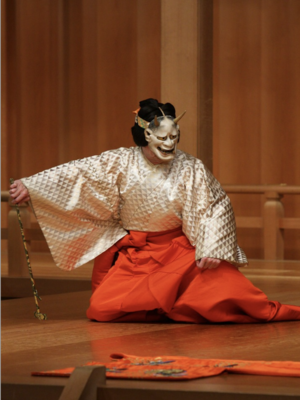
Lady Aoi (Aoi no Ue)

Unknown, revised by Zeami


Lady Aoi (Aoi no Ue): A Happy Ending?
xz2@middlebury.edu
         Lady Aoi (Aoi no Ue) is a Muromachi period (1338-1573) Noh play by an unknown author. It was originally written for the troupe of Inuō Dōami, a famous Noh actor of Ōmi Province (present-day Shiga Prefecture), who performed the play in 1413. While Aoi no Ue is often attributed to the master playwright Zeami Motokiyo ... read more

         Lady Aoi (Aoi no Ue) is a Muromachi period (1338-1573) Noh play by an unknown author. It was originally written for the troupe of Inuō Dōami, a famous Noh actor of Ōmi Province (present-day Shiga Prefecture), who performed the play in 1413. While Aoi no Ue is often attributed to the master playwright Zeami Motokiyo (1363?-1443?), Zeami’s contribution to the play might have been limited to minor revisions and paraphrases. Aoi no Ue is the oldest of the many Noh plays that draw on The Tale of Genji (Genji Monogatari) by the Heian period (794-1185) woman writer Murasaki Shikibu (973-1014?). Lady Aoi is a character featured in the “Heartvine” (Aoi) chapter in The Tale of Genji. The principal wife of Genji and a daughter of the Minister of the Left (Sadaijin), Lady Aoi is possessed by the jealous and vengeful spirit of Lady Rōkujo, Genji’s long-time lover. In the original tale, Rōkujo’s living spirit eventually kills Aoi shortly after Aoi gives birth to Genji’s first son. The play adaption, on the other hand, ends with what appears to be “a happy ending”: Rōkujo’s evil spirit is pacified, and Aoi is saved. Do these women fare better under the pen of their creator, the Heian woman writer Murasaki Shikibu, or the Muromachi male playwright? I shall respond in the negative.

         In the Noh play, Aoi is represented by an empty embroidered kimono placed toward the front of the stage. The play begins with a courtier announcing Lady Aoi’s grave illness as a result of spiritual possession. In the first act, Teruhi the Shamaness successfully identifies the malevolent spirit of Lady Rōkujo but fails to exorcise it. There are several allusions to the classical texts in Rōkujo’s speeches, including numerous Buddhist sutras and The Tale of Genji. For example, Rōkujo mentions Yūgao, a lover of Genji also killed by Rōkujo’s living spirit, and repeatedly refers to the decrepit carriage. During the Kamo Festival, Rōkujo was publicly humiliated by Aoi’s drunken male attendants who broke Rōkujo’s carriage and pushed her to the back of the crowd. While Murasaki narrates this conflict with convoluted plots, the Muromachi playwrights only make indirect and peripheral references to the incident. Aoi’s pregnancy with Genji’s first son, another reason for Rōkujo’s jealousy, is also left unmentioned. After Rōkujo’s intransigent spirit strikes the kimono representing Aoi with a fan, Teruhi accuses her of seeking revenge on Aoi and becoming overwhelmed with jealousy, a behavior unfitting of her noble upbringing. This scene deviates from the original Heian tale in two ways. Firstly, the character of Teruhi the Shamaness does not exist in Murasaki’s story. In addition, the act of “secondary wife beating” is, in a way, anachronistically placed: it is a Muromachi-period custom in which the former/abandoned wife vented her anger by beating her ex-husband’s new wife (Shirane, 427). Rōkujo’s jealousy is further dramatized by the main actor (shite)’s change of masks between the two acts, from the deigan (literally “golden or gilded eyes”) mask that embodies her repressed emotions, to the nightmarish hannya mask that represents her degeneration into a demon. In the end, Rōkujo is dispelled by the holy man of Yokawa, a celebrated mountain ascetic monk. The demonized spirit even attains nirvana and is forever released from the cycle of death and rebirth.

         The “happy” ending of salvation, however, should not be read as an indication of lesser misogyny in the play. Lady Aoi’s agency and subjectivity are utterly erased by the male playwrights who cast her as a quiet and motionless kimono. While silencing Aoi, the play is silent when it comes to the complex and multi-layered emotions Rōkujo has experienced, the earlier political downfall of her husband and family, her lack of conscious knowledge of the wandering spirit, and notably, Murasaki’s portrayals of Genji’s sense of guilt toward her. The Noh character of Lady Rōkujo is flattened and reduced to a mere symbol of female jealousy and sinful women’s monstrous power. Rōkujo in the Noh play is the “bad woman.” She is belligerent, vindictive, and even masculine. While the villain is unwomanly, Aoi, the “good woman” by societal standards, is represented by a mere piece of cloth. Ultimately, the illegitimate masculinity symbolized by Rōkujo has to be tamed and conquered by the legitimate male authority. I would give Aoi no Ue a 5/5 rating. For readers familiar with the original Heian Tale, the theatrical adaptations of the Genji story may give readers some insights into the changing sociopolitical landscapes of the Muromachi period. Readers who have not read Murasaki should also be able to follow the adapted story and enjoy the theatrical aspects of the performance.


Work Cited:


Shirane, Haruo. Traditional Japanese Literature: An anthology, beginnings to 1600. Columbia University Press, 2012.

Total Votes : 0 Vote Up Edit Reply


xz2@middlebury.edu

What's the significance of Aoi being represented only by an empty kimono in the play?


axzou@middlebury.edu

I also found the spreading and integration of commoner and court culture during the Warring States period very interesting, especially as aristocrats and cultural figures fled to the provinces. This period was marked by significant social upheaval and the blending of cultural practices, which leads me to wonder how this interchange of culture enhanced relationships between the people of the capital and those in the provinces. Additionally, was there any resistance to this cultural exchange during this time? How did these interactions influence social hierarchies and power dynamics, and what lasting impacts did they have on Japanese society as a whole?


jcruzmendez@middlebury.edu
I found the reading Lady Aoi entertaining. It reminded me of the video we saw in class where it showed the possession of a spirit and the chants that would be performed. It is also nice to see the stage from the Theatrical Elements section, which showed how the plays would be presented.

nleung@middlebury.edu
I enjoyed reading Lady Aoi. However, reading the script of the noh made it feel that each performance would be quite short. Do the audience only watch one performance? Or are there multiple performances of noh with kyougen in between?

as5@middlebury.edu
After reading Lady Aoi, it intrigues me how it was mentioned that certain parts of the story were either changed or completely omitted from the play. I can understand doing so to make it more digestible and easier for the audience that may find it difficult to follow along, but it had me thinking about a topic we were discussing in another class of mine. To what extent is it okay to alter or change something? I wonder how much of an effect these changes to the play have on something like the interpretation of it. Considering those who would've been knowledgeable on the Tale of Genji, how must they have felt with this new "iteration" of the play? In the end, is it really better to change and omit some parts of the story, especially considering how some aspects changed that might be insignificant to others may be significant to certain others?

mgamez@middlebury.edu
Lady Aoi illustrates key characteristics of No drama, such as the focus on supernatural elements and the emotional struggles of its characters. The play’s protagonist, a vengeful female spirit, aligns with the tradition in No of exploring intense emotions through figures from the afterlife. Zeami’s revision of the original play subtly refined the phrasing, preserving its emphasis on restraint and the internal turmoil of the characters. I find it intriguing how Lady Aoi uses these elements to create a haunting atmosphere, reflecting the psychological depth typical of No Drama theater. One question I have is how the portrayal of Lady Rokujo’s spirit as a vengeful spirit might have resonated with the audiences of the time.

sgosnell@middlebury.edu

The rise of the medieval period and of a new culture was particularly interesting to read about. There definitely was more interaction between the once distinctly separate culture of the capital and the culture of the provinces. Unlike the Heian period, this new period also seemed to complicate and contest the strict distinctions between class and status structures. The nō drama tradition also illustrated this rapprochement of the classes, for in Lady Aoi: he play accounted for the unfamiliarity of Tale of Genji among commoners by making it generally entertaining, while also including details that would speak to those who had had access to the original tale. How, then, did this cultural transition impact the relationship that commoners had with literature, specifically in adding to the literary archive of the period?


xz2@middlebury.edu

Brown, Steven T. Theatricalities of power: The cultural politics of Noh. Stanford University Press, 2001.

In his monograph, Steven Brown engages in a close reading of the Noh play, Aoi no Ue. Brown historicizes the theatricalities of this play by contextualizing it within the materiality of the Muromachi period (1338-1573). Chapter 2 features the opening scene in which Teruhi the Shamaness identifies the malevolent spirit of Lady Rōkujo. Brown examines Teruhi’s lyric chants and Rōkujo’s entrance song while describing the sociopolitical aspects of spiritual possession and exorcism. This chapter contains a noteworthy account of a performance of Aoi no Ue by Inuō Dōami, a famous Noh actor who performed the play in 1413. Inuō’s description of using the carriage as a prop gives modern readers some idea of how the play was performed during the Muromachi period. Brown also analyzes Rōkujo’s obsession with the carriage and wheel imaginary with reference to the socioreligious background of the Aoi Festival. The chapter ends with the scene in which Rōkujo strikes the empty kimono that signifies Lady Aoi. Brown interprets this scene in relation to the Muromachi practice of “secondary wife beating” (uwanari uchi).

In Chapter 3, Brown suggests an intriguing reading of Rōkujo’s possession of Aoi as “a possession out of dispossession” (68). The play erases the traces of Rōkujo’s political dispossession by not mentioning her deposed husband and deceased father. The play also omits several portrayals by Murasaki Shikibu (d. 1014) of Genji’s sense of guilt. While the original Tale of Genji was written by Murasaki and revealed the Heian woman writer’s subjectivity, Brown reminds his readers that Aoi no Ue was exclusively authored and revised by the Muromachi male playwrights’ utterances of female subject positions. Rōkujo was dispossessed of not only the better carriage position at the Aoi Festival, but also the right of serving as the “carriage” of Genji’s socioeconomic progeny, i.e., carrying his eldest son and all the privileges associated with this status. Along these lines, Brown elaborates on various ways in which the Muromachi women’s inheritance rights and powers were constricted. Brown closes the chapter with a detailed account of the successful pacifying rituals performed by the holy man of Yokawa, while referring to the relevant Buddhist texts and traditions. In these two chapters, Brown provides illuminating insights to understand the play’s theatrical adaptations in relation to the historical reality of the Muromachi period. Besides the audiences of Japanese literature and theatre, scholarly readers interested in history, religion, and critical theory may find this book particularly useful as well.

Konparu, Kunio. The Noh Theater: Principles and Perspectives. New York: Weatherhill/Tankosha, 1983.

In Chapter 6, Konparu classifies Aoi no Ue as a madness-themed play in which Rōkujo is the main character (shite) and the exorcists are the “foil” characters (waki). Zeami Motokiyo (1363?-1443?), the master playwright to whom the play is often attributed, wrote a number of plays with mad main characters. In Table 5 of this chapter, Konparu outlines four categories of ghosts in Noh, and Lady Rōkujo falls under the third category of possessing ghosts. For plays with a woman shite, the acting technique is not aimed at displaying femininity, but at expressing the woman character’s complex mental state and rich emotions. Konparu presents a brief account of Aoi no Ue alongside another play that features Rōkujo, Nonomiya. Table 40 of Chapter 17 surveys different kinds of wigs and masks in Noh theater. Rōkujo’s wig is called naga-kamoji (long switch). This hairstyle symbolizes a beautiful noble woman in the Middle Ages and is used only in Aoi no Ue nowadays. Konparu’s work helps scholarly readers to locate this particular play within the broader contexts and traditions of the Noh theater.

Udaka, Michishige. The Secrets of Noh Masks. Kodansha International, 2010.

This book contains two key elements: a) personal writings and accessible notes authored by the master Noh actor and mask carver, Udaka Michishige, and b) brilliant photos of thirty-two different Noh masks by photographer Yamagata Shuichi. The section titled “Women and Ghosts” includes the two masks of Lady Rōkujo in the play Aoi no Ue. The first mask that appears in the play is called deigan, which means golden or gilded eyes. Udaka notes that deigan embodies a complex mixture of different emotions. The photos beautifully capture the golden paint not only in the eyes but also on the teeth, as well as the slightly disheveled hair. Udaka refers to the play Aoi no Ue in his account of the hannya mask. He also mentions the Japanese folk belief of jealous women with horns and the white tall headdress called tsunokakushi (literally “horn concealer”) worn by the bride in a traditional wedding. Readers may wish to take advantage of the delicate photography by comparing the presentations of different woman characters’ hair. There are four masks in this section interested readers may refer to: magojiro mask with neatly combed hair (used for noble and beautiful women of charming disposition), the deigan mask, the hannya mask, and the shinja mask with the most disheveled hair which embodies the greatest insanity (shinja is a more nightmarish version of hannya and is used in another famous Noh play, Dojoji).

Keene, Donald. Nō And, Bunraku: Two Forms of Japanese Theatre. Columbia University Press, 1990.

In Chapter 3 of the part on Noh, Keene also studies both Nonomiya and Aoi no Ue and clarifies why the first falls under the third category, the woman plays, while the second belongs to the fourth category of the madness plays. In his account of various Noh masks, Keene briefly mentions the etymology of the word hannya. In the Sanskrit original, ironically, hannya means “wisdom”, but here it might originate from the name of a mask maker, Hannyabō.

Morita, Toshiro. “Onryo: Hannya,” Noh Mask Database, accessed December 1, 2021, https://www.the-noh.com/sub/jp/index.php?mode=db&action=e_view_detail&data_id=11&class_id=1

Morita echoes Keene’s etymological account of the word hannya and describes the mask maker Hannyabō as a monk from Nara. The author also presents an alternative explanation that the mask was named hannya because the art of making demon masks requires true wisdom. General readers may access this database for a variety of resources on the Noh Theater.