Lady Aoi (Aoi no Ue): A Happy Ending?
Lady Aoi (Aoi no Ue) is a Muromachi period (1338-1573) Noh play by an unknown author. It was originally written for the troupe of Inuō Dōami, a famous Noh actor of Ōmi Province (present-day Shiga Prefecture), who performed the play in 1413. While Aoi no Ue is often attributed to the master playwright Zeami Motokiyo (1363?-1443?), Zeami’s contribution to the play might have been limited to minor revisions and paraphrases. Aoi no Ue is the oldest of the many Noh plays that draw on The Tale of Genji (Genji Monogatari) by the Heian period (794-1185) woman writer Murasaki Shikibu (973-1014?). Lady Aoi is a character featured in the “Heartvine” (Aoi) chapter in The Tale of Genji. The principal wife of Genji and a daughter of the Minister of the Left (Sadaijin), Lady Aoi is possessed by the jealous and vengeful spirit of Lady Rōkujo, Genji’s long-time lover. In the original tale, Rōkujo’s living spirit eventually kills Aoi shortly after Aoi gives birth to Genji’s first son. The play adaption, on the other hand, ends with what appears to be “a happy ending”: Rōkujo’s evil spirit is pacified, and Aoi is saved. Do these women fare better under the pen of their creator, the Heian woman writer Murasaki Shikibu, or the Muromachi male playwright? I shall respond in the negative.
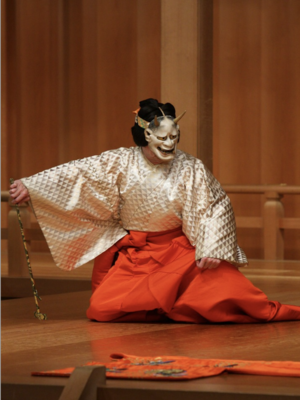
In the Noh play, Aoi is represented by an empty embroidered kimono placed toward the front of the stage. The play begins with a courtier announcing Lady Aoi’s grave illness as a result of spiritual possession. In the first act, Teruhi the Shamaness successfully identifies the malevolent spirit of Lady Rōkujo but fails to exorcise it. There are several allusions to the classical texts in Rōkujo’s speeches, including numerous Buddhist sutras and The Tale of Genji. For example, Rōkujo mentions Yūgao, a lover of Genji also killed by Rōkujo’s living spirit, and repeatedly refers to the decrepit carriage. During the Kamo Festival, Rōkujo was publicly humiliated by Aoi’s drunken male attendants who broke Rōkujo’s carriage and pushed her to the back of the crowd. While Murasaki narrates this conflict with convoluted plots, the Muromachi playwrights only make indirect and peripheral references to the incident. Aoi’s pregnancy with Genji’s first son, another reason for Rōkujo’s jealousy, is also left unmentioned. After Rōkujo’s intransigent spirit strikes the kimono representing Aoi with a fan, Teruhi accuses her of seeking revenge on Aoi and becoming overwhelmed with jealousy, a behavior unfitting of her noble upbringing. This scene deviates from the original Heian tale in two ways. Firstly, the character of Teruhi the Shamaness does not exist in Murasaki’s story. In addition, the act of “secondary wife beating” is, in a way, anachronistically placed: it is a Muromachi-period custom in which the former/abandoned wife vented her anger by beating her ex-husband’s new wife (Shirane, 427). Rōkujo’s jealousy is further dramatized by the main actor (shite)’s change of masks between the two acts, from the deigan (literally “golden or gilded eyes”) mask that embodies her repressed emotions, to the nightmarish hannya mask that represents her degeneration into a demon. In the end, Rōkujo is dispelled by the holy man of Yokawa, a celebrated mountain ascetic monk. The demonized spirit even attains nirvana and is forever released from the cycle of death and rebirth.
The “happy” ending of salvation, however, should not be read as an indication of lesser misogyny in the play. Lady Aoi’s agency and subjectivity are utterly erased by the male playwrights who cast her as a quiet and motionless kimono. While silencing Aoi, the play is silent when it comes to the complex and multi-layered emotions Rōkujo has experienced, the earlier political downfall of her husband and family, her lack of conscious knowledge of the wandering spirit, and notably, Murasaki’s portrayals of Genji’s sense of guilt toward her. The Noh character of Lady Rōkujo is flattened and reduced to a mere symbol of female jealousy and sinful women’s monstrous power. Rōkujo in the Noh play is the “bad woman.” She is belligerent, vindictive, and even masculine. While the villain is unwomanly, Aoi, the “good woman” by societal standards, is represented by a mere piece of cloth. Ultimately, the illegitimate masculinity symbolized by Rōkujo has to be tamed and conquered by the legitimate male authority. I would give Aoi no Ue a 5/5 rating. For readers familiar with the original Heian Tale, the theatrical adaptations of the Genji story may give readers some insights into the changing sociopolitical landscapes of the Muromachi period. Readers who have not read Murasaki should also be able to follow the adapted story and enjoy the theatrical aspects of the performance.
Work Cited:
Shirane, Haruo. Traditional Japanese Literature: An anthology, beginnings to 1600. Columbia University Press, 2012.