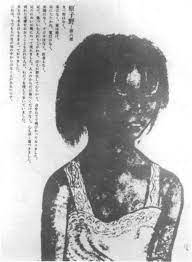
Schwenger, Peter, and John W. Treat. “America’s Hiroshima, Hiroshima’s America.”
Asia/Pacific as Space of Cultural Production, 21, no. 1 (Spring, 1994): 233-253.
https://doi.org/10.2307/303414.
This piece is an interesting duet-like work that discusses the postwar perspectives of Hiroshima and the US from the opposing side in order to deconstruct and analyze the cultural consequences of the war and atomic bombing. On one side, Peter Schwenger discusses the United State’s perception and cultural point of view of the war, atomic bombing, and Hiroshima as a whole, and on the other side, John Whittier Treat discusses Hiroshima’s perception of and cultural takes on the United States, as well as their reactions to the atomic bombing.
In Schwenger’s section of the piece, he discusses the disneyification of the atomic bombing, in that Americans and American culture percieved the bombing as a spectacle. Schwenger brings up a segment from a popular US television show, This is Your Life where a Hiroshima survivor tells their story about the bombing and is then put face to face with one of the pilots involved in the bombing and shake his hands. Additionally, reenactments featured in parades celebrating the end of WW2 like “Tribute to Victory” simulate the bombing and war on the pacific front. These examples of media and consumption reflected the widespread notion that Americans glorified the bombing as a spectacle and an example of American might. Very little compassion is given to the survivors of the bombing, and focus is instead shifted to America’s display of power in the bombings of Hiroshima and Nagasaki.
Treat’s section discusses Japan’s response as one of great pain. Hibakusha, or survivors who wrote about the atrocities of Hiroshima were examples of a cultural response to the bombing, and America is often seen as an over-powerful victimizer of Japan. Despite the fact that the atrocities on Hiroshima and Nagasaki were inexcusable, Treat also problematizes Japan’s position as playing the victim, as they committed several atrocities during the war. To completely ignore these acts in considering the bombing would also be an immoral stand and, similar to America, give very little compassion to the victims of those acts of aggression.
This piece is very unique in how it presents both sides together, and the analysis of each perspective is very in depth. In analyzing postwar Japanese literature, it is important to consider where Japanese culture and society lies in their reactions to the atomic bombing. I feel that the piece did a good job of presenting this information in an unbiased manner. This piece also gives a good backdrop as to how other facets of culture like manga and comics reacted to the bombing.
Treat, John Whittier. “Hayashi Kyoko and the Gender of Ground Zero.” In The Woman’s Hand: Gender and Theory in Japanese Women’s Writing. Edited by Paul Schalow and Janet Walker. Stanford, Calif.: Stanford University Press, 1996.
In a section of Hayashi Kyoko and the Gender of Ground Zero, John Whitter Treat analyzes Hayashi Kyoko’s reactions to the atomic bombing as she reflects on them in a 1982 piece, “Buji.” In “Buji,” Kyoko writes about her trip to Hiroshima. The trip both strengthened her stand on being against atomic weapons and energy, as well as made her question the assumptions she made as a atomic bomb survivor from Nagasaki. Having been her first time visiting the city, this made her feel separate from the hibakusha of Hiroshima. Treat then discusses criticisms made about Kyoko’s work as being too focused on the atomic bomb, that her works are cheaply made because works by hibakusha will always create empathy in readers. This argument was furthered by critics in how hibakusha tend to be abstract in their retellings, straying away from exact details due to the mental trauma they have endured. Treat finally closes out the section by discussing a quote by Eli Wiesel, who ponders on whether or not witness-storytelling makes one a “peddler of night and agony.” Treat believes that as second-generation (and further) atomic bomb survivors, we are forced by Kyoko to recognize this “ancestry while insisting upon the right to be free of it.” I believe that the piece brings up very important points on the complexities of Kyoko and other hibakusha, and presents Kyoko’s perspective in a clear way. Treat does a good job of discussing how it is crucial to see from Kyoko’s pessimistic perspective in looking at postwar Japan, as well as Japan’s overall reaction to the atomic bombings. A criticism I have with the piece is that although the critics were indeed insensitive to the experiences of hibakusha, seemingly telling them to move on, their points in line with Wiesel’s concerns for being a peddler of night and agony are indeed valid. Although it is important to reflect on atrocities that have occured, for example in Hiroshima and Nagasaki, we as “‘second-generation’ survivors of a nuclear war” must also look to change the world in the present.
Stevem. “Barefoot Gen - The A-Bomb Anime.” Filmed December 7, 2019.
https://www.youtube.com/watch?v=pcXPYwKPqK0
In the youtube video “Barefoot Gen - The A-Bomb Anime,” Stevem discusses in depth about the post war anime and manga, “Barefoot Gen.” The anime was created by Keiji Nakazawa and depicts Gen and his family’s life during World War 2 in Japan. A few struggles that are highlighted in the anime are the poverty, food shortages, and social ostracization of being anti-war during this time in Japan. Stevem points out that the anime does a good job of characterizing Gen and his brother as innocent and this along with the musical scores and imagery make many scenes seem very lighthearted. This innocent youthfulness is heavily contrasted with the a-bomb scene and difficulties of wartime Japan. In the a-bomb scene, we see the horrors, death, and apocalyptic imagery all in vivid animated detail. However, as Stevem quotes Misayo Yamane, the wife of Keiji Nakazawa, “‘You can’t depict war without graphic images.’” Touching on Eli Wiesel’s point of peddling night and agony, this anime responds by saying this kind of imagery, this rawness is absolutely crucial in telling the story of the bombing of Hiroshima and Nagasaki. I believe that this video provides good information on the anime “Barefoot Gen.” The anime itself is a good example of the cultural response to the bomb. Themes of shock, defeat, and disparity are all highlighted in wartime and postwar Japan. However, the theme of anti-war sentiment within Japan is a unique theme that is often absent from other forms of media surrounding postwar and wartime Japan. Displaying public ostracization, humiliation, and punishment for holding an antiwar position brings a stance from Japanese culture that doesn’t outright victimize Japan as a nation, but also discusses the injustices of the war altogether, which I found to be refreshing.
BBC News. “Hiroshima atomic bomb: Survivor recalls horrors.” Filmed August 5, 2015.
https://www.youtube.com/watch?v=-07xiaBl2vk
A BBC news report from 2015 looks back on the bombing of Hiroshima 70 years later and interviews Keiko Ogura as they tour Hiroshima. The news clip assesses and problematizes the insensitivity of US news coverage at the time of the bombing, highlighting only the patriotism of the bombing, as well the physical damage done to Hiroshima and Nagasaki, while avoiding its human cost. Keiko discusses the horrors that she witnessed when the bombing occurred, as well as her encounter with Americans’ ignorance surrounging the a-bomb. Even today, as students visit Hiroshima, they say that much of the information regarding human cost of the bomb comes as a surprise. I believe that the clip does a good job of highlighting how the US struggled to come to terms with the full extent of damage they did to Japan. Although the clip is indeed biased and is meant to commemorate and honor Hiroshima, it also glosses over the crucial details of atrocities that Japan did during the war. However, it is excused because it would seem insensitive to Keiko and Hiroshima on its 70th anniversary of the bombing, and these details aren’t necessary to discuss when looking at Hiroshima in the context of the war, but rather Japan as a nation during and after the war.