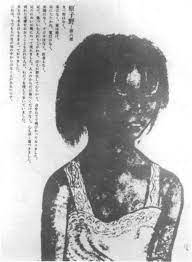
Two Grave Markers

Hayashi Kyoko


Hibakusha - From Life to Page
ttanchanco@middlebury.edu
Hayashi Kyoko’s “Two Grave Markers” is a genbaku bungaku (literature discussing the atomic bombing of Japan) written in 1986 that tells the tale of Wakako and Yoko, two young women who died from the atomic bombs. They are depicted as two best friends who come from a small village far from Nagasaki, and were factory ... read more

Hayashi Kyoko’s “Two Grave Markers” is a genbaku bungaku (literature discussing the atomic bombing of Japan) written in 1986 that tells the tale of Wakako and Yoko, two young women who died from the atomic bombs. They are depicted as two best friends who come from a small village far from Nagasaki, and were factory workers in Nagasaki at the time of the bombing. Shortly after the bombing, Wakako (with no physical damage but sick with radiation poisoning) returns to the village without Yoko, leaving many bewildered and fearful of what happened over the course of the bombing.

Hayashi writes on the experiences of hibakusha, or A-bomb survivors. It is apparent that this work is based heavily on Hayashi’s lived experiences as she herself was a factory worker in Nagasaki when the atomic bombs were dropped. This intimate connection between Hayashi and the two girls in the story is apparent through the cutting imagery and realism that appears throughout the work. Descriptions of the bombing and the chaos it ensued were written in excruciating detail. To add, the intangible aspects of being a hibakusha, like the feelings of guilt, fear and survival instincts were executed with acute specificity. Not only does this add to the depth and believability of the characters, it elevates the experience of the reader by immersing them into the perspective of a hibakusha.

In short, I deeply enjoyed this story. However, it is important to acknowledge this text properly. Although the text is riveting, its purpose was to educate readers and provide hibakusha like Hayashi an outlet for their traumatic experiences. In all, this text is very valuable in that it does not just discuss the atomic bombs from an objective point of view, it brings to light the intimate and individual experiences of hibakusha. Therefore, I feel that this story is inappropriate for readers looking for recreational violence, and is best suited for those who wish to gain valuable insight on historical tragedy and trauma. Finally, the overall flow and storytelling of the text is superb and ranks highly among other genbaku bungaku I have read.

Hayashi Kyoko. Two Grave Markers. In Bulletin of Concerned Asian Scholars, translated by Kyoko Selden, 18:1, 23-35, 1986. DOI: 10.1080/14672715.1986.10412588

Total Votes : 0 Vote Up Edit Reply

Best Friend's Betrayal: A tale of two Nagasaki Atomic Bomb Survivors in Hayashi Kyōko’s “Two Grave Markers”
sgregory@middlebury.edu
“Two Grave Markers” is a book about two atomic bomb victims set in Nagasaki, Japan after the atomic bomb was dropped on August 9, 1945 during World War II. In an eloquently expressed way, Hayashi Kyōko conveys the story about two young girls who are best friends, Wakako and Yoko. Together they experience the bombing ... read more

“Two Grave Markers” is a book about two atomic bomb victims set in Nagasaki, Japan after the atomic bomb was dropped on August 9, 1945 during World War II. In an eloquently expressed way, Hayashi Kyōko conveys the story about two young girls who are best friends, Wakako and Yoko. Together they experience the bombing firsthand while at work in a factory. Both Yoko and Wakako make it out of the factory alive but are faced with the lingering horrors of the bombing as they flee to the mountaintop refuge where they are reunited. Yoko was injured badly when the bomb was dropped and her open wounds act as a house for maggots to eat her alive. Wakako, recognizing her friend’s fate and not wanting to fall under the same, leaves Yoko atop the mountain. The next day Wakako begins her trek home but is faced with the horrors of what has just happened coupled with the discovery of Yoko dead where she had left her. Upon her return, Yoshi, Yoko’s mom, believes she knows what Wakako did that day atop the mountain, but Tsune, Wakako’s mom, is rigid in proving her daughter’s innocence. This creates a bifurcated relationship between the two mothers that plays out over the course of the rest story on top of Wakako’s return home.

This story conveys strong themes of guilt, sacrifice, betrayal, and tragedy but is written in such a way you are encouraged to emphasize with all the characters. Wakako’s actions in the story highlight the human will for survival; and through her actions, the story conveys the raw emotions of atomic bomb victims. I found myself emotionally moved by this piece, it was written in such a potent matter that I felt as I was watching this on television, rather than reading it. The portion of the story where Wakako decides she can no longer stay by Yoko’s side was so visual it made me cringe because it was written in an extremely articulated way. Hayashi knows how to pull the reader’s heartstrings, and I recommend this story to anyone who enjoys a text they are fully engrossed in. I will admit, this story is not best suited for the weak-stomached, as many horrific parts of the story are described in a vivid manner. Personally, I enjoyed this story but can see where these scenes could be hard for some readers. Hayashi Kyōko witnessed the atomic bombing first-hand, so her accounts are extremely accurate and are part of the reason this story is written so well but also very graphic. If I were to rank this story on a 5-point scale it would receive a 5 without a doubt. I found myself completely engrossed in the story of these two best friends, and furthermore the dichotomous relationship between the mothers of the two that plays out after Wakako’s return. If this story was longer, I could see myself reading it late into the night unable to put it down.


Hayashi Kyōko. “Two Grave Markers.” In The Atomic Bomb: Voices from Hiroshima and Nagasaki, by Kyoko Iriye Seldon, Mark Seldon, 24-54. New York: M.E. Sharpe., 1989.


Total Votes : 0 Vote Up Edit Reply

Wakako and the Reader’s Heart-Ache
mgromero@middlebury.edu
Hayashi Kyoto (1930-2017) does a beautiful job in pulling out an empathetic response from the reader, one where you find yourself crying at the end. Two Grave Markers is a story of two young best friends who were working in a war factory when the atomic bomb was dropped on Nagasaki on August 9th, 1945. ... read more

Hayashi Kyoto (1930-2017) does a beautiful job in pulling out an empathetic response from the reader, one where you find yourself crying at the end. Two Grave Markers is a story of two young best friends who were working in a war factory when the atomic bomb was dropped on Nagasaki on August 9th, 1945. Wakako and her best friend, Yoko, eventually die as a result of the radiation, but Hayashi focuses on Wakako’s immense guilt throughout the story. As a reader, the immediate thoughts are of remorse, but also of pain for Wakako because the betrayal she commits is understandable. As a piece of A-Bomb literature, it is expected for the story to be sensitive and place the readers in a pensive state. However, in comparison to another A-Bomb story like Ōta Yōko’s “Residues of Squalor”, Hayashi uses certain mechanisms like the friendship between the girls, their youth, and absence of guilt to make the reader feel genuinely upset. 

Many in Japan wanted to ignore or forget the nuclear genocide and would attack A-Bomb writers by claiming they were stuck in the past and needed to move on. As witnesses, all A-Bomb writers continued to write about the nuclear bombs to make sure those who lost their lives were remembered and guaranteed no bomb would ever be dropped again. Many A-Bomb writers struggled to capture their reader’s attention because their audience would never understand the event, but the beautiful friendship both girls had with one another and ultimately how the story ends touches the readers, helping them to understand the magnitude of this trauma. Moreover, the storyline to get there is heart aching. For example, Yoko’s mother's reaction can split the readers into agreeing, disagreeing, or understanding her anger toward Wakako. Like any other young girl, Wakako felt many insecurities, and her intruding thoughts were exacerbated by the event because they revolve around the idea that she should have died instead of Yoko. She truly felt unworthy to live. Reading about a child thinking this way is gut-wrenching. The bigger concept of the atomic bomb tragedy is understood by feeling so deeply for Wakako. Readers understand how common life can end in a disturbing instant, which is both terrifying and saddening at the same time.

Hayashi makes the readers care. She wholeheartedly accomplishes the goal of pushing the readers to acknowledge the nuclear bombs. Still, they are often mentioned briefly and the depth of their impact is somewhat weakened. We all know we do not want a nuclear bomb, but we do not know why. Why Japan refuses to have nuclear bombs, why the world was never the same, why we want to live are questions relevant to Hayashi’s story. Expect your heart to ache because Hayashi shows the people of Nagasaki as people, innocent people who lost the concept of life, will, and guilt in a flash of light. I personally think this is a story many should read because it gives you an appreciation for life, a life where you hope war stops in the world, so nobody has to experience what Wakako and Yoko lived through. 


Hayashi Kyoko. Two Grave Markers. In Bulletin of Concerned Asian Scholars, translated by Kyoko Selden, 18:1, 23-35, 1986. DOI: 10.1080/14672715.1986.10412588

Total Votes : 0 Vote Up Edit Reply

The Radiation of the Two Grave Markers
jayhoc@middlebury.edu
“Two Grave Markers,” published in 1975 by Hayashi Kyoko (1930-2017), is a deeply moving piece about the aftermath of the atomic bombing of Nagasaki (1945) to end World War II (1939-1945). The story is centered around the experience of a girl, Wakako, as she deals with the literal and emotional trauma radiating from the bomb. ... read more

“Two Grave Markers,” published in 1975 by Hayashi Kyoko (1930-2017), is a deeply moving piece about the aftermath of the atomic bombing of Nagasaki (1945) to end World War II (1939-1945). The story is centered around the experience of a girl, Wakako, as she deals with the literal and emotional trauma radiating from the bomb.

Our story begins at the end, with Tsune - the mother of Wakako, a fourteen-year-old girl - at the grave markers of Wakako and her friend Yoko. It opens with little doubt about how it will end for the two girls in Nagasaki. The story jumps around in time, to the moment when Wakako arrives back in the village to the surprise of her mother. We then move back in time, revealing the events of what went on when the bomb dropped. The question, it seems, is not whether Wakako will die. Rather, it is if she will find peace with her decisions and return to nature, or if she will be haunted forever by guilt and shame.

The main character Wakako proves to be incredibly cynical to the point of being misanthropic, having seen so much death and destruction. She doubts that others are truly mourning and thinks that they are as wrapped up in self-interest, as she is. At times, this selfishness can make her overwhelmingly unrelatable. Yet, who are we to blame a fourteen-year-old who has seen things we never have? She has seen so much to the point that “everything in the village was so healthy it disturbed her,” writes Hayashi. By the end, it is not hard to sympathize with Wakako, who faces “maggots” from her events with Yoko. Others who were lucky enough to be far from Nagasaki, close to the natural elements, were spared from the difficult decisions necessary to even survive. Even so, those who did not witness the same horrors are the same ones who pester her with questions about Yoko. No one except for Wakako can understand the horrors of that day. Even Tsune must grapple with her daughter slowly being drained of her life. Tsune is hoping that there is an innocence that is no longer present. As others attack her daughter, Tsune is firm in her belief that “[i]f [there] was to resent something, let it be the huge, monster ball of fire.” After all, the atomic bomb poisons every character in this story. It serves as the true villain. Even if the other characters appear to be protected by the pastoral settings, the reality of death hovers and buzzes, with the poison radiating everywhere. 

I would highly recommend “Two Grave Markers” to anyone, especially to who question the horrors of Nagasaki. Hayashi Kyoko is unapologetically honest, sparing no details of the psychological and physical trauma of the atomic bomb. Even if one survived, it is clear that it came at a cost of one’s humanity. Wakako lacks relatability, but how could readers ever relate to such an event? The story is not made to be relatable, rather it haunts and digs deep into not only the characters — like the maggots Wakako faces — but also the reader. Hayashi pulls back no punches, suggesting we all lost our humanity. It is only a matter of time before the radiation reaches us.


Citations

Hayashi Kyoko. Two Graves. In The Atomic Bomb: Voices from Hiroshima and Nagasaki, by Kyokko Iriye Selden and Mark Alden, 24-54. Routledge, 2015.

Total Votes : 0 Vote Up Edit Reply

The Story of a Best Friend’s Survivor Guilt
ayepizmedina@middlebury.edu
“Two Grave Markers” was written by Hayashi Kyoko in 1975 and this piece entails the story of two young girls, Wakako and Yoko, who experienced the Nagasaki Bombing which took place on August 9th, 1945. This story was one of many of Hayashi Kyoko’s pieces with the central theme being survival of bombings and the ... read more

“Two Grave Markers” was written by Hayashi Kyoko in 1975 and this piece entails the story of two young girls, Wakako and Yoko, who experienced the Nagasaki Bombing which took place on August 9th, 1945. This story was one of many of Hayashi Kyoko’s pieces with the central theme being survival of bombings and the intense feelings of grief, loss, and guilt survivors face in the aftermath of the event. Hayashi having experienced a bombing herself; her own narrative seems to be conveyed through her writing in this piece.


The characters in this story feature the two best friends Wakako, Yoko, the girls’ mothers Tsune and Yoshi, and people from the place where the girls are from. The main character, Wakako, was one of very few that survived the Nagasaki bombing and returned home. However, after her return, she is left to deal with the guilt of separating from her best friend, Yoko, when the A-bomb hit. The story switches narratives in a flashback like fashion from the day of the event and Wakako’s life after she returns home. The characters in the story are curious as to how the two girls got separated and form their own hypothesis about what they believed happened. Wakako’s mother, Tsune, is one of the characters I took a liking for since she defends and validates her daughters’s survivor experience from the A-bomb during her return while at the same time showing resilience when witnessing her own daughters trauma manifest.


I believe Hayashi portrayed an extremely detailed rendition of A-bomb trauma that was felt all throughout Japan, and it might have been a way of coping with her own experience as an A-bomb survivor. I was greatly disturbed and intrigued by this piece for its vivid imagery and the themes of grief, guilt, loss, trauma, within the story. The story line was extremely engaging and leaves readers speechless, wondering what they would have done if they were in Wakako’s shoes.


Although this is a fictional story, is heavily based on a very real and tragic occurrence. I would recommend this piece to anyone looking to explore a more deeply personal account of the bombing of Nagasaki and themes surrounding survivor guilt. It may not be for everyone since this text contains a gruesome story that may upset some readers, but overall, it contains some very powerful messages.


Hayashi Kyoko. Two Graves. In The Atomic Bomb: Voices from Hiroshima and Nagasaki, by Kyokko Iriye Selden and Mark Alden, 24-54. Routledge, 2015.


Total Votes : 0 Vote Up Edit Reply


ttanchanco@middlebury.edu
Regarding Eli Wiesel's statement regarding text that peddles darkness, how does Hayashi's work fare with this discourse? Are the extremely realistic descriptions of the effects of the atomic bomb necessary when discussing the atomic bombs and their victims? Does the solemn but positive ending bring closure or feel forced?

sgregory@middlebury.edu
This story was extremely well written and thought provoking. The question I find myself coming across was Tsune wanted so bad to prove Wakako's innocence, is this because she cant bear the guilt of Yoko's death or does it ride more on not wanting to believe her daughter committed those actions?
 

sgregory@middlebury.edu
Furthermore, how did the atomic bomb affect daily Japanese life and how does it have lasting effects today - especially for those of who are survivors?
 

jayhoc@middlebury.edu
3/9 - I was surprised to read in the secondary readings that Hayashi Kyoko was so heavily criticized. Was it really fair for those who had not went through the same trauma she did to criticize her? Furthermore, even if she did embellish/change details, is literature about facts? Is that not what pictures and history for? Is literature suppose to tell the truth, or is it supposed to convey an emotion - even if detached from reality? I was also interested in the continual juxtaposition between natural v. unnatural. This appears not only in the maggots, but also the settings from the pastoral lands versus the industrial setting. Do the orange trees that bookend the story have significance?

gdevries@middlebury.edu
Daily Question 3/9: Hayashi Kyoko beautifully writes of the horrors that occurred after the dropping of the a-bomb. Wakako recalls vivid details, especially those related to death and decay. She also feels extreme survivors guilt and is haunted by the death of her best friend, Yoko. Because Kyoko survived the bomb and experienced survival guilt, is the character Wakako in part a rendition of herself?
On another note, were Kyoko's works criticized because they were very descriptive and almost fiction-like? Perhaps if she had written them in a more factual manner they would have received less hate.

cetrillard@middlebury.edu
Daily Question 3/9: I noticed that Hayashi used a lot of color in her writing such as the "orange mountains," "purple light," and "colorful blizzard." This is more of a general question about all the readings we've done so far: One thing I've picked up on in our readings is that the authors tend to use a lot of color descriptors in their writings. How has Japanese culture influenced writing styles to include color as a significant detail? Does the writer's gender have any influence on their use of color descriptors?

alinas@middlebury.edu
 In "Two Grave Markers" Wakako remembers grabbing onto a man's ankle and begging him to help free her from the rubble only to have him kick her away. Yet once Wakako is able to free herself she also kicks away someone else who grabs her ankle. Why didn't Wakako help the person (who could possibly have been Yoko) who grabbed her ankle? If she had helped another victim do you think her experience of survivors guilt would be different why or why not?

nlara@middlebury.edu
  1. How does Hayashi Kyoko depict survivor's guilt in her literature?

mmflores@middlebury.edu
The guilt Wakako felt and the rumor of Yoko affected her until the her death. The use of maggots gave readers a vivid imaginations of how the guilt plagued Wakako. For example, the scene where Yoko told Wakako not to kill the maggot because it is her made me shiver. I am curious to wonder if maggots were used to represent more than just Yoko? For example, were the maggots used to portray the aftermath of the bomb in the form of a maggot turning into a fly?

swittig@middlebury.edu
I think it is interesting that both Ota and Hayashi resorted to imagery of small invertebrates, moreover the killing of them, as representations of human life. Ota used the slugs, particularly dissolving them with DDT as a way to express what it was like for those who observed the physical explosion. But I feel like Hayashi takes it a step further by tie maggots specifically to Yoko. I am curious as to why she chose to do so and have Yoshi, Yoko, and Wakako all acknowledge the tie.

nquizon@middlebury.edu
How are modern adaptations/references to the atomic bombings, such as the animated film Akira, received in comparison to how Ota and Hayashi are criticized for grief peddling?

mgromero@middlebury.edu
Like most, I noticed the many motifs in her work, I was particularly interested in those that foretold death. Wakako was described to be extremally beautiful when she returned, she was pale and unusually pretty that even her mother was concerned. I wondered why the author specifically choose to mention this early on, was it to show the beauty in her resilience? Maybe to show how she stole Yoko's beauty? Or maybe the beauty of dying to be reunited with her bestfriend? As well, as the correlation between the maggots and reincarnation and how that related to Wakako feeling guilty for not being able to fulfill her "bestfriend duties" of staying by her side. Do close relationships have special meaning in Japan? After all one cannot blame her for running, but the explanation of her feeling she denied Yoko's right to ask for her to stay made me curious.

egavin@middlebury.edu
I was fascinated by the perception of guilt in the story. Depending on the individual in the story or the mood of the author, people view the deaths associated with the atomic bombing differently. How does the potential guilt of the survivors shape how Japan changes post World War II? Does it change anything?

rurbina@middlebury.edu
Daily Question 3/9: Kyoko's writing is that of fiction. Was her style a point of criticism?

sabrinak@middlebury.edu
Daily Question 3/9: As Hayashi uses a lot of adjectives to describe her story, how different would "Two Grave Markers" be if she didn't use as descriptive language?

ayepizmedina@middlebury.edu
 

While reading this story, I felt that Hayashi Kyoko's way of describing this traumatic event also had a lot of visual and imagery filled representations like that of Ota's work. Do you think that Hayashi Kyoko included a lot more vivid descriptions than that of Ota's? If so, do you think Hayashi faced more criticism because of this?


ttanchanco@middlebury.edu

Schwenger, Peter, and John W. Treat. “America’s Hiroshima, Hiroshima’s America.”

Asia/Pacific as Space of Cultural Production, 21, no. 1 (Spring, 1994): 233-253.

https://doi.org/10.2307/303414.

This piece is an interesting duet-like work that discusses the postwar perspectives of Hiroshima and the US from the opposing side in order to deconstruct and analyze the cultural consequences of the war and atomic bombing. On one side, Peter Schwenger discusses the United State’s perception and cultural point of view of the war, atomic bombing, and Hiroshima as a whole, and on the other side, John Whittier Treat discusses Hiroshima’s perception of and cultural takes on the United States, as well as their reactions to the atomic bombing. 

In Schwenger’s section of the piece, he discusses the disneyification of the atomic bombing, in that Americans and American culture percieved the bombing as a spectacle. Schwenger brings up a segment from a popular US television show, This is Your Life where a Hiroshima survivor tells their story about the bombing and is then put face to face with one of the pilots involved in the bombing and shake his hands. Additionally, reenactments featured in parades celebrating the end of WW2 like “Tribute to Victory” simulate the bombing and war on the pacific front. These examples of media and consumption reflected the widespread notion that Americans glorified the bombing as a spectacle and an example of American might. Very little compassion is given to the survivors of the bombing, and focus is instead shifted to America’s display of power in the bombings of Hiroshima and Nagasaki. 

Treat’s section discusses Japan’s response as one of great pain. Hibakusha, or survivors who wrote about the atrocities of Hiroshima were examples of a cultural response to the bombing, and America is often seen as an over-powerful victimizer of Japan. Despite the fact that the atrocities on Hiroshima and Nagasaki were inexcusable, Treat also problematizes Japan’s position as playing the victim, as they committed several atrocities during the war. To completely ignore these acts in considering the bombing would also be an immoral stand and, similar to America, give very little compassion to the victims of those acts of aggression. 

This piece is very unique in how it presents both sides together, and the analysis of each perspective is very in depth. In analyzing postwar Japanese literature, it is important to consider where Japanese culture and society lies in their reactions to the atomic bombing. I feel that the piece did a good job of presenting this information in an unbiased manner. This piece also gives a good backdrop as to how other facets of culture like manga and comics reacted to the bombing. 


Treat, John Whittier. “Hayashi Kyoko and the Gender of Ground Zero.” In The Woman’s Hand: Gender and Theory in Japanese Women’s Writing. Edited by Paul Schalow and Janet Walker. Stanford, Calif.: Stanford University Press, 1996.

In a section of Hayashi Kyoko and the Gender of Ground Zero, John Whitter Treat analyzes Hayashi Kyoko’s reactions to the atomic bombing as she reflects on them in a 1982 piece, “Buji.” In “Buji,” Kyoko writes about her trip to Hiroshima. The trip both strengthened her stand on being against atomic weapons and energy, as well as made her question the assumptions she made as a atomic bomb survivor from Nagasaki. Having been her first time visiting the city, this made her feel separate from the hibakusha of Hiroshima. Treat then discusses criticisms made about Kyoko’s work as being too focused on the atomic bomb, that her works are cheaply made because works by hibakusha will always create empathy in readers. This argument was furthered by critics in how hibakusha tend to be abstract in their retellings, straying away from exact details due to the mental trauma they have endured. Treat finally closes out the section by discussing a quote by Eli Wiesel, who ponders on whether or not witness-storytelling makes one a “peddler of night and agony.” Treat believes that as second-generation (and further) atomic bomb survivors, we are forced by Kyoko to recognize this “ancestry while insisting upon the right to be free of it.” I believe that the piece brings up very important points on the complexities of Kyoko and other hibakusha, and presents Kyoko’s perspective in a clear way. Treat does a good job of discussing how it is crucial to see from Kyoko’s pessimistic perspective in looking at postwar Japan, as well as Japan’s overall reaction to the atomic bombings. A criticism I have with the piece is that although the critics were indeed insensitive to the experiences of hibakusha, seemingly telling them to move on, their points in line with Wiesel’s concerns for being a peddler of night and agony are indeed valid. Although it is important to reflect on atrocities that have occured, for example in Hiroshima and Nagasaki, we as “‘second-generation’ survivors of a nuclear war” must also look to change the world in the present. 


Stevem. “Barefoot Gen - The A-Bomb Anime.” Filmed December 7, 2019.

https://www.youtube.com/watch?v=pcXPYwKPqK0

In the youtube video “Barefoot Gen - The A-Bomb Anime,” Stevem discusses in depth about the post war anime and manga, “Barefoot Gen.” The anime was created by Keiji Nakazawa and depicts Gen and his family’s life during World War 2 in Japan. A few struggles that are highlighted in the anime are the poverty, food shortages, and social ostracization of being anti-war during this time in Japan. Stevem points out that the anime does a good job of characterizing Gen and his brother as innocent and this along with the musical scores and imagery make many scenes seem very lighthearted. This innocent youthfulness is heavily contrasted with the a-bomb scene and difficulties of wartime Japan. In the a-bomb scene, we see the horrors, death, and apocalyptic imagery all in vivid animated detail. However, as Stevem quotes Misayo Yamane, the wife of Keiji Nakazawa, “‘You can’t depict war without graphic images.’” Touching on Eli Wiesel’s point of peddling night and agony, this anime responds by saying this kind of imagery, this rawness is absolutely crucial in telling the story of the bombing of Hiroshima and Nagasaki. I believe that this video provides good information on the anime “Barefoot Gen.” The anime itself is a good example of the cultural response to the bomb. Themes of shock, defeat, and disparity are all highlighted in wartime and postwar Japan. However, the theme of anti-war sentiment within Japan is a unique theme that is often absent from other forms of media surrounding postwar and wartime Japan. Displaying public ostracization, humiliation, and punishment for holding an antiwar position brings a stance from Japanese culture that doesn’t outright victimize Japan as a nation, but also discusses the injustices of the war altogether, which I found to be refreshing. 


BBC News. “Hiroshima atomic bomb: Survivor recalls horrors.” Filmed August 5, 2015. 

https://www.youtube.com/watch?v=-07xiaBl2vk

  A BBC news report from 2015 looks back on the bombing of Hiroshima 70 years later and interviews Keiko Ogura as they tour Hiroshima. The news clip assesses and problematizes the insensitivity of US news coverage at the time of the bombing, highlighting only the patriotism of the bombing, as well the physical damage done to Hiroshima and Nagasaki, while avoiding its human cost. Keiko discusses the horrors that she witnessed when the bombing occurred, as well as her encounter with Americans’ ignorance surrounging the a-bomb. Even today, as students visit Hiroshima, they say that much of the information regarding human cost of the bomb comes as a surprise. I believe that the clip does a good job of highlighting how the US struggled to come to terms with the full extent of damage they did to Japan. Although the clip is indeed biased and is meant to commemorate and honor Hiroshima, it also glosses over the crucial details of atrocities that Japan did during the war. However, it is excused because it would seem insensitive to Keiko and Hiroshima on its 70th anniversary of the bombing, and these details aren’t necessary to discuss when looking at Hiroshima in the context of the war, but rather Japan as a nation during and after the war.