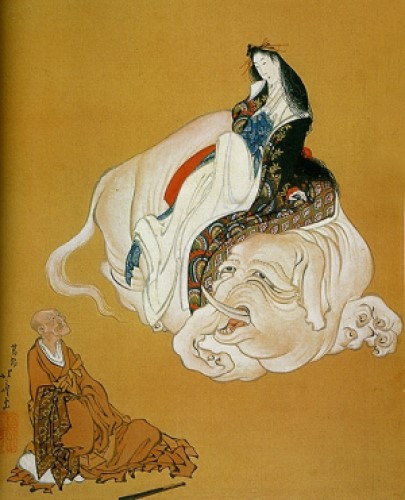
The Woman of Pleasure at Eguchi

Saigyo?


mlazar@middlebury.edu
test more read more

test more


mlazar@middlebury.edu
a q

omilutin@middlebury.edu
Test

ipentony@middlebury.edu
The Woman of Pleasure at Eguchi was an interesting short story that featured a female character who was portrayed in a very different light from most of the female characters we have seen so far this semester. Most of the women we have read about so far are written about in the setting of courtship, and are usually coming from an aristocratic background. However, this woman worked at a pleasure house, which implied to me that she was more likely a commoner. However, despite her background we see that she devotes herself to Buddhism and becomes a nun. Is this different portrayal of women a common theme across most of the Buddhist literature of the time period? If so, what does it say about Buddhist ideals and overall attitudes towards women more broadly?

pauls@middlebury.edu
The Life of an Amorous Woman, is one of the first true POV type readings that we have had in this class. It is told from first person, and as such, reads much different then our previous articles, which were more like stories being recounted by a narrator. However, the narrators of the different stories of The Life of an Amorous Woman are telling about their own experiences, which allows us to get insight into the thoughts of women living during the Edo period. It may be because of the change in perspective, but I also felt that this reading was better translated than the ones we had in the past. Is this going to be something we see improve as our readings get closer to the modern age? And is this due to the evolution of proto-Japanese into something more recognizable/closer to modern Japanese, that is easier to translate?

nleung@middlebury.edu
The theme of karma seems to be prevalent at this time due to Buddhist influences. In addition, the people during this period viewed everything as fleeting and were hence somewhat pessimistic towards life. In the story, the two characters don’t seem to be in a romantic relationship, but use poems to communicate. Has the function of poems changed from more of a tool for courting to a tool for everyday communication since it has become more popular amongst commoners?

mgamez@middlebury.edu
I thought that the Woman of Pleasure at Eguchi was a very interesting read. It played with power dynamics and misleading or underestimated expectations. The courtesan, who is initially judged by the priest for her lifestyle, turns the tables by demonstrating a deep understanding of Buddhist principles, challenging the typical view of her as morally inferior. This reversal of roles makes the story compelling, as it questions societal assumptions about wisdom and virtue. If this story suggests that spiritual understanding and enlightenment can come from those outside of traditional societal or religious roles, I wonder how this would challenge the way people during that time viewed authority and morality?

dennisl@middlebury.edu
I noticed in  "The Woman of Pleasure at Eguchi", that the Buddhist ideal of impermanence is referenced in the form of the "momentary lodging" poem. I am curious if this principle encompasses the concept of the woman's cycle of bad karma being "impermanent" because she was able to make a positive change in her life or if it only involves materialistic or tangible things such as the lodging.


mlazar@middlebury.edu

a res


omilutin@middlebury.edu

Test


daguilar@middlebury.edu


Linfamy. “The CRAZY Ways Japanese Courtesans Dealt With Pregnancies.” YouTube, May 22, 2021. https://www.youtube.com/watch?v=eKBNLBZWquc&list=PLOWnSFzV-C9Yi1N1cZ_u2v-ed5tNeBXaK&index=10.
This video by Linfamy offers an engaging and accessible introduction to historical perspectives on courtesan life in Tokugawa Japan (1603-1868), focusing on how pregnancies were handled in that context. The creator sources two scholarly works, Fertility and Pleasure: Ritual and Sexual Values in Tokugawa Japan by William R. Lindsey and Women and Class in Japanese History by various authors, to address questions like whether courtesans had agency in deciding to keep their babies, societal views on abortion, and the use of contraceptives during the period. Linfamy is known for presenting historical topics with humor and charisma, using a mix of essential information and lighthearted, sometimes irreverent, commentary. This style makes the material approachable for a general audience but may not appeal to those seeking purely academic or formal presentations. The video does a good job of providing historical context while simplifying complex ideas, making it a strong starting point for anyone curious about the topic. While the humor is a defining feature, it occasionally risks overshadowing the gravity of the subject matter. Still, the content remains informative, covering a broad range of questions and offering meaningful insights into gender, sexuality, and societal norms in classical Japan. This video is particularly useful for beginners seeking an entertaining yet educational overview of courtesan life during this period.


daguilar@middlebury.edu


Hix, Lisa. “Sex and Suffering: The Tragic Life of the Courtesan in Japan’s Floating World.” Collectors Weekly, March 23, 2015. https://www.collectorsweekly.com/articles/the-tragic-life-of-the-courtesan-in-japans-floating-world/.
This article gives a fascinating and focused look at the realities of courtesan life in the Edo period (1603-1868). It provides plenty of context to understand the era, touching on politics, fashion, gender roles, and societal expectations. At first glance, courtesans might seem better off than women in farming villages because they were well-fed, well-dressed, and often highly educated. However, the article explains how these privileges were part of an idealized illusion of the floating world (a form of escapism fostered by the entertainment districts in the Edo period, featuring courtesans, actors, musicians, and more), created and maintained by men who worked hard to promote it. Hix does a great job breaking down the layers of this illusion by showing how courtesans were celebrated for their education, ability to fake emotions, and cultural influence as fashion icons. But behind the glamour, they faced immense pressure to meet the expectations of the brothels and society, revealing the burden and suffering they carried. This article is easy to follow and doesn’t require much background knowledge to understand, which makes it perfect for anyone wanting to learn more about courtesan life during this period. While a lot of what’s covered overlaps with what we’ve discussed in class, I enjoyed how it used courtesan life as a lens to touch on so many different topics, from fashion to morality to gender roles. It’s a great read for anyone looking to explore the Edo period from this unique perspective.