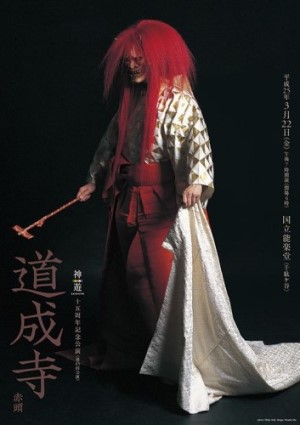
Dōjōji (Dōjōji Temple)

Kan'ami (written by), Zeami Motokiyo (revised by), Kanze Nobumitsu (sometimes attributed to)


A Play one must Read and Watch
mgromero@middlebury.edu
Nō theater evolved under the patronage of the Ashikaga shogun in the Muromachi period (1336 to 1573) as a political means for the shogun to gain cultural authority in Japan. This particular Nō play is a continuation of a 15th century tale known as the Dōjōji Temple Story, but the date when the Nō play ... read more

Nō theater evolved under the patronage of the Ashikaga shogun in the Muromachi period (1336 to 1573) as a political means for the shogun to gain cultural authority in Japan. This particular Nō play is a continuation of a 15th century tale known as the Dōjōji Temple Story, but the date when the Nō play Dōjōji was created is unknown. The Nō play is under the fourth class of Nō plays, mad-woman or sometimes referred to as miscellaneous plays, which is typically reserved for plays that do not fit the other types. The other classes being: God, man, woman, madwomen, and demons. The Nō play Dōjōji is believed to have been created by Kan'ami, famously edited by Zeami Motokiyo, though it is argued by some that Kanze Nobumitsu should be accredited. The cultural significance of Dōjōji alone grants an obligation for others to read the play, however, I find it a necessity to read the play in order to enjoy the stage play to its fullest extent. 

In order to dissect Dōjōji, we first need to understand the Dōjōji Temple Story, which was a tragic love story of a monk during his religious pilgrimage who fell victim to a lovesick woman. Those who surrounded her insulted her for believing that the monk was going to renounce his Buddhist teachings and Enlightenment for her. Despite the mockery, she endured she believed he would fulfill his promise of returning, but after discovering he had no intentions of returning she transformed into a serpent hellbent on finding him and enacting revenge by either forcing him to marry her or killing him. What happened was worse. She pursued him to the Dōjōji temple where he hid underneath a bell, coiling her serpent body around the metal bell, and as the priests prayed for her damnation as she burned, so did he. Not only that as she was banished into hell for her sins, so was the monk and they were both reborn as snakes, dragging the monk who was originally set to reach salvation back to the starting line, because of the infatuation of some woman. The story ultimately ends with, this is why one does and should not interact or talk with women. Not knowing this context will only lead to curiosity when in the Nō play Dōjōji, the abbot forbade women from entering the temple. He does so in order to avoid the spirit of this serpent from awakening and harming another innocent man. In this case, the victim was the monk as he had no input of the woman loving him, and falling subject to her punishment leads the audience to pity him. In the Nō play, however, while it falls under the category of mad-women, the audience cannot assign blame to the woman without debate. 

The Nō play Dōjōji opens with the abbot instructing two priests to prepare for the bell ceremony and prevent women from entering. A woman from a nearby village heard about the bell dedication ceremony and when the priests tries to stop her, explaining the abbot’s instructions. She hypnotizes the priests and jumps into the bell, causing it to fall and when it is lifted again, a demon is revealed to have taken her place. In the reading, this is the most confusing part to read, and watching the play is more impactful and impressive when one sees the shite, the title of the principal Nō actor, shoot up into the bell as it drops. To a regular audience, it is nothing more than a theatrical trick, but when knowing the Dōjōji Temple story, the viewer understands the importance of the bell, as well as any appreciator of Nō plays, knows that the performance of Nō play Dōjōji is required for an actor to know before they are considered a master. Why? Because the act of jumping into the bell is far more impressive when learning the small details behind it. One, the bell is heavy, extremely so, that the shite risks serious injury and death when jumping. Actors are trained specifically to do this climate performance act and the Nō play Dōjōji is the only Nō play where the shite can change their attire by themselves in all of Nō plays, which is culturally a huge responsibility considering the strictness in rules mandated by Zeami and the shogun in Nō plays. The act of a demon emerging from the bell as it is being lifted, also reveals the mastery of the actor, who likely dedicated years in order to perform the shite role. Nō plays like Dōjōji attract massive audiences because of the mastery of the actors. 

In conclusion, theatre is meant to be seen and the Nō play Dōjōji is no exception as its nuances are best appreciated on stage, however, the reading of the play provides context through the Dōjōji Temple Story. I recommend reading and watching Nō plays because of their drama and sensationalism, but the Nō play Dōjōji is special because it is a classic and far more complex than one originally thinks. In order to understand how so, one must read and watch the play.


Total Votes : 1 Vote Up Edit Reply


xz2@middlebury.edu

The play of Dōjōji is different from the previous version we read. The woman is no longer a widow seducing the monk. The cause of the tragedy in the play is a joke of the girl's father, "Some day that priest will be your husband, and you will be his wife! (248)" The priest turned the girl away with a joking answer, too. What's the literary significance of this change? Does it humanize the character?


kmacalintal@middlebury.edu
 

The plot of the Noh play "Dōjōji" seemed to be motivated around the bell in the Dojoji temple. What does a bell in a temple usually stand for or symbolize? What is the significance behind the woman/dancer/serpent inhibiting and taking the bell down? Does the woman's choice to showcase herself as a dancer make a statement about the relationship between art and manipulation?


mgromero@middlebury.edu
 

I noticed the recurring event of women assuming the consequence of death whether or not they were at fault. However, it is my understanding in Buddhist teachings, death is part of the cycle of rebirth and not a punishment, is it intentional that women go through literal hell or become demons and are prevented from continuing the rebirth cycle?


mgromero@middlebury.edu
 

In the "How a Monk of the Dojoji," the transformation of a woman into a snake reminded me of the Bible and the story of Adam and Eve, which many justify the treatment of women based on Eve's betrayal. Though returning to our general theme of gender in Japanese literature, is there anything in Buddhism that suggests women are evil and perceptible to deception. As we see in all our readings, women have certain freedoms and the emperor was a descent from a goddess, yet women are still targeted and portrayed as objects as if to control that temptation correlating to evil. Or perhaps was this a trend that began in order to further limit women in social life and therefore justify the rule of men?


nzambranoromero@middlebury.edu
It was interesting to see how a shift in writing to be more focused on the life of the commoner, as mentioned in the reading. I thought that it was interesting that the latter half of the medieval period involved movement into provincial cultures, and away from war and violence. I thought it was an interesting transition, considering earlier readings were largely focused on violence and war. I am curious as to how people transitioned into this new form of art. We've read how a lot of the earlier texts were used to learn the structure and standards for writing. Was it the same case for nō plays? Lady Aoi, for instance, was one of the first nō plays and it draws off a scene from the Tale of Genji, apart from the reference to the tale, how were people able to understand what was happening since it was such a novel thing?

jlegido@middlebury.edu
As I read I was able to sense a different shift in themes/concepts from these readings in comparison to the ones from the previous weeks. There now seems to be a lot of deception and it feels like the stories are a bit more "dense" to read. I really enjoyed the imagery, especially in "How a Monk of the Dojoji"; what stood out to me in particular, and to some of my classmates, was the woman becoming a snake, which immediately made me think of Christianity, specifically Adam and Eve getting deceived/manipulated by the snake. Is there any symbolism behind the snake in Japanese culture? Is it evil or was it just used as evil in this story? Is there a connection to religion?

axzou@middlebury.edu

In the Noh excerpts "The Sought-for Grave," "Komachi and the Hundred Nights," "The Iron Crown," and "Dōjōji," the female characters are often depicted in intense emotional states, particularly surrounding jealousy, obsession, and revenge. Connecting it back to what we've discussed in class, does it seem like these characters are victims of their own emotions, or do they exert some form of agency within the constraints of their narratives?


jcruzmendez@middlebury.edu
In the Dōjōji, it was interesting to see a connection with the text we've read before. I consider it to be a follow up, "what happened after?", to the previous text--about the serpent wrapping itself around the bell with the priest inside. In the Dōjōji it explains the backstory (previous text) to explain why women were allowed to the courtyard.

lmcnamara@middlebury.edu
 

In The Sought-For Grave, Unai is condemned to suffer for the deaths of her two lovers, even though she did not directly cause their tragic fates. This situation raises questions about how audiences perceive her suffering—whether it elicits sympathy or reinforces the stereotype of women as sources of misfortune. The symbolism of Noh costumes, where colors and patterns carry specific meanings, suggests that Unai's attire could influence viewers' interpretations of her character. How might the symbolism in her costume shape the audience's reaction to her suffering? Would it invoke empathy or justify her punishment?


nleung@middlebury.edu
I was wondering why these noh plays tend to be so dramatic. Could it be related to the fact that we have transitioned now to a samurai culture where all men are prepared for war and death so they perhaps have a more melancholic mindset?

as5@middlebury.edu
Reading the "How a Monk of the Dōjōji in the Province of Kii Copied the Lotus Sutra and Brought Salvation to the Serpents," I was disturbingly intrigued by the portrayal of the woman who housed the two monks. The story reminded me of The Tale of Genji, in that the supernatural is present through negative emotions. Similar to how Yūgao suddenly passed away, seemingly from the jealous spirit of Genji's former mistress, the widow in this story also passed away due to her desires not being fulfilled and the promise to her having been broken. Although the causes of the deaths are different in each story, the harboring of negative emotions either from the individual or a third party seems to be the catalyst for "judgment" being handed. It makes me wonder, how big of a role does this idea of the supernatural or  "karma" play in Japanese culture?

dennisl@middlebury.edu
I noticed in most of the stories there were minimal stage directions (mainly just moving around and looking in different directions) and there weren't any set changes mentioned. I was wondering if this simplistic approach is reflected in all or most Nō dramas and if so is the appeal of this genre mainly in the dialogue?


mgromero@middlebury.edu

A.Jackson, Reginald. "Desiring Spectacular Discipline: Aspiration, Fraternal Anxiety, and the Allure of Restraint in Nō's Dōjōji." Asian Theatre Journal : ATJ 36, no. 1 (Spring, 2019): 49-78. http://ezproxy.middlebury.edu/login?url=https://www.proquest.com/scholarly-journals/desiring-spectacular-discipline-aspiration/docview/2188100378/se-2?accountid=12447.

In this work, the author tackles how the male-dominated identity of Nō dramas, “magnif[ied] misogyny, [by] reinforc[ing] sexual differences [and male bonding].” The idea of male supremacy falls apart when taking into account women’s contribution to literature and their needed presence on the stage. However, the Muromachi period’s strict binary sex rule prevented women from participating in social practices as they used to. Though that did not remove the nature of sexual desires that persisted throughout art practices in Japanese history. Nō theatre became a place that fed into the sexual desires of men through professionalizing the female identity, which translated into ambiguity in attire, mannerisms, and performance. Ultimately to appear lustful and satisfy the audience’s curiosity; and by embodying a taboo the theatre justified women’s demonization, on their female or sexual nature. There are five categories in Nō plays, three of which women are a part of the main cast. They are always left with the villain image or being susceptible to evil. Nakasone, one of the fellow authors Jackson used, made an interesting note that, “the women who fall into the Blood Pool of Wickedness ‘are those who defy men and cause them inconvenience-revealing the true sentiments of a male-centered society (pg.68).’” The portrayal of women as demons is due to the misogynic community of the Nō community that blamed their lustful desires onto the image of women. For this narrative to persist the theatre excluded women from joining the stage, tailoring their art education to selective Waka examples, and training men to embody femininity. 

B.Lina, Nurul and Fauzi Naeim. "Kawamoto's Dojoji Temple: Puppetry, Gesture and Myth/Kawamoto Del Templo Dojoji:Títeres, Gesto y Mito." Arte, Individuo y Sociedad 27, no. 3 (2015): 501-513. doi:http://dx.doi.org/10.5209/rev_ARIS.2015.v27.n3.46603. http://ezproxy.middlebury.edu/login?url=https://www.proquest.com/scholarly-journals/kawamotos-dojoji-temple-puppetry-gesture-myth/docview/1777508497/se-2.

This article explains the use of puppetry to tell the Dōjōji Temple story and its impact on the message of the play, however, in respect to the Nō play Dōjōji, it serves as background about the tale of the first woman who became a serpent and attacked a monk at Dojoji Temple. Most of the article’s analysis about theatre is not as helpful. However, the summary of the Dōjōji Engi Emaki explains the abbot in Nō Dōjōji’s decision to forbid women in the temple. The temple was the setting of a tragic story, where a woman felll in love with a monk and attempted to seduce him, and proposed marriage. However, the monk was set to devote himself to the path of Enlightenment and instead gave her a Buddha statue claiming he would be back and as she waited, through the mockery of others, she discovered he lied to her. The village blamed her for her “stupidity” for falling in love with a monk and was set to find him despite the bleeding, humiliation, and anger she endured. Once she found the monk willing to give himself to religion, but not her, she transformed into a serpent and chased the man to the Dōjōji temple, where he hide in a bell, which as she burned, she set fire to the bell at the same time, burning him alive. A tragic tale for the monk who fell prey to the lovesick irrational woman, but it further illustrates the continuity of women being unable to control their emotions and seeking repercussions. When the new bell was set to be installed in Nō Dōjōji, the priest wanted to avoid reawaken this spirit from harming another innocent man, so he banished women from the ceremony. 


C.Rood,Benjamin.“NohDojoji-YouTube.” Youtube, uploaded on 2000. Accessed on Novemeber 29, 2021. https://www.youtube.com/watch?v=MLu9927A8YQ.

The video is a live performance of the Nō play Dōjōji, which in most plays provides a more insightful perspective into the work than script writings ever could. Personally, it made the script make more sense, in the sense that I was able to see the actor vanish into the bell by jumping in and reappear as a demon through a costume change. Since the reenactment is in Japanese, non-Japanese speakers would have a difficult time knowing what is happening in the play if they did not have previous knowledge of Dōjōji. Reading the play beforehand and then watching this video makes for the best encapsulation of the play. Witnessing the panic of the abbot and servants makes sense when you read the initial instruction the abbot gave to not allow women for the dedication service because of the story of a previous demonic woman. The live stage play explains certain actions described in the script that delivers a more impactful message by watching it play out, while the script provides details newcomers to the play would not have.  

D.Umeno, Jasmine C.E., "The Demonic Women of Premodern Japanese Theatre" (2015). Scripps Senior Theses. 708.https://scholarship.claremont.edu/scripps_theses/708

The author, like others, delves into Dōjōji’s “gendered power relations.” Their take is how priests and temples are institutional systems that aid women in gaining salvation regardless of whether they become demons or monsters in the Enlightenment process. In the Muromachi period, women’s role was strictly set and Buddhism reflected this ideal by claiming women were tainted and inherently vessels for evil, which Nō plays portrayed women as something to be cautious of. Nō plays historically were written, acted, and dedicated for and by men, so the patronage of plays similar to the Dōjōji is not a surprise. Umeno claims the act of pretending to be a dancer to enter the sacred grounds is an act that demonstrates religious devotion and dependency from women to the temple for salvation. While she dies in the end, her path to Enlightenment is granted because her death means she can be reborn as a man. Umeno emersed herself into Muromachi Buddhist ideas and revealed that Dōjōji is an anomaly among the Nō plays because women can reach salvation through death.