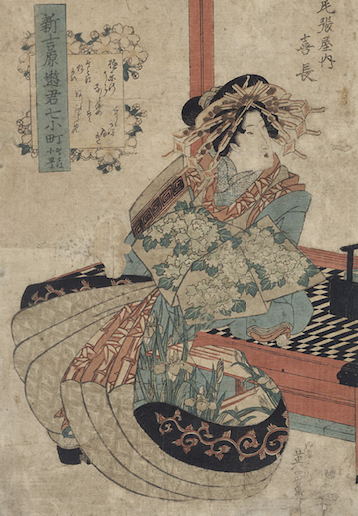
Kayoi and Sotoba Komachi
The two plays Sotoba and Kayoi Komachi are centered on Ono no Komachi, a legendary waka poet of the Heian (roughly 800-1200CE) Period. She gained great renown not only for her her poetic skill but her beauty also. Not much is known about her actual life, but this lack of knowledge did not doom her to obscurity; rather, the disconnect between her biographical details and her literary persona have made Komachi the construct unforgettable. The stories and rumors surrounding her person have, over time, coalesced and turned Komachi into a literary archetype of her own.
This effect is clearly shown in the two plays Stupa Komachi and Sotoba Komachi. These two plays, authored by the legendary Kan'ami in about 1350CE (500 years after Komachi lived!), take the image of Komachi the beautiful and turn her into Komachi the aged and withered. By using her character this way Kan'ami explores the Buddhist concept of mujō: the concept of impermanence. The two plays are as follows:
In Sotoba Komachi, two monks who encounter an old woman sitting on a stupa, an old wooden Buddhist carving, in the mountains. The monks confront the woman, saying that sitting on the stupa is disrespectful to the Buddha. The woman then reveals herself to be Ono no Komachi, a poet famous for her skill and beauty. After a witty religious debate Komachi becomes possessed by the spirit of Fukakusa, a former suitor Komachi rejected. Possessed, Komachi reenacts their relationship: Komachi said that she would only love Fukakusa if he journeyed to her home for one hundred nights in a row, but Fukakusa died on the 99th night, leaving the promise unfulfilled. After the fit of madness Komachi reaffirms her devotion to Buddhism.
In Kayoi Komachi, a mysterious old woman brings daily baskets of fruit, nuts, and firewood to a Buddhist monk. Intrigued, the monk inquires about her identity and is shocked to learn that she is the ghost of Komachi. The monk then goes to pray for her, but when he does, she is possessed by the spirit of Fukakusa. Together, they recount their story for the monk, and in the end, moved, the end the monk releases both from their attachment to the world and set them free to be reborn.
Though this is a book review, not an analytical essay, I think the most valuable takeaway from these two plays is the analytical essay part. The stories aren't particularly exhilarating nor the performance (Nō plays are famously slow), but they do show us the fascinating relationship between authors, their muses, their characters, and how they change over time. Isn't it fascinating how ancient Japanese authors saved the real Komachi from being forgotten but also, over time, constructed a Komachi completely different from the original? Furthermore, the Komachi character has continued to evolve; Mishima Yukio, a famous post-WWII Japanese playwright, has recast a number of ancient Nō plays for a modern period, among them Sotoba, which was in turn influenced by the Japanese defeat and Nietzschean philosophy.
So in the end, I wouldn't actually recommend reading either of the Komachi plays; I believe the most interesting thing about them lies not in the actual words that they are made of, but the processes that have led them to be written in the way they have. Maybe just skim the plays to understand what the essays (or book reviews) about them have to say about Japanese literature as a whole.
Bibliography:
Broma-Smenda, Karolina. "How to Create a Legend? An Analysis of Constructed
Representations of Ono No Komachi in Japanese Medieval Literature." IAFOR Journal of Literature & Librarianship 3, no. 1 (2014): 1-24 doi:10.22492/ijl.3.1.03.
Broma-Smenda explores the construction of Ono no Komachi as a literary archetype in this essay; as there are remarkably few accounts of Komachi's personal life, Broma-Smenda argues for the divorce of her biographical and literary identities. This allows writers to use her character to explore themes such as karma and female enlightenment. I think this is a very useful way of analyzing texts mentioning Komachi; it allows us to move beyond debating the technicalities of her life and begin analyzing the influence her name has had in Japanese literature. Furthermore, Broma-Smenda argues that she also becomes a symbol in Buddhist literature, as the leitmotif of Komachi's withered beauty becomes a symbol for Buddhist mujō, or the impermanence of everything worldly, just like their paintings of the decaying female corpses.
Kim, Junghee. "Mishima Yukio’s Modern Noh Play Sotoba Komachi: Nietzsche’s Influence and the Ideal Post-war Artist." Sungkyun Journal of East Asian Studies 18, no. 2 (2018): 245- 62. doi:10.21866/esjeas.2018.18.2.006.
Kim writes not of the ancient version of Sotoba Komachi but of a modern eponymous version. The playwright, Mishima Yukio, sets this version of Sotoba in a park. A 99-year-old woman begins gathering cigarette butts and is admonished by a young poet; after debate, she is revealed to be Ono no Komachi, and the two are transported into a dinner party of the distant past. Komachi also appears to be young and beautiful. Shocked, the poet falls in love with Komachi despite her warnings. The poet then realizes that he will never again feel the ecstasy of falling in love; he swears to meet her again in 100 years and dies. The setting then reverts to the park; a policeman finds the withered Komachi standing over the poet's dead body and scoffs when she claims that the poet was making advances to her.
Kim claims that the ancient version of Sotoba has an unclear meaning and that Mishima incorporated Nietzsche's Birth of Tragedy into the modern version. Though I disagree with his first claim—other scholarly works have convinced me that Sotoba functions as a Buddhist fairy tale teaching people about the impermanence of worldly beauty—it was interesting to learn about Nietzsche, who I had not read about before. Kim argues that, while influenced by the Japanese defeat in WWII, Mishima sought to combine logical reason (what Nietzsche called the Apollonian) with passionate emotion (the Dionysian) in art. To that end, Mishima revises Sotoba Komachi and depicts Komachi as the Apollonian force of rationality while complementing her with the male poet, a representation of the Dionysian haze of instinct and emotion. Though it was interesting to learn about a modern rewriting of this play, I am too unfamiliar with Nietzschean philosophy to refute or comment on this argument.
Thornton, Peter. "Monomane, Yugen, and Gender in Izutsu and Sotoba Komachi." Asian Theatre Journal 20, no. 2 (2003): 218-25. doi:10.1353/atj.2003.0031.
https://www-jstor- org.ezproxy.middlebury.edu/stable/1124599?seq=1#metadata_info_tab_contents
In "Monomane", Thornton analyses gender change in Noh plays. He posits that the climactic point of Noh plays is always accompanied by the transformation (henshin) of a main character (shite). Drawing on Judith Butler's theory of gender performativity, he defines gender as "a set of repeated and ritualized actions" which congeal into identity. He claims that when Komachi is possessed by Fukakusa in Sotoba, she changes from a woman to a man; not only do the lines of the actor deliberately obfuscate the identity of the character portrayed, but the actor actually changes costume to shed physical representation of Komachi's gender. This analysis was revelatory to me because I, having not watched the play, did not know about the costume change. Finally, Thornton also draws a parallel with The Well Curb inspired by the Ise Monogatari; he explores the female to male transition the daughter of Ki no Aritsune undergoes when she puts on the clothing of her long-dead husband, Narihira.
Strong, Sarah M. "The Making of a Femme Fatale. Ono No Komachi in the Early Medieval Commentaries." Monumenta Nipponica 49, no. 4 (1994): 391 - 412. doi:10.2307/2385255.https://www.jstor.org/stable/pdf/2385255.pdf?refreqid=excelsior% 3A0f0b37618965313d18fcaf5dca344c7c
Strong's article explores Komachi not as the typical symbol of impermanence but as a femme fatale. She notes that the real Ono no Komachi had no reputation for coldness, drawing on the Kokinshuu. Yet, over time as different stories collapsed upon one another, she gained this reputation. By the time medieval commentators began writing about the Ise Monogatari, they depicted Komachi as an archetype of unreciprocated affection. Though I agree that the Komachi symbol does have a dimension of femme fatale, I think the main archetype associated with her is rather with fallen beauty and the Buddhist concept of impermanence.