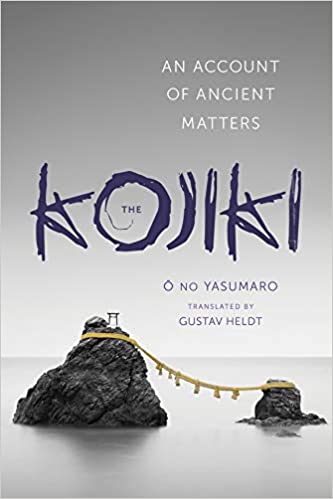
For those who enjoy mythology and wildly creative, imaginative legends, the Kojiki of ancient Japan is a fantastic read. Also known as Record of Ancient Matters, the Kojiki is a chronicle of mythologies that encapsulates the origins of Japan. The book was completed in 712 for the empress by a scribe of the court named ...
read more
For those who enjoy mythology and wildly creative, imaginative legends, the Kojiki of ancient Japan is a fantastic read. Also known as Record of Ancient Matters, the Kojiki is a chronicle of mythologies that encapsulates the origins of Japan. The book was completed in 712 for the empress by a scribe of the court named O no Yasumaro. As a whole, the Kojiki consists of several myths, which all together construct a story of the creation and development of Japan, spanning from the world of the gods in heaven to the descent to earth of the ancestors of the imperial family, through the reign of the first thirty-three sovereigns (Shirane, 29).
Book 1 introduces the reader to the Japanese creation myth, in which central characters appear. Namely, these are the deities Izanami, “She Who Invites God” and Izanagi, “He Who Invites God,” who later give birth to the noble children Amaterasu, “Great Heaven-Shining Goddess” and Susano-o, “Ferocious Virulent Male God” (Shirane, 31). The interactions between these characters, often tumultuous and tense, set the tone for the book, which is highly gendered and reflective of modern-day gender roles in Japan.
Despite this gendered theme, throughout Book 1, the concept of femininity is explored in different ways through Amaterasu and her relationship with Susano-o. Amaterasu is first introduced to the narrative as a warrior goddess, who faces Susano-o with “a tremendous war cry” as he ascends to the heavens to her domain following his expulsion by Izanagi (Shirane, 34). On the other hand, Susano-o is characterized as a selfish troublemaker, who only causes problems for his sister. His antics are put starkly against the ideas of femininity when he causes one of Amaterasu’s weaving maidens to strike her genitals against the shuttle and die, terrifying Amaterasu (Shirane, 35).
Nonetheless, the compassion, curiosity and overall humanness of Amaterasu’s character makes her quite likable, and for that reason she is my favorite figure in Kojiki. Indeed, although Amaterasu is introduced to the story as fierce, her character proves to be multidimensional. When Susano-o rampages through her domain of High Heaven, she does not reprove him and instead posits that he was doing these things for justifiable reasons, “hoping for a remedy” (Shirane, 35). Nevertheless, she does eventually become afraid of her brother’s actions and hides herself in the Heavenly Rock-Cave, drowning Heaven in darkness (Shirane, 35). The relatable emotions of anger, compassion and fear that Amaterasu exhibits foster an image of the deity as both divine and human.
One of my favorite parts of the story follows Amaterasu’s experience in the cave. Although slightly explicit, the scene when Amaterasu is drawn out of the cave by myriad deities of Heaven was fascinating. In an effort to restore light to Heaven, these deities put on a scene, and one of them exposed her chest and genitals as “the Plain of High Heaven sh[akes] as the eight hundred myriad deities [laugh] at once” (Shirane, 36). Curious and confused, Amaterasu peeks out from the Heavenly Rock-Cave to see what the matter is, and the deities pull her out of the cave and block the entrance. This scene exemplifies Amaterasu’s hummanness through her wide array of emotions.
One of my least favorite scenes is when Susano-o claims to be victorious following his and Amaterasu’s creation of female deities. Asserting that it was because of his good intentions that the “graceful maidens” came into being, Susano-o rages victoriously through the land of Amaterasu, “defecat[ing] and strew[ing] his feces in the hall” and “breaking down the ridges of Amaterasu’s rice paddies,” which instills fear in the Sun Goddess (Shirane, 35). As a whole, this scene displays the unjust power relations that existed between men and women, transcending sibling relationships.
The themes that appear in the Kojiki are quite similar to those found in Greek mythology, and thus I would recommend this collection to those who enjoy similarly ancient writing. However, like any mythology, it is not an easy or light read– the timeline and concepts can be confusing, the themes of genital mutilation and incestuous relationships can be uncomfortable, and the text requires time and careful consideration. For this reason, those who have a deep interest in Japanese literature or want to learn more about the origins of Japanese culture would enjoy this anthology.