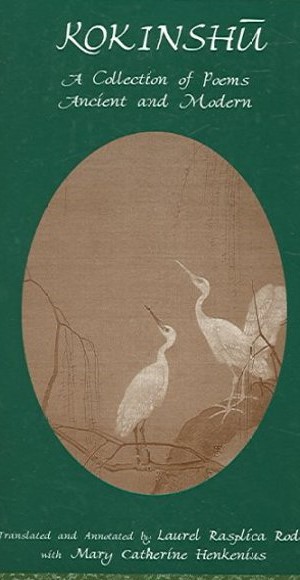
Kokinshū (Collection of Japanese Poetry Ancient and Modern)

multiple authors


Like Drops of Dew on a Page
aubriannaw@middlebury.edu
Have you forgotten the beauty of the world and lack the energy to go outside?   If so, the Kokinshū, classical Japanese poetry, will transport you into the heart of nature where you may reconnect with humanity’s purest emotions. Intended to legitimize the Heian imperial power within the aristocracy, in roughly the year 905, many authors ... read more

Have you forgotten the beauty of the world and lack the energy to go outside?  

If so, the Kokinshū, classical Japanese poetry, will transport you into the heart of nature where you may reconnect with humanity's purest emotions. Intended to legitimize the Heian imperial power within the aristocracy, in roughly the year 905, many authors compiled the poems into a temporal arch which will guide you through a journey from poem to poem. Rather than following characters, we experience the seasons, travel, love and mourning in the memories of others that we all can relate to. This anthology will remind you of what you have forgotten, teach you lessons, and spark questions for self growth.  

With such few words, these poems are full of life. Within the spring section, we are confronted with the impermanence of life’s energy as we wish to pause time and prevent the decay of the world’s beauty (KKS 69, 70). As we venture into autumn, we are reminded to appreciate the “drops of dew” as if they are a “thread of jewels” (KKS 222). I actually went apple picking a few days after reading all about the dew and truly, never have seen dew in such beauty before. Truly, I recommend reading the seasonal poetry and then going to admire nature. Once you have frolicked in a garden of roses, you should cozy up inside next to a roaring fire and read about boats whisking you away into a far away land (KKS 409). After you have day-dreamed about escaping your responsibilities,  you may remember that special someone that made you spite the dawn for having to part (KKS 635, 636). They leave you in such a daze that you smile, questioning whether you’re living a dream or reality (KKS 637, 639, 640, 645). Lastly, if it’s not too late, you can empathize with the vulnerability of mourning with the poets who have passed themselves (KKS 832).  

The poem's few words give you the agency to let your imagination paint the image you need most in the moment. You are the main character, guided by the poems, exploring your own story. I most appreciate the Spring poems, which taught me lessons I didn’t know I was searching for. I struggle with accepting regret. I envision a beautiful life as one absent of regret. And yet, I understand the poem below as a cherry blossom’s beauty stems from it passing without regret as the world would be a darker place if they never passed at all. Today, we spend so much energy trying to prolong life and prevent our inevitable fate, although this piece makes me wonder whether the magic of life only exists because of the ever approaching fall.  

nokori naku 

chiru zo medetaki  

sakurabana 

arite yo no naka  

hate no ukerebaif  


It’s their falling without regret 

I admire— 

Cherry blossoms: 

a world of sadness 

they’d stayed.  

 Anonymous 

I, like so many of us, have detached myself from nature. I barely remember to go outside yet alone appreciate the “drops of dew” (222). And yet, after reading the Autumn poems, I’ve sought out dew. Admiring fresh dew drops on an apple tree, I feel pulled to write my own verses. My favorite part about this poetry anthology is that it feels universal and it’s common threads are important. I believe that anyone who reads this will connect to some of the poems in ways that will help them grow. I appreciate many of the Kokinshū poems: ones that spark new discoveries or ones that help me to remember to appreciate the little things. There are some poems that I don’t feel I connect with, but I believe others will.  


The Kokinshū can be difficult to interpret at times without basic knowledge of the culture and context of classical Japan. It feels as though the more you understand, the more you are able to identify the references in the poems. However, I believe that if someone were to read it without any prior knowledge, they would be able to enjoy and learn from the text, just with more help from their imagination. I also only read an excerpt of the anthology and thus, I believe you can read as much and as little as your heart desires. A benefit of reading the piece in its entirety is that you’ll be able to get more of a sense for the artistry that went into collaging the works of art into a cascading story of the progression of time. If you have a minute or a day, I believe you get more out of this reading than you give. Ultimately, the Kokinshū deserves four out of five cherry blossoms. It might even inspire you to write some waka, Japanese poetry, yourself. 

Total Votes : 2 Vote Up Edit Reply

A Poetic Language of Love within the Kokinshū: A Collection of Ancient and Modern Poems Review
kngai@middlebury.edu
“On a moonlit night / Indistinguishable is / The plum blossom – / By scent, then seek it, / And you shall know it well.” This is just one of the thousands of ravishing poems that reside within the Kokinshū. The Kokinshū is an early anthology of the waka form (31 syllable Japanese poems) of Japanese poetry that was created in ... read more
  • “On a moonlit night / Indistinguishable is / The plum blossom – / By scent, then seek it, / And you shall know it well.” This is just one of the thousands of ravishing poems that reside within the Kokinshū. The Kokinshū is an early anthology of the waka form (31 syllable Japanese poems) of Japanese poetry that was created in 905 and was one of the first of 21 imperially commissioned poetic anthologies in this period. A collection of ancient and modern poems that incorporated ironic wit and ratiocination that has been read as evidence of sophisticated awareness of the discrepancies between language and reality. The Kokinshū contains 1,111 poems across 20 books on themes ranging from love, seasons, and seasonal change, to travels, and parting. Although it was the first anthology to "divide" itself into seasonal and love poems, many of the topics overlap one another to fully emphasize the impressions authors were attempting to present. 

    The poems within the Kokinshū were written by aristocrats for aristocrats, thus, much of the language is used to represent life in this Heian court era. Lower-class members of society would not be able to read let alone even have access to this type of literature. One poem that particularly stood out for me was the 71st poem by an anonymous author reads “It's their falling without regret / I admire – / Cherry blossoms: / a world of sadness / if they'd stayed.” This poem integrates many of the themes that make up waka poetry in its emotional, loving, and sensitive portrayal expressed through natural and seasonal motifs. In modern days, we tend to seek attractive physical looks and personality traits, however, this was not the case in the romantic aristocratic Heian era. 

    Courtship methods instead were revolved around "poetic exchanges" and how both men and women were able to convey their depths of sentimental desire and or lust. The ability to be in touch with your feelings and able to deliver them effectively was a rather important quality, contrasted to many of today’s views on male masculinity, and a lack of this poetic talent would affect one's reputation and decrease the other's amorous desirability. Another poem delicately demonstrates this reading “A mountain cherry / Through the drifting mists / Faintly / Seen thus there is a lady / I long for all the more.?” These kinds of poems along with the several nature-focused poems such as the one mentioned prior were able to touch upon aspects of an individual’s yearnings. Much like the longing of finding the love of one’s life, the eagerness for winter’s perish was present, and with this, the spring transition and blossoms falling connects to the fundamental constant change our world and lives undergo. The fact that blossoms are bound to fall and die, partaking in the cycle of life and death, is what makes them so beautiful and admirable, much like one’s beginning, middle, and end stages of love. A fragile beauty would be diminished soon, forcing us to better appreciate the intricate details of this world and its gifts like the people we love. 

    The emergence of kana literature in the first period of the Heian era was marked by the continued prominence of Chinese-based literature and culture and gradual introduction of native vernacular and cultural forms, particularly court-based vernacular literature written in the kana syllabary. This surge in kana's popularity became integral to everyday aristocrat life and eventually assimilated the rise of women writers. The writing system enabled Japanese people, especially women, to write more easily in their own language. Although its main contributor, Ki no Tsurayuki, defines the role of waka, aristocratic women like Ono no Komachi adopted this native syllabary as their first language and used it to write diaries, memoirs, and poetry such as her work in the Kokinshū. Despite the fact that Tsurayuki actually critiques Komachi's poetry stating “Her poetry is moving and lacking in strength…Its weakness is probably due to her sex (McCullough 1985, 7), 18 of her poems were able to make an appearance in the Kokinshū. They are strongly associated with notions of love, and she was able to successfully prove her strengths and the significant contribution female poets made to the waka tradition. 

    Personally, I would highly recommend many of the poems in the Kokinshū. They give insight into Heian poetry customs, mannerisms, traditions, and simply what life was like in a lyrical, heartful manner. While the importance of aristocratic romantic courtship is highlighted, love is only represented as the main central idea in a small number of books that make up the Kokinshū. Other poems in the other books feature other regards to Heian society that play an equally or even larger importance. 


    Works Cited 

    McCullough, Helen Craig, and Tsurayuki Ki. 1985. Kokin wakashū: the first imperial anthology of Japanese poetry : with Tosa nikki and Shinsen waka. 

Total Votes : 0 Vote Up Edit Reply

The Kokinshū: A Raw and Captivating Anthology
fgruson@middlebury.edu
A literary masterpiece, compiled and edited at the height of the Heian Period (784-1185), the Kokinshū (905) captivates its readers with tonal and written beauty through waka poetry. The Kokinshū is divided into 20 books, each of which is attributed to a poetic topic such as love, seasonal change, and mourning. Unlike the vast majority ... read more

A literary masterpiece, compiled and edited at the height of the Heian Period (784-1185), the Kokinshū (905) captivates its readers with tonal and written beauty through waka poetry. The Kokinshū is divided into 20 books, each of which is attributed to a poetic topic such as love, seasonal change, and mourning. Unlike the vast majority of literary works in 12th century Heian Japan, the Kokinshū invites poets to express their raw emotions in vast array of waka. Waka is a 5/7/5/7/7 poem. Although there is usually no protagonist character within lyrical waka poems, the organization of the Kokinshū provides thematic consistency for the reader. Poems about a specific topic, not even written by the same author, would build off of each other and provide further insights into the topic. The Kokinshū’s gentle, raw, and emotional presentation of waka poetry transports the reader to life and culture of Heian Japan.

The overarching theme that I found most compelling was love. Through love poetry, poets in the Kokinshū were given freedom to express their emotional vulnerability, loneliness, or even despair. Arguably the most notable poets who wrote about love in the Kokinshū was Ono No Komachi (825-900). Although little is known about her life outside of poetry and her role at court, Ono No Komachi’s poetry shows her embodiment of the passionate women in female Japanese poetry. Unlike many other poets during the Heian period, she does not write about waiting for a lover. Instead, she uses her dreams as a means to show her sexual desire. Throughout her waka poems, she evokes an authentic and captivating voice. This voice, both vulnerable and powerful, impacts the reader while reading her work. Although I could not always relate to her woes with love, her writing style gave me a window into her life in Heian Japan.

            As you read the Kokinshū, one cautionary note is that there are several ways to understand the meaning of a poem in the anthology. That being said, it would serve the reader well to be open to more than one interpretation. Every scholar that focus on this anthology has had his or her own interpretations. Therefore, as a reader, one should not force one specific reading of a poem if you do not feel comfortable accepting it. Especially since the anthology was written several centuries ago, cultural changes and translation choices can heavily influence how a certain poem is read.

            To summarize the poems I have read from the Kokinshū in two words, I would say “gentle beauty.” I have never read a collection of poems in which I have felt so vulnerable and empowered through Heian poets’ expression of various themes. The Kokinshū puts the recurring theme of impermeability under question while incorporating the beauty which life offers. Just like any great literary work, the Kokinshū expands the reader’s world views. In particular, Heian Japan comes to life in the Kokinshū. If I were to use a rating system to rank this text, I would not hesitate to give it a 9.5/10.

Total Votes : 0 Vote Up Edit Reply

An Anthology Anyone Can Relate To
kmacalintal@middlebury.edu
The Kokinshū is a carefully crafted piece of art that can help a reader make more sense of the world around them. Edited and compiled in the early tenth century, this collection of 1,111 Japanese poems takes the reader on a journey to explore topics from seasons to love and loss. Most of the poems ... read more

The Kokinshū is a carefully crafted piece of art that can help a reader make more sense of the world around them. Edited and compiled in the early tenth century, this collection of 1,111 Japanese poems takes the reader on a journey to explore topics from seasons to love and loss. Most of the poems included in this collection take the form of waka, which is a 31 syllable Japanese poem whose measures follow the pattern of having 5, 7, 5, 7, and then 7 syllables. The editors of this collection strategically arranged the poems for reasons varying from highlighting a temporal progression to altering older anonymous poems by juxtaposing them with more contemporary authors. By placing poems that describe similar events or themes next to each other, the editors encourage readers to view these originally unrelated poems in relation to one another. Through this special arrangement, the reader is not just able to study observations on seasons, travel, love, or death, but can also develop a deeper understanding of each topic with one another. 

Of the topics touched upon in the Kokinshū, the ones focused on seasons are my favorite. Through the descriptive observations and honesty of the narrators, the reader can re-experience all the emotions and common thoughts associated with the changing seasons. They are reminded of the sadness when flowers wither and the frustration when temperatures and calendars do not exactly line up. To be more specific, poems 70 and 71 resonate with me differently. Poem 70 describes an event where the narrator witnesses cherry blossoms falling from their tree, wishing they could stay longer. Poem 71 naturally builds from the previous one, using similar imagery and continuing to describe the event of falling blossoms. It describes the newfound thoughts of the narrator as they begin to draw larger conclusions and meaning from the flight of these blossoms. While both of these poems are placed under Spring 2 of the Kokinshū, I think they can be read as more than just an observation of the season. These poems do more than just bring the reader back to the spring season to witness its progression; they encourage one to think more about the preciousness and purpose of impermanence. As a whole, through the events described in them and the careful language that does so, these poems, similar to many others in the collection, can help someone better understand the beauty of life and the purpose of death around them. 

“KKS 70

Topic unknown.

mate to iu ni If saying ‘stay!’

chirade shi tomaru would stop their

mono naraba falling, could I hold

nani o sakura ni these blossoms

omoimasamashi more dear

Anonymous

KKS 71

Topic Unknown

nokori naku It’s their falling 

without regret

chiru zo medetaki I admire—

sakurabana Cherry blossoms:

arite yo no naka a world of sadness

hate no ukereba if they’d stayed.

Anonymous”

(Cook, 94-95)


Ultimately, the Kokinshū is an anthology of poems that anyone can relate to. While I may have only read a small portion of this anthology, about fifty poems to be exact, I can say that this collection is a must-read. It takes the time to carefully describe events that everyone in their life will experience at one point or another from the changing of seasons to mourning. While there may be no explicit main characters or character tensions, how the poems are placed make it difficult for the reader to put down once it is picked up. The imagery, language, and structure do not just allow each poem to naturally flow into the next, but they also challenge the reader to view them in relation to another. After reading this collection of poems, the reader will appreciate how it instills these newfound emotions and understandings toward nature, life, and mourning. So if you are looking to make more sense of the changing colors around you, feel what it is like to be lost in love, or feel enlightened, the Kokinshū is a collection just for you. 


Shirane, Haruo. Kokinshū: A Collection of Poems Ancient And Modern. Translated by Laurel Rasplica Rodd. Princeton, NJ: Princeton University Press, 1984. 


Shirane, Haruo. “Kokinshū (Collection of Ancient and Modern Poems, CA. 905).” Translated by Lewis Cook. In Traditional Japanese Literature, Abridged Edition, 89-112. New York: Columbia University Press, 2012.

Total Votes : 0 Vote Up Edit Reply

Poetry of Other-Worldly Power
gfahrner@middlebury.edu
The Japanese of the Heian period (794 – 1185) believed that poetry contained an eternal power which held other-worldly abilities. The poet Ki no Tsurayuki (872 – 945) would eventually write in the Collection of Ancient and Modern Poems (ca. 905), “Not using force, it moves heaven and earth, makes even the unseen spirits and gods ... read more

The Japanese of the Heian period (794 – 1185) believed that poetry contained an eternal power which held other-worldly abilities. The poet Ki no Tsurayuki (872 – 945) would eventually write in the Collection of Ancient and Modern Poems (ca. 905), “Not using force, it moves heaven and earth, makes even the unseen spirits and gods feel pity, smoothes the bonds between man and woman, and consoles the hearts of fierce warriors—such a thing is poetry.” The Collection of Ancient and Modern Poems better known as the Kokinshū was a compendium of Heian waka poetry compiled by Tsurayuki amongst others. The collection is divided into twenty books or scrolls, each is of a different theme and was further divided by three stylistic periods as well. Most of the poems in the compendium are composed as individual waka poems, with some exceptions. Waka poetry is made up of thirty-one syllables, separated by five ku or measures in 5, 7, 5, 7, and 7 syllable increments. Generally, each waka poem is one or two sentences separated by these syllable lengths. The poetry of the Kokinshū is vastly interesting and thoughtful, perhaps holding eternal power as was believed in the Heian period.

As described above, the sections of the Kokinshū are divided by a thematic subject. Some of the most intriguing subjects include the seasons, love, mourning, and death. These interested me as the way that the poets approached them was unlike poetry, I am familiar with. The poems on seasons often included elements of “mist”, “wet sleaves” of garments, and “blossoms” or “leaves”. In addition, the theme of sadness towards the changing seasons, each with their specific themes and thematic elements, I might add, gave the impression of how ephemeral they are and furthermore, perhaps the profound shortness of life. This lends to a justification with the same fascination in the other topics above. The theme of love is often accompanied with a sense of two lovers being separated or similarly in a forbidden love connected through poetry along with the overarching themes of the seasons. Although I believe that these ideas are common today, the restricted nature and the higher influence of a hierarchical system within society during this era likely increased the prevalence of these thematic concepts. Lastly the themes of mourning and death are also prevalent. This interest in death and mourning was so high likely because of the prevalence of religions such as Buddhism and Shintoism where death plays a large role. This is not to mention the low life expectancy of around thirty to forty years within all levels of Japanese society.

            The Kokinshū begins with a preface, a standard practice during the Heian period. However, this is a point where the various versions of the translations and interpretations differ. Some contain a single preface written in Japanese and end with a postface in Chinese, while other translations contain the aforementioned postface as a second preface instead. Regardless of these differences, many scholars including Professor of Emeritus of Asian Languages at Arizona State University, John T. Wixted, take note of the inclusion of these passages in Chinese. He writes in the 1983 issue of the Harvard Journal of Asiatic Studies, that this inclusion takes into question the influence of ancient Chinese poetry and literature on the development of the poetry of the Japanese Kokinshū. Although I agree this an interesting area of investigation, I would rebut that this influence only adds to the authenticity of the Kokinshū rather than to degrade it as it seems Wixted is arguing. I believe that the pursuit to finding a piece of Japanese poetry or more broadly any literature void of influence is both illogical and impossible. The world is not built of separate pieces. Though they be of different identities, they are connected with the rest of the world. Put simply, regardless of the influence of Chinese culture on the poetry in the Kokinshū, the poetry within is authentically Japanese. That is not to say we should ignore these things, rather, to take note of them without giving it a negative connotation as seems to be common in these contexts.

            Another point of interest for many scholars is the effort in which is taking to translate even the simplest sections of the Kokinshū. In a review by Amy V. Heinrich, she notes the differences between various translations of the text. For example, two separate translations of poem 160:

160      Ki no Tsurayuki                                           160      Tsurayuki

through the broad skies dark                                   What grieves the cuck

with midsummer rains your cries                            that he calls the whole night through

echo all night long                                                      his cries resounding

oh nightingale what is this                                       in heavens overshadowed

secret sorrow you proclaim                                     with the Fifth Month's constant rain.

Despite these major differences in translation, Heinrich mentions that she believes that in fact these differences elevate the poetry because it allows more deliberation and interpretation up to the reader. I hold the same view as Heinrich here, even if the translation is not exact to the direct meaning, I believe one of the motivations behind the creation of poetry is to express profound thoughts and emotions and different translations allow for more interactions with the reader by allowing them to interpret the poems based on their own thoughts and emotions.

The Kokinshū is a collection of the most interesting poetry from the Heian period. The compendium provides the reader, a true demonstration of the other-worldly abilities of poetry, each inclusion as interesting and thought provoking as the last. In addition, however, the Kokinshū also gives modern readers a glimpse of Heian society. I would certainly recommend this collection to poetry enthusiasts and casual readers alike.  Many of the waka poems are honestly breathtaking.

Total Votes : 0 Vote Up Edit Reply

An Understandable Poem Collection for Beginners of Japanese
gito@middlebury.edu
Ginto Ito (ID00832244) Sex and Death in Classical Japan, JAPN0221A 2024 Fall Professor Otilia Milutin October 7, 2024   Bibliography Shirane, Haruo. “Kokinshu (Collection of Ancient And Modern Poems, CA. 905)” Traditional Japanese Literature An Anthology, Beginnings to 1600. New York: Columbia University Press, 2012.    Book review of Kokinshu: Understandable Poem Collection for Beginners ... read more

Ginto Ito (ID00832244)

Sex and Death in Classical Japan, JAPN0221A 2024 Fall

Professor Otilia Milutin October 7, 2024


Bibliography

Shirane, Haruo. “Kokinshu (Collection of Ancient And Modern Poems, CA. 905)” Traditional Japanese Literature An Anthology, Beginnings to 1600. New York: Columbia University Press, 2012.


Book review of Kokinshu: Understandable Poem Collection for Beginners of Japanese

 Ginto Ito

In this book review, I will recommend Kokinshu to a beginner of Japanese or who has started to get interested in Japanese culture due to the two features that make the reader easy to understand: the short length of each section and the theme given in each section. This review will start with an overview of the Kokinshu, the part of which I am in favor of, and move to the reason for the recommendation.

First, I will give general information about Kokinshu. Kokishu is formally known as the “Collection of Ancient and Modern Poems,” which was created around the 10th century (Shirane 2012, 89). The letter Kana is used, which was created after the usage of Chinese characters, meaning the originality of Japanese letters. It is divided into twenty scrolls or sections, and each of them refers to poetic topics such as the seasons, love, mourning, or even mixed topics (Shirane 2012, 89).

The poem that I treasure most is number 71, which is in the section on “Spring”: “nokori naku / chiru zo medetaki / sakurabana / arite yo no naka / hate no ukereba”: Its English translation is: “It’s their falling without regret / I admire / Cherry blossoms: / a world of sadness / if they’d stayed” (Shirane 2012, 79). I have put a slash between each measure to indicate the division into syllables of 5,7,5,7,7. The reason why I love this poem is because it represents the Heian Japanese feeling of “Mono no aware,” which means “the pathos of things” (Shirane 2012, 79) here embodied by the depiction of falling cherry blossoms. This poem means that sakura, the cherry blossoms, are beautiful when all of the blossoms have fallen off, and the author wishes that human relationships would be perceived as similar to that. This indicates that people at that time thought falling sakura was just as beautiful as Sakura in full bloom, something I think conveys a unique sense of mono no aware.

Finally, I will argue two reasons for the recommendation: first, the short length of the poem, and second, the division by theme, which both make the reader easily understand the cultural sense of each theme. For the first reason, compared with other types of Japanese literature, I felt that Kokinshu is easy to understand even for beginners of Japanese since each poem is independent and readers can choose whatever poem they like and deeply read it. For other literature, such as the Tale of Ise or the Diary of Izumi Shikibu, the poems are a critical part of the text, and the reader cannot understand how the poem will affect the whole understanding of the story, which might be too difficult for the beginners. On the other hand, since this Kokinshu is a set of poems, even if the reader cannot understand one poem, the reader could search for another independent poem, which I consider a friendly feature for beginners. For the second reason, I felt that the division by topics also makes it easier to understand and explore Japanese culture through poems. For instance, in the spring theme section, many Sakurabana, cherry blossoms are used. As I have explained in the poem I live above, even with that, the Sakura is used and was one of the themes in Spring, which the example of that poem shows the actual relationship between season and poem. To sum up, from this feature, I feel that the reader can recognize that sakura is associated with spring, which I think it is enjoyable and easy for the readers to understand Japanese culture and poems.

In conclusion, for two reasons that make the reader easily understand the content, the short length with independent sets of poems and the categorization by themes, through book review, I will recommend Kokinshu, especially to Japanese learners.


Total Votes : 0 Vote Up Edit Reply


jenglish@middlebury.edu
The term Mono no Aware (物の哀れ) comes out of Heian period literature, but it was picked up and used by an 18th century Japanese cultural scholar, and came to be central to Japanese cultural tradition. In what ways can we see this concept reflected in the poetry of the Kokinshuu, as well as other texts?

kngai@middlebury.edu
With strong Chinese influence that persisted within Japan, I was thinking about the overall role of women in Japanese traditional literature and poetry. Did Confucianism, an ideological thought in China with beliefs of male superiority and the idea that women were submissive to men or played a lesser role in society, exist in Japan, and if it did, how did these women achieve power through their writing. What did society think of this increase of female representation in the domain of literature that gradually prevailed?

pchase@middlebury.edu
The editors of the Kokinshu have an important role in terms of structuring poems thematically, providing initial descriptions before some poems, and deliberately choosing to conceal certain poets' identities, labeling them "anonymous." How do the editors’ personal interpretations of each poem impact the reader's response? How does knowing (or not knowing) the name of the poet change our reading experience?

aplanting@middlebury.edu
In the poems Love 2, 3, and 5, I noticed that all the author mentioned was that love only brought pain. Those poems begged the questions, "Is attachment to the physical world worth the pain?" and, "Why not leave the pain in this world for a better place?". In Love 5, it was noted that love fades but brings no beauty with its fading unlike how summer brings the beauty of autumn as it fades. Were the thoughts of these authors influenced by, the now long introduced, Buddhist religion? If so, what impact did Buddhist traditions have on Japanese literature?

kmacalintal@middlebury.edu
 

In the background provided on the Kokinshū, it was shared that the editors ordered the poems to help guide the reader's understanding of each one individually and collectively. Based on this information, could some of the poems under certain sections be read in a different light, especially those written as anonymous with an "unknown topic?" Could a poem under Spring or Summer be read in terms of mourning or love? If so, how?


gfahrner@middlebury.edu
The editor notes that the primary subject of Komachi's poems is of beauty, love, and dreams. I was wondering what role dreams played within Japanese society? Often in other cultures, dreams were seen to be as visions of the future or of prophecy. Was it similar or different within Japanese society or did it depend on the contents of the dream?

aubriannaw@middlebury.edu
Ono no Komachi’s poems highlight the elusive and romantic world of dreams. Dreams appear to be a world where forbidden love and the barriers to romance lesson, allowing lovebirds to connect in this imaginary plane. We’ve played with the two worlds of life and death, but this third plane of dream is fascinating. This stood out to me in poems 645 & 646 where we see two lovers question whether their secretive encounter was a dream or reality. This flirty exchange leads me to wonder how lovers see dream worlds as an escape from reality, a place where they can be free to love one another?

mgromero@middlebury.edu
 

The trend revolving around the topic of ephemerality is seen very much so in the Kokinshuu and how most poems despite it being about love, seasons, flowers, or sandals touch on the idea that time is fleeting and so I was wondering if many poets used ephemerality as a justification to indulge in pleasures in possible excess or rejected norms that they could not attach their name to the practice, but to live life is to take advantage of its shortness. Some other questions that came up as I read for today was what were ministers from the left and right and their importance in the court? And lastly, with clans switching to devoting their affluence into their daughters and educating them, those ladies in waiting who were not selected, what was their next role?


pruffolo@middlebury.edu

One poem in particular that struck me was poem 71, in Spring 2:

“It’s their falling without regret

I admire—

Cherry blossoms:

a world of sadness

if they’d stayed.”

At first, I wasn't sure if I had read the poem right, as I have always associated cherry blossoms with beauty and joy - how could the falling of the cherry blossoms bring sadness? My personal reading of this after giving it some careful thought is that the author finds beauty in death and the brief nature of life, similar to how we mentioned in class on Monday that part of life's beauty is his brevity. I was wondering if anyone else had some insight or different readings for this fascinating poem. 

nzambranoromero@middlebury.edu
While reading, I thought about the huge influence that women had during the Heian period, and how they were essentially the first to take the Kana form of literature, straying away from the established Chinese way of writing. The contrast between the kana and the 'prestigious' Chinese poems was also something I found interesting, where the biggest takeaway was that the kana often provided more psychological dimensions. Then, when Komachi was brought up as legend in poetry, I found it cool that the kana and waka forms of poetry were largely influenced by woman. Understanding how patriarchal societies were during this time, I wonder if the kana and waka poetry was as renowned as it appears to be now? Additionally, after reading from the selected poems, I found the explanation to each poem, as talking about the cruelty of reality and how even in dreams not everything is as one would want, to be profound and wonder how closely it was tied to the perspective of women during the time.

mkemmer@middlebury.edu
In the 71st poem from the Kokinshu’s Spring 2 section, an anonymous poet explores the concept of death through the life cycle of cherry blossoms, stating that he admires their “falling without regret” and that it would be “a world of sadness if they’d stayed.” What does this say about the literary concept of impermanence and the fragility of beauty as related to both the natural and human experience?

sgosnell@middlebury.edu
Unlike the collection of poems that we read in class last time, the expanding use of waka and kana produced new genres of literature, including travel diaries, semi-autobiographical poetry and poem-tales. At the same time, however, the text explains how kana in waka poetry was primarily used by aristocratic women, markedly assuming a lower ranking than men, who were the predominant users of Chinese in literature. This simultaneous expansion-reduction tension in the development of poetry makes me wonder about its standing. Specifically, how did this impact the influence or significance of poetry within the court? Has this had an effect on the meaning of contemporary Japanese poetry in the present day? Additionally, how did the seemingly woman-led category of personal, private poetry influence gender roles at the time?

axzou@middlebury.edu

I find the use of pivot words in traditional Japanese poetry to be fascinating as it allows poets to weave multiple meanings and layers into a single poem. With this technique, a single poem can simultaneously express different ideas and evoke various feelings which makes me curious about how the cultural and linguistic nuances of pivot words during the Heian period influenced the interpretation of the poems written during this time. How did cultural context shape the way these words were understood and appreciated? Additionally, how might readers today, who are removed from the original cultural and linguistic context, interpret these poems differently than readers during this period?


rpessah@middlebury.edu
 

The author states that in Komachi's works, "she describes the world of dreams as an alternative--often preferable reality in which social restrictions of the walking world might be overcome" (113). I was wondering how do the social restrictions depicted in Komachi's dream poems influence her portrayal of love? Also, how do these restrictions affect her self-perception?


jcruzmendez@middlebury.edu
In the previous readings we have seen how Empress Suiko had her nephew, Prince Shotoku, serve as a regent. While I was reading "The Heian Period", I was wondering if Emperor Seiwa also received any assistance from a relative when he became a ruler at the young age of nine? The poems we read also made me wonder if they were considered private, not distributed to the public, considering that the women worked closely related to the imperial court?

gito@middlebury.edu
 

While reading Kokinshu, I wondered how the relationship between the noun and the season is created. In Kokinshu, it is obvious that they are separated into seasons, and with each, I felt the commonness such as in spring the falling of Sakura, and in summer the amanogawa. Still in current Japan, when generating a Haiku or Waka, the creator needs to put the Kigo, the seasonal word. Since there is a similarity in the current Kigo and the Kokinshu’s division by seasons I wondered when did these relationships with season and nouns started and how they are defined.


tjwang@middlebury.edu
 

When reading the section about The Heian Period, I was pretty shocked to read about The Tale of Genji. I know about Genji from Overwatch and was pretty shocked to find out he was a fictional character written a long time ago. I was also pretty intrigued by the takeover by the samurai in the Heian Period. I was also pretty interested by the fact how a lot of female writes grew in population and wrote amazing work, such as the Tale of Genji. A question that I had was were stories written by women more targeted towards a female audience or more towards the general population?


ipentony@middlebury.edu
While reading the Kokinshu, I was especially struck and impressed by the way the many short poems were arranged thematically so that while reading them, it almost felt like I was reading only a few longer poems instead of many shorter ones. These poems felt similar to those we read from the Man'yoshu in some ways, such as in their emphasis on nature and the seasons, specifically spring and autumn. However, in other ways these poems were clearly from a different time period with its own, unique poetic style - namely due to their much shorter length and the way they were arranged to flow together rather than to stand alone as completely separate poems. I wonder if there was any specific goal that the compilers of the Kokinshu had in arranging the poems in this way. It makes the individual poems much more readable - was this purposeful to try to create a poetic anthology that would be more accessible to the lower classes? Or was the Kokinshu still only really read by the elites like the Man'yoshu was?

pauls@middlebury.edu
The Heian period was characterized by a rise in women-written poetry from the nobility, specifically that in the first proto-Japanese, as opposed to poems by their male counterparts, which were still in Chinese. This means that the earliest Japanese poems were about private life and personal topics. The textbook calls this difference an “internal, psychological dimension that was rarely found even in men’s kana writing”. This reminded me of one of the points in our last class; that reading a translated Man’yoshu poem in English often felt like a poor rendition of the literary art, one that had lost much of the beauty that comes from the way the words are arranged in a poem. I’m not an English or language major, but this raises the question of how language affects our perception of writings. Focusing on Japanese poems, how did the transition from Chinese written poems to Japanese written poems correspond with a shift in their topics, style, flow, or appreciation? For readers like myself, who are not native speakers of Chinese or proto-Japanese, the distinction will be nigh impossible, but still fun to think about!

nleung@middlebury.edu
I find it interesting how it is pointed out that one of the characteristics of the Kokinshu that made it stand out was the way in which the editors arranged the order of the poems. In addition, the book also mentions that a lot of the poems included have "never since been esteemed very highly". I was wondering whether that is because we are not understanding the poems in its original meaning, whether the meanings of the poems have been lost over time, or for some other reason.

as5@middlebury.edu
While reading "Incest and Rebirth in Kojiki," I found it interesting how at the end of page 460 and the beginning of page 461, after having explained the themes of incest, sacred birth, death, and rebirth, and their applications, that Izanami does not have any grandparents. This makes me wonder, how does the absence of grandparents for Izanami affect the cycle of death and rebirth in this narrative? Especially considering how Izanagi and Izanami are portrayed to have committed incest "to bring about the rebirth of their parents," I can't help but wonder why Izanami's rebirth isn't mentioned, and if it is because it's believed that Izanami has no grandparents, why would this be? What implications or significance may this have in shaping this sacred lineage?

gnadecki@middlebury.edu
I found the idea of writing used as a form of asserting power to be a theme in the reading, specifically during the Heian period. Previously, we've seen stories that consolidate the power of the emperor (Izanagi and Izanami and Amaterasu) as well as using writing as a means to gain the favor of the emperor. However, this definition has now expanded. While the court still used some writings to fall into favor with the emperor, this wasn't their only aim. I found it interesting how women were able to find a voice in this period. With their writings being motivated by both the desire to gain power as well as to express disillusionment with court life, it is interesting to see people higher up in the system showing some rebellion against it. I wonder how obvious this disdain was to others as well as if anyone was punished for their sentiments? However, I find this unlikely as their writings were viewed in more of a personal lens. I also find the contrast between women writing in Japanese and men writing in Chinese to be interesting. Both sexes viewed their language as the superior, creating a divide but also a sense of pride in their writing. I wonder how the transition to the language of Japan ultimately becoming Japanese rather than Chinese played out and how this did or did not disrupt gender roles, specifically when viewed through the lens of literature?

dennisl@middlebury.edu
In the Heian Period, the concept of the cloistered emperor system was introduced, in which the retired emperor still held power over the current emperor. I am wondering what the point of "retiring" was if they weren't actually giving up any power. It is also mentioned that Retired Emperor Shirakawa held power through three reigns after he stepped down. I am curious about the specifics of how the system worked in this scenario and whether the subsequent emperors held any power after their own retirements.

jfabre@middlebury.edu
 

Something I wondered during the reading was about the relationship between the Heian court's poets and those before them. In poem 623 by Ono no Komachi from the Kokinshuu, she uses seaweed as a metaphor for her love, similar to the way Hitomaro refers to his late wife using the imagery of seaweed. Is Ono no Komachi referencing Hitomaro's poem, or is it a coincidence that they use the same imagery? Would Ono no Komachi (and other female poets) have been educated and able to read previous poetry, which would have been written with Chinese characters?


gfahrner@middlebury.edu

Heinrich, Amy Vladeck. Review of On Attempting the Impossible: Translating the Kokinshû, by Laurel Rasplica Rodd, Mary Catherine Henkenius, and Helen Craig McCullough. The Journal of the Association of Teachers of Japanese 21, no. 1 (1987): 59–76. https://doi.org/10.2307/488893.

Translations of ancient texts have proven to be difficult for scholars throughout history. It is all too easy for the meaning of a text be to literally be lost in translation. In this review by Amy Heinrich, she compares the translations of sections of the Kokinshū by Laurel Rodd and Mary Henkenius as well as Helen McCullough, Heinrich notes the extreme difficulty in which it takes for these three scholars to create a comprehensive translation of the poetry within the Kokinshū. However, as Heinrich notes, despite the lack of exact accuracy to the exact meaning so the poems, these differences in translation in fact add to the meaning and broaden our understanding of the poetry.

Hockx, Michel, and Ivo Smits. “Canon Formation in Japan: Genre, Gender, Popular Culture, and Nationalism” in Reading East Asian Writing: The Limits of Literary Theory. Routledge, 2015.

In this chapter Hockx and Smits explore the origins of the Kokinshū noting the true meaning of canon in reference to Japanese literature. The authors cover the Chinese and Traditional Japanese texts would have had the most influence on the Kokinshū’s development. The authors also compare this literature to that of Europe. The authors also delve into the influence of women in the development of the Japanese canon.

Konishi Jin’ichi, and Helen C. McCullough. “The Genesis of The Kokinshū Style.” Harvard Journal of Asiatic Studies 38, no. 1 (1978): 61–170. https://doi.org/10.2307/2718933.

In this translated article by Helen McCullough, Konishi Jin'ichi discusses the influence of Chinese poetry on the development of the Kokinshū style. Jin'ichi breaks down the Chinese style into different periods and compares these to each other and to the Kokinshū style. Jin'ichi concludes that although there may be Chinese influence on the Kokinshū style, the impact is most likely negligible.

Shirane, Haruo; Shirane, Haruo. Traditional Japanese Literature (Translations from the Asian Classics) . Columbia University Press. Kindle Edition.

Wixted, John Timothy. “The Kokinshū Prefaces: Another Perspective.” Harvard Journal of Asiatic Studies 43, no. 1 (1983): 215–38. https://doi.org/10.2307/2719022.

Within historical Chinese and Japanese anthologies, the preface was of great importance as it justifies its very creation, often serving as a counterargument or assertion to the overall discourse of the time. In this article, John Wixted, delves into the two prefaces of the Kokinshū, the manajo, written in Chinese by Ki no Yoshimochi, as well as the kanajo, written in Japanese by Ki no Tsurayuki. The goal of this article was to discuss and examine the Japanese poetic traditions considering the influence of early Chinese critical theory. While the article largely focuses on this theme of Chinese critical theory in the development and expression of poetry within the Kokinshū, Wixted notes themes of the other-worldly influence of poetry on the human condition and the ability of poetry to influence the heavens and earth alike.