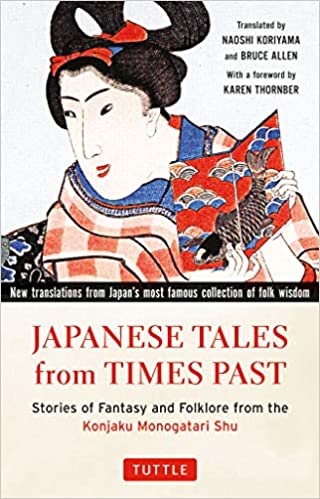
Konjaku monogatari (Tales of Times Now Past)
multiple authors
The endings ("lessons learned") of some tales are painfully misogynistic. "The story tells us that a noble lady should not get close to such a priest," when the express was raped. In another story, the man's death was blamed on the woman since she "interferes and tries to act too clever." In what ways do these stories reduce living women into mere temptations?
In the stories "How a Monk of the Dojoji ..." and "How Kaya No Yoshifuji, ..." in the Konjaku monogatari, animals seem to play an important role. In the former, the woman and then later the monk she desired become serpents. In the latter, Yoshifuji is tricked by a fox and later becomes a monkey-like creature for a brief period. Why were these animals chosen and what the symbolism is behind them?
Content warning: My post will focus on sexual violence. Please engage however feels right for you.
I am intrigued and saddened by how the story, “How a Monk of the Dōjōji….” engages with consent and sexual violence. We see the widow attempt to coerce the young Monk into engaging with her sexually and when he continues to refuse, she continues. A quote that particularly stood out was the very last, “evil woman’s passion for the young monk must also have come from a bond formed in a previous life.” What does this mean?
The symbolism of nature is heavily prevalent in Japanese Heian poetry and as we move onto the monogatari, I find it curious the repeated usage of the "moon," "dew," "snow," "dreams," and "reality" are used. As mentioned in the reading monogatari and Buddhist teachings clash and contrast one another as the fabrication of love is the promotion of lies of the other world. Though my question is why use the moon or other physical representation associated with the "other world" that is associated with no suffering and shape it into one? Why did the poets choose to use the moon in their poems and how did it become so popularized that in many poems, these elements are associated with love. Lastly, how is Buddhism and Shintoism represented in Heian poetry and did the clergy ever respond with a counter form of literature to respond to the monogatari?
As I read I was able to sense a different shift in themes/concepts from these readings in comparison to the ones from the previous weeks. There now seems to be a lot of deception and it feels like the stories are a bit more "dense" to read. I really enjoyed the imagery, especially in "How a Monk of the Dojoji"; what stood out to me in particular, and to some of my classmates, was the woman becoming a snake, which immediately made me think of Christianity, specifically Adam and Eve getting deceived/manipulated by the snake. Is there any symbolism behind the snake in Japanese culture? Is it evil or was it just used as evil in this story? Is there a connection to religion?
One thing I noticed is that although the stories are bizarre in their realities, the Buddhist moral is always clearly stated. It's almost as if the exaggerated tales are meant to hook an audience and entertain them to the point of unintentionally accepting a new Buddhist ideal. It kind of reminds me of other religious stories like those in the Quran or Bible. They also tell a seemingly-realistic story that has some supernatural elements and ends with a clear principle favored by the religion.
The story arc of these short tales was not what I was expecting, it had a very interesting turn of events. It kind of reminded me of ghost stories in the sense that they use fear as a method to teach people about Buddhist values and morals. The tale of "How a Thief Climbed to the Upper Story of Rashōmon Gate and Saw a Corpse" was a little confusing for me as I was not very clear on what this story was trying to teach/convey. Does hair in this story have a deeper meaning/ symbolize something? I know that in ancient China, the cutting of hair went against the notion of filial piety, and I was wondering if hair had a similar meaning in Japan during this time period.
I found it interesting that so many of these stories functioned as Buddhist allegories - often ending the story with a "lesson" relating to Buddhist beliefs. Were these stories written and shared in order to attempt to convert Japanese people to Buddhism, or just to enforce its teachings to existing Buddhists?
There were also some "secular" stories that the textbook states were meant "for entertainment and practical purposes". If the compiler(s) of these stories were trying to preach Buddhist teachings, why include these secular stories alongside the Buddhist allegorical ones?
What was the criteria for choosing these stories to be in TJL? Some have a pretty obvious "moral of the story": "“HOW KAYA NO YOSHIFUJI, OF BITCHŪ PROVINCE, BECAME THE HUSBAND OF A FOX AND WAS SAVED BY KANNON” is told to get people to pray to Kannon (Guanyin), "“HOW A MAN WHO WAS ACCOMPANYING HIS WIFE TO TANBA PROVINCE GOT TRUSSED UP AT ŌEYAMA" is a tale on not to make yourself vulnerable to strangers, etc. But stories like "“HOW A THIEF CLIMBED TO THE UPPER STORY OF RASHŌMON GATE AND SAW A CORPSE" feel kind of random, like the only reason its been passed down is because "the thief told someone what had happened, and whoever heard his story passed it on". Honestly though I quite liked reading all of them, and they were all pretty entertaining (they had some semblance of a storyline).
Also, what's with: “So the tale’s been told, and so it’s been handed down."? All the stories ended with it; is it some sort of classic way to end Japanese stories? It's cool that they all have this, if it's truly part of the story, or maybe it has just been added to all the stories to maintain consistency.
Reading the stories from the Konjaku Monogatari was very interesting. They were a bunch of short stories that gave life lessons (though sometimes the lessons were very niche). I really enjoyed the story of the man fooled by the fox and the one of the man fooled by the other man while walking with his wife. These cautionary tales are cool not only in the way that they give life lessons, but also with how they tie Buddhism into the stories.
What do these stories reveal about the values and beliefs of the time, and how do they use Buddhist teachings to reinforce their messages?
Source 1
Mori, Masato. 1982. “Konjaku Monogatari-Shū: Supernatural Creatures and Order.” Japanese Journal of Religious Studies 9 (2–3): 147–70. https://search.ebscohost.com/login.aspx?direct=true&db=reh&AN=ATLA0000930497&site=eds-live&scope=site.[1]
Mori examines the Konjaku Monogatari-shū, and in particular it’s 27th volume, through a structural framework in which setsuwa are broken into three categories: an editorial act, selection act, and narrative act (each aspect of this structure is examined in turn). Mori focuses particularly on an attempt “to clarify the meaning assigned to supernatural creatures during the Heian period”, and in doing so addresses the overall structure of Konjaku (148). Mori then goes on to characterize demons, namely as creatures that invade the inside from without, and as enemies of order. The author provides an intriguing interpretation of demons and analyzes their nature and role within Konjaku while providing an abundance of examples, tying it all to structure, and also provides a classification of supernatural creatures. Though the article is limited in scope, Mori effectively elucidates the descriptive and narrative role of supernatural creatures, while also successfully tying it to Konjaku as a whole.
Source 2
Reider, Noriko T. “Transformation of the Oni: From the Frightening and Diabolical to the Cute and Sexy.” Asian Folklore Studies 62, no. 1 (2003): 133–57. http://www.jstor.org/stable/1179083.
Reider follows the evolution of oni throughout history, examining how their depiction and perceptions of them have changed over time. Reider also analyzes how Japan’s broader socio-economic circumstances and modern commercial interests have shaped conceptions of the oni. The analysis covers an extremely broad range, beginning as early as the Nihon Ryōiki, The Tales of Ise, and Konjaku Monogatari-shū, and extends to the present. There is little specific focus on Konjaku, but the article provides context that is enlightening and intriguing and allows one to better situate and understand the supernatural creatures that appear in it. There is a wealth of history, such as how oni came to be used to “describe Japan’s real-life enemies”; how oni affected other historical realities is also handled, which makes the article highly informative and easy to read (147).
Source 3
Kelsey, W. Michael. “Salvation of the Snake, the Snake of Salvation: Buddhist-Shinto Conflict and Resolution.” Japanese Journal of Religious Studies 8, no. 1/2 (1981): 83–113. http://www.jstor.org/stable/30233261.
Kelsey examines “Buddhist-Shinto relationships as seen in a single cluster of stories, namely, those having to do with snakes” (83). In this analysis, Kelsey primarily handles the Nihon Ryōiki and the Konjaku Monogatari-shū. Given the fundamentally Buddhist nature of the Konjaku Monogatari-shū, as well as the frequent appearance of snakes, the article is highly relevant to understanding and interpreting the collection. Kelsey examines the contrast between early Shinto and early Buddhist treatment of snakes, as well as the syncretic evolution of depiction of snakes, and ties it to how the two religions frame conflict. Overall, the article provides both a wealth of analysis about the Konjaku in particular, but also elucidates the broader religious context for the collection, which help to explain a lot of the Konjaku’s more confusing elements. Its specificity and thoroughness render the analysis compelling, and it makes the religious framework of the Konjaku clear, making it invaluable to any reader not extremely well-versed in the religious history of early Japan and how it manifests in texts of the time.
Source 4
Reider, Noriko T. "Yamauba: Representation of the Japanese Mountain Witch in the Muromachi and Edo Periods." International Journal of Asian Studies 2, no. 2 (07, 2005): 239-264. http://ezproxy.middlebury.edu/login?url=https://www.proquest.com/scholarly-journals/yamauba-representation-japanese-mountain-witch/docview/208903669/se-2?accountid=12447.
Similar to Source 2, in this article Reider traces the history of the yamauba, or “mountain witch,” through the Muromachi and Edo periods. Though this means a lot of the analysis focuses on things far past when the Konjaku Monogatari-shū was written, the “archetypal figure” of the yamauba stems from the Konjaku (240). Accordingly, Reider uses the yamauba from the Konjaku as a foundation to compare with other depictions of the yamauba. To do this, Reider provides a thorough examination of the yamauba in Konjaku, which means that any reader comes away with a much greater understanding of one of Japan’s most famous monster’s inception. The emphasis is on how depictions of the yamauba evolved across the Muromachi and Edo periods, but that history is fascinating in its own right. Moreover, the progression stands as an intriguing example of how myth and folk shift across time.
[1] This is the link provided by the official citation, but a direct link to the paper is the following: https://nirc.nanzan-u.ac.jp/nfile/2246
Foster, Michael Dylan. Pandemonium and Parade: Japanese Monsters and the Culture of Yōkai. University of California Press, 2009. JSTOR, https://www.jstor.org/stable/10.1525/j.ctt1ppkrc
This book by Michael Dylan Foster explores the historical, cultural, and social significance of yokai—supernatural creatures in Japanese folklore. Foster elaborates on the origins of yokai, from ancient myths and classical literature to their presence in modern media and pop culture. Foster’s primary objective with this book is to examine how yokai have been “understood and interpreted through time, how they have played a role in vernacular practices, and how they have informed academic discourses that describe, explain, deny, or cherish them.” (3) Thus, individuals that particularly enjoy or are interested in learning about how folklore reflects, and shapes cultural identity are strongly encouraged to read this book, whereas those who simply want light storytelling of myths with more fiction than academic discussion may find it less interesting or difficult to engage with.
Foster, Michael Dylan. “The Metamorphosis of the Kappa: Transformation of Folklore to Folklorism in Japan.” Asian Folklore Studies, vol. 57, no. 1, 1998, pp. 1–24. JSTOR, https://www.jstor.org/stable/1178994
This article explores how the Japanese kappa—a mischievous water spirit—evolved from regional folklore into a prominent symbol of Japanese cultural identity. Foster brings about the idea of “folklorism” through the kappa’s transition from local oral traditions to its current adaptation in media and festivals. He sheds light on the metamorphosis of the kappa as although it is still ubiquitous and well-known, it is “radically different from the grotesque and mischievous creature that typifies its conception in folklore. It has become a clean, cute creature, used as a symbol of tourism, of commerce, of clean water, and even as a symbol of village and national identity.” (11) For those that are not only curious to learn about the origins of certain folklore but in the concept of folklorism to examine how traditional elements are reinterpreted will thoroughly enjoy reading this. However, if you are focused simply on the story-telling aspect of folklore, the focus on “folklorism” may detract from overall intrigue in the reading.
Lombardi, Linda. “Kitsune: The Divine/Evil Fox Yokai.” Tofugu, Tofugu, 9 Sept. 2014, www.tofugu.com/japan/kitsune-yokai-fox/.
This article offers an engaging elaboration on the mythical fox in Japanese folklore, the kitsune. Lombardi delves into the dual nature of the kitsune as both benevolent and malevolent, highlighting its shape-shifting abilities and its connections to Shinto deities. Its abilities vary and can range from illusions “usually with mischief – or worse – in mind,” and even human possession. Lombardi also discusses the many cultural significances of the kitsune, including its role as a messenger of Inari, the god of rice and prosperity, and its “trickster” persona in folktales. I highly recommend reading this article, especially if you’re looking for an introduction to Japanese mythology as its vibrant imagery, appealing layout, and non-academic tone make it a simple but very interesting read. Overall, this article is well-suited for general readers, enthusiasts of Japanese culture, and those intrigued by mythical creatures. However, those looking for an in-depth analysis in regard to folklore may find better luck reading another article.
Yamatomagazine. “The Hyakki Yagyo: How to Survive the Night of One Hundred Demons.” The Hyakki Yagyo: How To Survive The Night Of One Hundred Demons, 7 July 2019, yamatomagazine.home.blog
This blog post offers a short, yet concise exploration of the folklore of hyakki yagyo—a parade of supernatural beings like yokai, ghosts, and otherworldly creatures, also known as “the night parade of one hundred demons.” The blog post also mentions the origins of the myth, its cultural significance, and its representation in Japanese art. It highlights methods believed to protect people from the yokai’s harm, primarily from chanting sutras or simply avoiding the night altogether by staying indoors. Although a very short read, because of its engaging storytelling and conciseness, I think it would appeal to casual readers interested in learning about a popular Japanese folktale without much prior knowledge. However, because the blog post focuses more on the storytelling aspect as opposed to a more elaborate concept surrounding folktales, those wanting a more academically rigorous read may find it too simple.
1. Reider, Noriko T. “Yamauba, the Mountain Ogress: Old Hag to Voluptuous Mother.” In Japanese Demon Lore: Oni from Ancient Times to the Present, 61–89. University Press of Colorado, 2010. https://doi.org/10.2307/j.ctt4cgpqc.10.
This article explores how the depictions and conceptualizations of the yamauba, the literary Japanese mountain witch, have changed throughout the medieval period to the modern period in Japanese literature. Focusing on yamauba representations in monogatari (fairy tales), Noh plays, and kabuki (classical Japanese theatre), the article showcases how the characteristics of the yamauba are contradictory– she is simultaneously good and evil. Unlike other scholarship on yamauba, this article considers the positive aspects of yamauba not as separate from, but as an integral part of a wider Japanese literary culture that places yamauba in the realm of the marginalized. Indeed, whether she is consumed by wickedness or benevolence, her difference lies in just that– either she is so monstrous that she must be banished to the mountains, or she is so beautiful to the point of excessiveness. This article provides a clear illustration of how folktale mirrors cultural realities.
2. Reider, Noriko. “Yamauba and Oni-Women: Devouring and Helping Yamauba Are Two Sides of the Same Coin.” Asian Ethnology 78, no. 2 (2019): 403–28. https://www.jstor.org/stable/26845333.
Noriko Reider’s article explores the good-evil duality of the yamauba, emphasizing the complementary nature, rather than discordance, of its two sides. By comparing yamauba with oni, the latter being an indisputably evil, non-female monster in Japanese folklore, Reider highlights their interchangeable usage and overlapping traits, including cannibalism, fearful appearances, and shame. Additionally, the dual roles of yamauba—proactive predators linked to fear and evil, and welcoming, benevolent figures—are connected to oni, reflecting how female agency and movement are associated with monstrosity. Through demonstrating the connection between yamauba and oni, Reider’s analysis positions yamauba within a patriarchal framework, revealing how their depiction reflects male-dominated society and gender roles. Best suited for those already familiar with Japanese folktales, his article serves as a comprehensive analysis of two particular characters in Japanese literature and offers insights into their cultural and literary significance in Japan.
3. EKMEKÇİ, Çelik. The Empowered Woman Image in The Japanese Yamauba Myth: “Yamauba The Devouring Witch.” Eurasian Journal of English Language and Literature, 4(2) (2022), 101-110. https://dergipark.org.tr/en/download/article-file/2460881
Drawing on the connection between the yamauba and the patriarchal order, this piece brings women writers of yamauba into the picture to form a more comprehensive understanding of gender roles in traditional Japanese culture. Rather than exploring the good-evil feature of yamauba, this work analyzes the root of the evil nature associated with this character through its relationship with the patriarchy. Using the Western narrative of medusa, in which terror is caused by men, the author suggests that women would “rather be feared than oppressed,” which then translates into their depictions of evil yamauba. The author asserts that yamauba stories thus exist as a space in which female writers can alleviate their frustrations with the patriarchal world order, creating a sense of female empowerment. Although the piece concludes with a striking claim that “yamauba can be nothing but negative,” as a whole the text introduces a compelling take on the role of yamauba within gendered and cultural norms, and invites readers to form their own opinions on the complexities of the yamauba character.
4. Hansen, Kelly. “Deviance and Decay in the Body of a Modern Mountain Witch: Ōba Minako’s ‘Yamanba No Bishō.’” Japanese Language and Literature 48, no. 1 (2014): 151–72. http://www.jstor.org/stable/24394378.
Focusing on Oba Minako’s story “The Smile of a Mountain Witch,” this piece, authored by Kelly Hansen, analyses the text through a feminist lens. The original story follows the journey of a yamauba with mind-reading abilities who alters her speech to avoid causing others harm. Over time, this suppression leads to her physical decay and eventual death. Hansen interprets female speech in the story as a “barometer for female physical deterioration” and a disruptor of the hegemonic order. She connects this theme to broader patterns in traditional Japanese literature, where deviant female speech often evokes fear and reinforces patriarchal norms. Through employing a contemporary feminist approach, Hansen’s analysis situates yamauba within the Japanese cultural dynamics of deviant female speech. Offering both a focused reading of Oba’s text and a broader feminist critique, this piece serves as a compelling introduction to the yamauba as a literary figure within Japanese culture.
5. “Yama Uba, Japanese Mountain Witch,” Japan Avenue (blog), September 24, 2021,
Replete with images, emojis and bold statements, this blog post on yamauba certainly leans into the fantastical elements of this literary character. Although likely to appeal to kids and foreigners who have interest in Japan, the text does connect the traditional yamauba to popular culture by demonstrating her representations in anime and video games, which invite the readers to think about yamauba in the context of Japanese culture. This post also goes over the legend of Kintaro, a story of the son of a yamauba who has supernatural powers, as a way to show how the actions of these mountain witches are not always evil. However, the blog concludes by stating that ultimately, the true nature of yamauba is wicked. Although lacking the educational aspects or nuance that would allow for a comprehensive understanding of yamauba, this blog post is successful in showing the storybook reputation that yamauba have in Japan and abroad, especially on children.