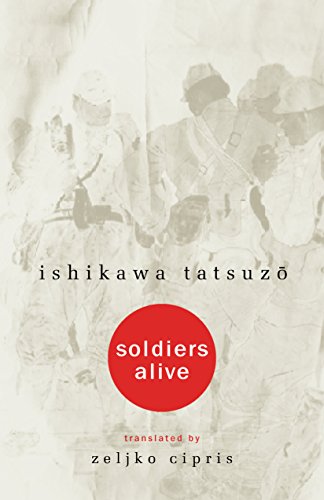
Soldiers Alive

Ishikawa Tatsuzo


Psychological Metamorphosis: A Review of Ishikawa Tatsuzō's Soldiers Alive
zhengqianl@middlebury.edu
Ishikawa Tatsuzō’s Soldiers Alive reflects the thoughts, conversations, and activities that center around a platoon of the Takashima Division of the Japanese army. Set in December 1937 to January 1938 during the Second Sino-Japanese War, the story focalizes around the soldiers of Kurata Platoon, tells in detail their war crimes, and delves deep into their ... read more

Ishikawa Tatsuzō’s Soldiers Alive reflects the thoughts, conversations, and activities that center around a platoon of the Takashima Division of the Japanese army. Set in December 1937 to January 1938 during the Second Sino-Japanese War, the story focalizes around the soldiers of Kurata Platoon, tells in detail their war crimes, and delves deep into their psychology before and after conducting merciless killings. Strict adherence to objectivity along with laser-sharp observation, Ishikawa Tatsuzō presents to the world an invaluable piece of war literature that fills the blanks of historiography. 

In any warfare, those who are the closest to the battlefield are always the soldiers. Protagonists in Soldiers Alive——Kurata, Kasahara, Hirao, Kondō——are all ordinary soldiers of the Takashima Division. As a writer who would like to inform the Japanese civilians about the truth of the war, Ishikawa reproduces a series of close-to-real war scenes through his naturalist description of these soldiers: Just because he “suspects” that a young Chinese woman is a spy, Kondō strips off her clothes in public and stabbed at her breasts with a dagger; Just because a 17-year-old Chinese girl’s loud crying (due to other soldiers’ murder of her mother) disturbs his sleeping, Hirao along with other soldiers stabs the girl to death; Army priest Katayama Genchō kills Chinese soldiers with a spade in one hand while holding a rosary in the other; After occupying Shanghai, these soldiers force Chinese women to serve as “comfort woman”  at their disposal; and they all feel elated because “this continent teemed with boundless riches; one merely had to take them…” (Ishikawa, 80).

Soldiers Alive not only revealed these soldiers’ brutal slaughtering of innocent civilians and prisoners of war but also demonstrated their psychological metamorphosis. Ishikawa deliberately slows the narrative pace and concentrates on how these soldiers gradually lost their humanity and sense of morality as the war progresses. Except for Corporate Kasahara, who was born as a farmer’s son, all other main characters in the novel are more or less educated: Before being dispatched to China, First Class Private Kondō was a university graduate and a medical doctor; Second Lieutenant Kurata, a respected elementary school teacher; First Class Private Hirao, “a romantic young man who had worked as a proofreader for a city newspaper” and whose “highly receptive, delicate nerves…could not but helplessly shatter in the harsh world of the battlefield” (Ishikawa, 74); Katayama Genchō, a well-educated monk. However, it is these very individuals who later transform into killing machines. After countless killings of Chinese soldiers and civilians, they eventually manage to get rid of the last remaining trace of morality. Kurata realized that killing must be cold-hearted, so he began to harden his heart to prepare for the daily massacre of civilians; Kondō became increasingly numb to crime and learned to boast about his “achievements”: to “get” a girl, to step on the body of a dead Chinese soldier, or to set a house on fire...; Army priest Katayama Genchō, when killing Chinese captives, did not experience the slightest pain in his conscience, but instead felt extremely happy…Ishikawa goes deep into the psyche of these soldiers, especially those with some educational background. He objectively and truthfully described the process of their losing the sense of conscience. In this unjust war of invasion, although these soldiers are “alive”, they have experienced a psychological metamorphosis by completely abandoning human feelings and a basic sense of conscience. Ultimately, they are transformed into “qualified soldiers” needed by the Japanese militarist authorities and suitable for the war of invasion. It is these haunting descriptions that make Soldiers Alive more credible due to its exposure to the war's alienating effects on humans than some historical materials that selectively record “historical facts.”

The many merits of the novel come with only one limitation. Ishikawa’s writing draws on the naturalist tradition and presupposes an environmental deterministic view on human nature. The novel regards the war environment as the only decisive factor that influences the soldiers and does not consider other factors——“The battlefield appeared to possess an astonishing power to transform all combatants into men of identical characters, identical thoughts, and identical needs” (Ishikawa, 100-101). According to Ishikawa, none of Hirao, Kondō, and Genchō are inherently evil. All of them are ordinary, law-abiding citizens before going to the battlefield. Only due to the peculiarly inhumane environment of war, they eventually lose their rationality and become ruthless killing machines. However, one crucial factor that is missing is the influence of fascist education and propaganda on these soldiers. Even though any war will bring about psychological impacts on soldiers, the war itself cannot provide a reasonable explanation for the massacre of civilians by these soldiers. The theory of Japanese ethnic superiority and chauvinism hyped up by Japanese militarists can nonetheless provide some clues for 21st-century readers----an inextricable connection exists between the domestic militarist education in Japan and the massacre of innocent civilians by the Japanese army in China.

That being said, under the harsh political milieu at the time, by not catering to militarist propaganda and setting aside the writing commandments imposed by the military on writers, Ishikawa's pursuit of truth and objectivity still deserves our respect. Despite the lack of explicit criticism of the Japanese invasion, the novel objectively presents an infernal image of the sufferings of civilians as a result of the barbarism of the protagonists.

Rating: 4.8/5

Although Soldiers Alive is a piece of fiction, readers interested in this period of history can discover a certain “historical truth” in it. Ishikawa’s outlining of the soldiers’ psychological metamorphosis is something that we can never find in works of historiography. Through this painfully objective literature and the vividly portrayed literary figures within, we are thereby granted access to the “real” psyches of the soldiers who participated in the Second Sino-Japanese War.

Total Votes : 1 Vote Up Edit Reply


efelix@middlebury.edu
What is the human cost of war and what can we make of the soldiers conflicting views on the war? In particular, how can we interpret "This time his[Hirao] romanticisms had plunged him into a delirium of despair?"

xiyaoh@middlebury.edu
Blind Chinese Soldiers & Soldiers Alive question: comparing mass consciousness in both works, what can we say about the influence of context/society on individual subjectivity? If subjectivity could be very easily manipulated by collective kindness, evilness or fanaticism, is there any solid value that human race could linger to? can we still trust humanity?

nyoshida@middlebury.edu
Soldiers Alive Question: the soldiers are often in direct contradiction with themselves. Described as normal men with normal lives previous to the war is a strange contrast in view of their cruelty in action. They feel a camaraderie with the Chinese and then a deep resentment. Is this author getting at the idea of war or human nature? Is this commentary on just the Japanese? What is interesting about some of the soldiers' rationale and emotions before killing?

zhengqianl@middlebury.edu

The novel spends a significant length talking about the mentality of the soldiers. What do you think lies behind their differential treatments of Chinese people and their own fellow Japanese soldiers and civilians?


ejkim@middlebury.edu
Ishikawa’s story was banned and “lead to the author’s conviction on charges of ‘disturbing peace and order’.” Under the changing political climate of the late 1930s, all materials to be published were subject to intensive censorship. Additionally, in one of the classes I’m taking this semester, I read about Japan’s opposition to the inclusion of references to comfort women in middle school. We see this pattern of favoring a glorious narrative, and conservatives have even forced the government to adopt an arrangement that watered down Japan’s wartime atrocities and responsibilities. What might this attitude reveal about Japan?

agclay@middlebury.edu
The soldiers are totally emotionally disconnected from the horrors surrounding them, going so far as to enjoying the "comfort" of using the stomaches of the dead Chinese as pillows. Why are they like this? Is is a defense mechanism? Is it just true hate? I ask myself this question every time I think about historical atrocities.

mkemmer@middlebury.edu
What is the narrative effect of simultaneously showing both the devastation of war and the emotional disconnect of many of the soldiers that fight in it? How does this impact readers' experience of Soldiers Alive as war literature?


zhengqianl@middlebury.edu

1)

Mihalopoulos, Bill. “Becoming Insects: Imamura Shōhei and the Entomology of Modernity,” in Power of Memory in Modern Japan, edited by Sven Saaler, and Wolfgang Schwentker. BRILL, 2008. ProQuest Ebook Central. http://ebookcentral.proquest.com/lib/middlebury/detail.action?docID=772021. 

The commentary offers an in-depth analysis of the intriguing movie The Insect Woman (Nippon konchu–ki) directed and co-written by Imamura Shohei. The article reflects on the movie’s intentional analogy between the lives of insects and those of humans as well as on its hidden theme about “the tragic ambiguity of modernization” (277).

2)

Yang, Daqing. “Convergence or Divergence? Recent Historical Writings on the Rape of Nanjing.” The American Historical Review 104, no. 3 (1999): 842-865. JSTOR, https://www.jstor.org/stable/2650991.

The article addresses the question of “whether there has been any significant convergence among historians writing on the Rape of Nanjing, or the Nanjing Massacre,” which is often considered the most notorious Japanese atrocity during the entire Sino-Japanese War (842). Other more comprehensive questions considered by the article: “Have years of debate and research produced any convergence among historians or actually widened their differences? What factors have conditioned their understanding of this particular event? What is the prospect of the community of historians, if there is one, producing a more truthful narrative of the past?” (842) The scope of the article focuses exclusively on three works of historiography: Nanjing Jiken (The Nanjing Incident), written by Kasahara Tokushi, a leading Japanese historian on wartime Japanese atrocities in China; Nanjing Datusha (The Nanjing Massacre), coauthored by Sun Zhaiwei and others, by far the most comprehensive scholarly work on the subject written in Chinese; and Iris Chang’s The Rape of Nanjing: The Forgotten Holocaust of World War II.

3)

Gorden, David M. “Historiographical Essay: The China-Japan War, 1931-1945.” The Journal of Military History 70, no. 1 (2006): 137-182. JSTOR, https://www.jstor.org/stable/3396811.

This essay “surveys much of the literature on that [China-Japan] war, published since the 1970s, from its origins to its end” (137); provides a thorough overview of the major incidents from 20 years before the China-Japan War to its end on 1945 with comments by other specialists; offers an insightful analysis of the rationale behind the Japanese appetite and invasion of China.

4)

Thomas J. Hennen, Jr. and Vida C. Stanton. “Let There be Peace: An Annotated Bibliography of Anti-War Literature and Realistic Fiction about War.” Language Arts 54, no. 1 (1977): 66-70. JSTOR, https://www.jstor.org/stable/41404482.

The list is an antiwar bibliography, a protest against mass media’s filtered, eye-catching portrayal of war scenes, and an effort to promote a realistic understanding of the atrocity of war. All the works contained are fictions that would “de-glorify” the war and restore its real horrors. By collecting works that observe war from a victim’s perspective, this list marks itself as a counterweight to the widespread victor (aggressor) perspective of the war in the media. The list mainly targets upper elementary and junior high students.

5)

Ikeda, Kyle. “Unarticulated Memories of the Battle of Okinawa: The Early Fiction of Second-Generation War Survivor Medoruma Shun.” East Asia Cultures Critique 22, no. 2 (2014): 301-328. 

This article concerns largely about the “significance of unarticulated personal memories of the Battle of Okinawa”, “reasons that they remain unnarrated” and   “the problem of uncovering and passing on such personal memories “if their owners avoid articulating them” (302). Ikeda puts the focus on how the second-generation survivor of the Battle of Okinawa, writer Medoruma Shun depicts two kinds of unarticulated personal memories in his early fiction: “memory constrained by social consequence and traumatic memory (302).