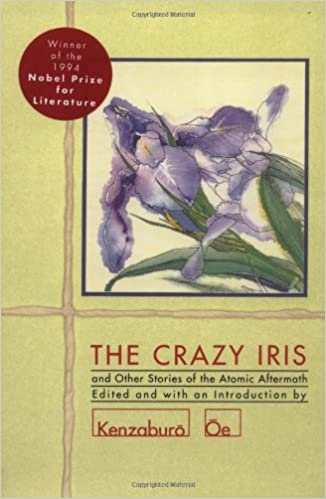
The Crazy Iris

Masuji Ibuse


A-Bomb Allegories for a Crazy Age
lwynne@middlebury.edu
The macrostructure of “The Crazy Iris,” a short story by Japanese novelist Masuji Ibuse (1898-1993) is as desolate as an atomic wasteland. Set in the final days of World War II, the Hiroshima-proximal city of Fukuyama is evacuated due to an imminent bombing announced by the Americans. An innkeeper repeatedly refuses the narrator’s attempts to ... read more

The macrostructure of “The Crazy Iris,” a short story by Japanese novelist Masuji Ibuse (1898-1993) is as desolate as an atomic wasteland. Set in the final days of World War II, the Hiroshima-proximal city of Fukuyama is evacuated due to an imminent bombing announced by the Americans. An innkeeper repeatedly refuses the narrator’s attempts to purchase an attractive antique jar of hers and even rejects his offer to temporarily harbor it for the duration of the raid. Later, he finds the jar split in two amidst the rubble of the inn, and after Japan’s surrender, he participates in the redistribution of wartime reserves. Lastly, he observes a dead woman floating in his friend’s pond next to an iris that bears unseasonal petals. The Atomic Bomb is mentioned several times, but never directly confronted. Despite this somewhat barren plot structure, a subsurface narrative confronting the implications of the A-Bomb lies perhaps just underneath a Western reader’s detection. I believe that, provided the contextualization of the titular iris and focal jar, any reader can enjoy “The Crazy Iris” for Ibuse’s skillful juxtaposition of mundanity with mass destruction: the humorous absurdity of continuing the human routines of daily life amidst unthinkable inhumanity.

The indirect, sometimes jocular tact with which Ibuse approaches the A-bomb results from his once-removed relationship to the bomb and differentiates “The Crazy Iris” from the narratives of firsthand witnesses. John Whittier Treat, Professor of East Asian Literature at Yale, distinguishes Ibuse from firsthand Hibakusha writers like Hara Tamiki (1905-1951), grouping A-Bomb writers into distinct generations:

“The first are those who were personally victims of the bomb and wrote of it to explain it to non-victims. The second generation (Oe Kenzaburo, Ibuse Masuji) are non-victims who write of the bombings to understand it themselves.”

As Ibuse belongs to the latter category, his writing presumably functions primarily to seek clarity for himself rather than offer up an explanation of the A-Bomb to his readers. Just because Ibuse is not a firsthand survivor does not make his understated handling of the Bomb and its aftermath any less valid, however, and his quest for understanding represents an important step in the evolution of the Hibakusha genre. Indeed, as “The Crazy Iris” likely follows the structure of an “I-novel” (a Japanese style of confessional writing in which the narrator and author are one), the circuitous, often subliminal ways the narrator confronts the A-Bomb can actually be taken as Ibuse’s personal disposition. Beneath the displays of routine humanity in “The Crazy Iris” —humorous mundanities like pointing out fishing hooks in others' hats or divvying up paper rolls— the confrontation of the A-bomb has gone subterranean, shrouded in symbolism like that of the iris.

The actual iris, the namesake of the short story, is mentioned only briefly at the beginning and ending, sandwiching an otherwise seemingly unrelated narrative of the direct aftermath of Hiroshima’s bombing. Yet from the very first line of the short story, which reads: “Shortly After Hiroshima was bombed, I was at a friend’s house in the outskirts of Fukuyama looking at an Iris which had flowered out of season,” we see the synchronicity of the bombing of Hiroshima and the blooming of the iris —not just mere correlation, but direct causality. Perhaps the iris blooms out of season due to the latent radioactivity of the bomb, which exploded only a hundred kilometers away from Fukuyama (radiation, after all, has the capacity to alter the most basic processes of nature). Less literally, however, this unseasonal iris likely connotes a traditional symbol rendered absurd by the bomb.

The Japanese perhaps most closely associate Hanashōbu, the Japanese Water Iris, with the Children’s Day festival. An article in the Japan Times notes that because the Hana Shobu’s “sword-shaped leaves are narrow and ridged,” they have come to symbolize the warrior spirit, and thus young boys bathe with iris leaves on this day to imbue them with protection. Ibuse, disillusioned with the false promises of war encapsulated by the iris, utterly dismantles this tradition. The iris failed to ward off the evil of the bomb, it failed to protect the boys who died fighting in the war, its connotations cease to make sense in the Post-A-Bomb age. This is not the iris of 10th century love poems; instead it belongs to a “crazy age,” one where entire cities can be disappeared in a brief flash of light, one where rain irradiates instead of cleanses, one where bodies succumb to an incurable and invisible poisoning, one where humans find justification to commit unjustifiable atrocities. Analogously, I saw Ibuse’s story of the jar as allegorical for the futility of clinging to traditional ways of thinking in a nonsensical world. The Imbe-ware jar, a product of the Heian period and emblematic of ancient culture, inevitably shatters in the A-Bomb-adjacent raid despite the narrators numerous attempts to preserve it; the Bomb renders old meanings obsolete new ones must be sought out.

As Treat delineated, Ibuse belongs to a generation of writers that aims not to explain the Bomb but rather to attempt understand it and in the “The Crazy Iris” Ibuse emphatically tells us that nothing in the past can contextualize it. The jar will not un-shatter; the “crazy age” heralded by the iris has new rules and the advent of atomic war cannot be compared to anything prior. It is precisely for these profound implications that I thoroughly enjoyed “The Crazy Iris,” and think you might to.

Total Votes : 0 Vote Up Edit Reply


lwynne@middlebury.edu
How does Ibuse being a secondhand witness to the Atomic Bombing of Hiroshima change the way he addresses it?

rherman@middlebury.edu
To what extent were the Japanese people resentful of the military? According to Ibuse's account, were townspeople relieved or angry about Japan's surrender? A mix of both?

nyoshida@middlebury.edu
What is the significance of the jar and the innkeeper's refusal to part with it? Is its relative survival followed by its eventual destructions symbolic of events happening in and around the story? Is the innkeeper symbolic of another kind of authority, and if yes, which one (Japanese government, the allies, etc)?

efelix@middlebury.edu
Is the iris being juxtaposed with the a-bomb? A quick search of iris symbolism in Japan revealed to me that the iris represents purity. In the ending, though we are told that, "'There's all the difference in the world, you know, between the iris in your story and the flower down there. They belong to completely different periods. The iris blooming in this pond is crazy and belongs to a crazy age!'" I am unsure of how to interpret this.

jenglish@middlebury.edu
What does the protagonist reflecting on and revisitng the words "Did you know you had a fish hook in your hat?" reveal? Does it elucidate anything about trauma, or how it might be processed? Does it say anything about guilt?

zhengqianl@middlebury.edu
Is there any element of Zen Buddhism in the story? When the protagonist sees the water jar in its fragments, he laments: "How transient, alas, the beauty of this world!" (Ibuse, 27). This connection between a jar and the world seem to reflect a Zen Buddhist proverb saying that the secret of the universe can be found nowhere but in a flower (in the context of the story, a jar). The blooming iris and a dead woman's body in the same pond also seem to suggest a Zen Buddhist mentality or even aesthetics of juxtaposing life and death together (somewhat resemble the yin-yang diagram I guess?)...

xiyaoh@middlebury.edu
As the vivid vitality of human beings is juxtaposed with vulnerability, and existence being shown in opposition to mortality, how does the author imply an alteration between the power of life and death in the story?

ejkim@middlebury.edu
For me, the use of the iris was a symbol of how transitory life is. This may (at least in the first read through) be the least compelling to western readers, for whom the delicacy and familiarity of the image, placed in the most indelicate of deaths, will not resonate as strongly. In what ways might a combined Western/non-Western perspective change the way we read and understand cultural, political, and literary issues? In other words, how might our perspective(s) act as a barrier to truly understanding the aftermath of a-bombings?

mkemmer@middlebury.edu
There seems to be a large amount of focus placed on material objects in this story - ownership of them, their gradual deterioration. What is the effect of this narrative focus when juxtaposed with the aftermath of the atomic bomb?


lwynne@middlebury.edu

Treat, John Whittier. "Atomic Bomb Literature and the Documentary Fallacy." Journal of Japanese Studies 14, no. 1 (1988): 27-57. JSTOR, www.jstor.org/stable/132530.


In his 1988 article on self-coined “documentary fallacy” within A-Bomb Literature, Treat argues that in recounting an event like the Atomic Bombings, a writer’s rhetoric will inevitably obscure objective facts, but that this is what makes the narrative believable and offers the only chance an author has at conveying meaning to their reader. He briefly writes of Masuji Ibuse and his relation to other Hibakusha writers, saying that because Ibuse is not a direct witness he does not fall victim to the fallacy of prioritizing fact over feeling, and seeks not to explain the A-Bomb but rather to understand it himself.


lwynne@middlebury.edu

Inoki, Linda. "Hana Shobu (Japanese Iris)." Japan Times. May 3, 2001. https://www.japantimes.co.jp/life/2001/05/03/environment/hana-shobu-japanese-iris/


In her brief article, Inoki discusses the various historical usages and connotations of irises in Japanese culture. I found the article very useful in contextualizing the atypical iris of "The Crazy Iris."


lwynne@middlebury.edu

Liukkonen, Petri. "Masuji Ibuse (1898-1893)." authorscalendar, 2017. http://authorscalendar.info/ibuse.htm.


Useful biography on the life of Ibuse and the hallmarks of his writing-style. Section on Black Rain does a good job of situating Ibuse relative to the Atomic Bomb and describing the approach he took to confronting it.


lwynne@middlebury.edu

Konaka, Yōtarō, and Winifred Olsen. "Japanese Atomic-Bomb Literature." World Literature Today 62, no. 3 (1988): 420-24. JSTOR, www.jstor.org/stable/40144292.


A broad survey of Hibakusha writers. Provides useful insight into how Ibuse tended to confront inhumanity with humanity and humor and how he adapted the gritty, uncomfortable accounts of direct Hiroshima survivors to construct his novel Black Rain (1965).


lwynne@middlebury.edu

DOWER, JOHN W. "The Bombed: Hiroshimas and Nagasakis in Japanese Memory." Diplomatic History 19, no. 2 (1995): 275-95. JSTOR, http://www.jstor.org/stable/24912296.


Provides a useful passage on how Ibuse based Black Rain (1965) directly off survivor's diaries as well as "interviews with some fifty hibakusha" (292) and tells of how Ibuse restores the "human dimension to the horror of nuclear destruction with immense dignity" (292).