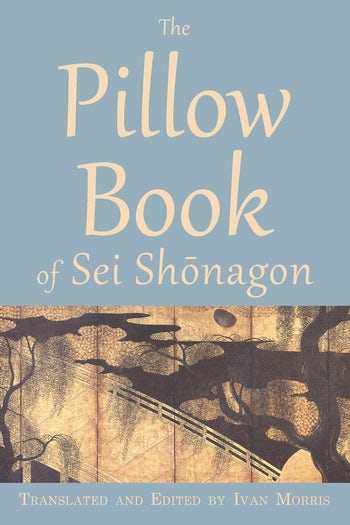
Superficiality and Silence as Means of Protest: A Review of The Pillow Book
In The Pillow Book (Makura no sōshi), Sei Shōnagon (966?-1017?) invited her readers to see the court life in the Heian period (794-1185) through her eyes. Sei’s outlook is refreshing, diverting, and witty. Readers like myself are irresistibly drawn to her unique style. As we find ourselves laughing with Sei, we are also following her lead, knowingly or not, to see what she’s seeing and feel what she’s feeling. Writing with artful superficiality and intentional silence, in her own way, Sei challenged the literary norms and gender conventions of her time.
The Pillow Book is a zuihitsu (literally, “following the brush”) diary of loosely connected fragments and free-flowing ideas, in contrast to extended plots and carefully crafted stories in the court tale (monogatari) tradition. While most major works by women at the time represented Empress Shōshi’s salon, including The Tale of Genji (Genji Monogatari) by Murasaki Shikibu (973-1014?), The Pillow Book belonged to the rival salon of Empress Teishi. The three hundred sections of The Pillow Book included various elements, such as lists, essays, and diaries. Unlike in a typical monogatari, Sei’s characters were often anonymous and lacked detailed descriptions. Indeed, a fuller portrait wouldn’t be compatible with Sei’s zuihitsu style, which is characterized by disjointed, quick-moving lines.
Through her distinctive prose, Sei compellingly accentuated her own feelings towards the objects of depiction. On the one hand, she made her perspectives very clear by the titles, most notably her lists, such as Depressing Things, Hateful Things, Pleasant Things. On the other hand, Sei didn’t hesitate to use exclamations to vocalize her thoughts. When she found something depressing, for instance, she would tell her readers without any reservation: “Pathetic and depressing in the extreme!” “How depressing when there is no reply poem!” “Oh, the dreariness of it!” “…only to have his hopes dashed!” (Shirane, 150). In the well-known first piece of The Pillow Book, we are only shown the splendor and beauty of each of the four seasons through Sei’s eyes. With selective emphases and omissions, Sei succeeded in asserting herself as a powerful writer with lots of control over her writings.
Sei avoided not only writing with convoluted plots but also talking about her own romances and the later tragic events in her life. The discrete sections in The Pillow Book are not chronologically ordered. The essay on the four seasons, for example, bears no specific dates and thus appears ahistorical. Perhaps this is because Sei did not share the taste for tragedy that dominated Heian monogatari narratives. Sei dedicated The Pillow Book as a memorial to commemorate a time of heightened glory, when Empress Teishi was still the imperial favorite. She intentionally left the subsequent downfall of her patron’s family unmentioned. One of the indirect references of these later events can be found in the story, “The Cat Who Lived in the Palace.” Even in this piece, Sei cast two animals as her characters, cat Lady Myobu and dog Okinamaro, thereby further erasing the historicity of the narrative. When reading this fun, fable-like story, readers might recall Fujiwara no Korechika’s unfortunate exile and secret return to the capital. Yet the tone permeating the story is not aware (sadness) but okashi, i.e., amusing and fun. The story itself is tragic and perhaps more appropriately described by the aware adjective (Sarra, 256).
Critics, including Murasaki Shikibu, have called Sei a superficial and shallow writer (Sarra, 229). I disagree with this accusation. Sei resisted “going into depths” or telling an extended, coherent, and historicized story about her characters or herself. In doing so, she refused her readers the often-taken-for-granted freedom to patronize either Sei or her characters through a male perspective that has dominated both Sei’s time and ours. Her deliberate superficiality and silence made her the storyteller with the most authority in her narratives. She insisted on us remaining attentive listeners before boasting our own imaginations and prior beliefs, and with her enchanting wits, she kept us engaged. Sei is certainly my favorite character, or should I say she has made herself the unquestionable main character despite being half-hidden—or precisely because she chose to appear this way? The Pillow Book turned out to become a great appeal to the commoner audience in the Edo period. I’d recommend it to all, including the non-specialist readers, and give the book a rating of 5/5 for its artistic talents and liberating potential.
Works Cited:
· Shirane, Haruo. Traditional Japanese Literature: An anthology, beginnings to 1600. Columbia University Press, 2012.
· Sarra, Edith. Fictions of Femininity: Literary Inventions of Gender in Japanese Court Women's Memoirs. Stanford University Press, 1999.