Thirteenth Night

Higuchi Ichiyo


Lex Clay agclay@middlebury.edu
agclay@middlebury.edu
  Higuchi Ichiyo’s Thirteenth Night is the story of a poor young woman named Oseki who made her family proud by marrying rich and imperial. But seven years later, the glamor of such a marriage has worn off–and she realizes the ugly truth. She is married to a cold fish and a tyrant. Being the ... read more


Higuchi Ichiyo’s Thirteenth Night is the story of a poor young woman named Oseki who made her family proud by marrying rich and imperial. But seven years later, the glamor of such a marriage has worn off–and she realizes the ugly truth. She is married to a cold fish and a tyrant. Being the wife of Harada Isamu has made her wealthy but mostly miserable. On the evening the story begins, Oseki commutes via rick-shaw to her parents’ house with the intention of declaring what has become crystal clear-she must divorce Osamu. Except it’s not crystal clear.  In a society where being a mother and a wife are so inseparably ensnared, leaving Isamu implies she must abandon her son Taro as well. Knowing this, deciding whether or not to empathize with Oseki became my point of conflict as the reader. Yes–a woman deserves to be free from the chains of an unbearable marriage, but is a mother not also responsible for the life of her child? I scratched my head and pondered. As a woman of 21st century America, I sure hope that, should I one day have a partner and children, I will have the freedom to leave one and keep the other if I wish. But I also wonder what I would have done, had I been Oseki, if I did not have that right. The truth is, it is impossible to know–but Thirteenth Night is food for thought in an uncomfortably conflicting regard. 

Leo Tolstoy begins his Anna Karenina with the words “All happy families are the same. Every unhappy family is unhappy in its own way.” Oseki’s father shares a similar opinion–family life is great in theory and disappointing in practice. He believes she is not alone in her chronic matrimonial suffering. There are countless women in woebegone marriages. So basically, Oseki should just grow up, grin and bear it. It’s her “fate”, anyway, Edna, of Kate Chopin’s 1899 novel The Awakening literally drowns herself. While her decision to end her life is hailed by many readers as a grand feminist gesture, I could not help but cower in disagreement. I say cower because I did not confidently disagree. I was aware that of all the people sitting in the room, I belonged to the contentious minority opinion. 

Though unlike The Awakening and other famous feminist texts, Higuchi Ichiyo offer’s no solution to Oseki’s sad case. In fact, the only obvious purpose of writing Thirteenth Night in the first place seems to be to raise awareness of the terrible condition of being a woman. I think that is the only point. In this sense there isn’t much to analyze. Perhaps all one can do is read and commiserate with Oseki. Her moonlit rickshaw ride back to her husband’s home seems only to affirm that happy marriages are a fantasy not worth pursuing–at least not if you are a woman.

Total Votes : 0 Vote Up Edit Reply

Jusan’ya: A Compelling Reflection Upon the Loss of Agency
mkemmer@middlebury.edu
Written by Higuchi Ichiyo in 1895, Jusan’ya (The Thirteenth Night) is, just as its title suggests, a short story of a single, pivotal evening. Told by juxtaposing two moments together, Jusan’ya unfolds into an enjoyable tale of regret and longing for what could have been, spurred by its characters’ reflections upon the societal expectations placed ... read more

Written by Higuchi Ichiyo in 1895, Jusan’ya (The Thirteenth Night) is, just as its title suggests, a short story of a single, pivotal evening. Told by juxtaposing two moments together, Jusan’ya unfolds into an enjoyable tale of regret and longing for what could have been, spurred by its characters' reflections upon the societal expectations placed on marriage in Meiji era Japan. The story is a mere fourteen pages long, but it packs a solid punch, culminating with an unexpected emotional bite that ultimately reshapes the context of the entire story itself.

Jusan’ya opens as the story’s protagonist, an unhappily married woman named Oseki, arrives unexpectedly at her parents’ house, shouldering a potentially life-altering decision. Suffering neglect and beration since the start of her marriage, Oseki desperately wants to divorce her husband Isamu. However, there are several complications: Oseki’s family relies on Isamu’s money to send her younger brother to college and also to improve their own low status in society. Oseki, additionally, has a young son named Taro who she will have to abandon if she leaves Isamu. After Oseki finally shares her long-suppressed misery with her parents, it shocks them both. Oseki’s mother empathizes with her frustrations, but her father urges her to consider the social and economic consequences of giving up the benefits of marriage to a man of such high status.

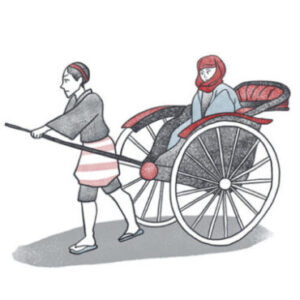
Shortly after, the narrative abruptly pivots to Oseki’s journey back home on a rickshaw where she unexpectedly reunites with someone from her past. The two commiserate about their paths in life, missed opportunities, and the inescapability of societal pressures. Lingering on this notion of regretful inevitability, the story ends.

Largely due to its short length, Jusan’ya keeps its cast small and its story contained, and this works in its favor. Two of only four characters with a speaking role, Oseki’s parents are particularly bright spots in the story. Oseki’s mother’s tirade about the dreadfulness of Oseki’s husband showcases a surprisingly liberal viewpoint for a Meiji era parent, making us as readers almost wish to join her in cheering Oseki on with her divorce. Additionally, Oseki’s father is an interestingly complicated character: he acknowledges the dismal reality of Oseki’s marriage, but ultimately still encourages her to uphold the status quo for the family’s benefit, knowing that she will continue to be trapped and miserable. For twenty-first century readers, this can be a frustrating aspect of Jusan’ya, but the story itself does not shy away from expressing the true reality of the depressing aspects of Meiji era marriage conventions.

As a protagonist, Oseki offers a perspective that is impressive for the story’s time period--she is a woman open about her dislike of both her marriage and her husband, boldly declaring her desire to seek a divorce. Yet, her wish to exercise her own agency clashes with her need to provide a better life for her family which, as heavily emphasized by the narrative, can only occur by relying on a wealthy man and suffering through a miserable marriage. Oseki’s cycling between determination and resignation is frustrating at times, but she is also undeniably relatable--choosing between upholding your own wants versus the needs of others is a choice everyone must make in life, no matter how difficult it may be.

As a whole, the story is engaging. Oseki’s frustrations capture us and encourage us to feel the same deep-seated bitterness she experiences. We, like Oseki, would never wish to be married to an uncaring man like Isamu. We too would want to escape. However, as we find out together with Oseki, there is always a cost. It is here that Jusan’ya weaves its tale of regret expertly, leaving both us and Oseki resigned to our sadnesses in life by the story’s final sentences.

Because of its short yet emotionally impactful narrative, Jusan’ya deserves a recommendation. This short story requires an audience in the mood for a skillfully constructed fictional reflection on the loss of female agency and the oftentimes dismal reality of marriage. These are always relevant themes, especially in female circles, and I believe that Jusan’ya has its own unique perspective to offer.
Total Votes : 0 Vote Up Edit Reply


rherman@middlebury.edu
"It was Oseki's misfortune to have been born so beautiful, and to have married above herself." (p. 248) To what extent was beauty correlated with a woman's agency during the Meiji period? Did it have any effect?

jenglish@middlebury.edu
This passage from page 248 reflects Oseki's father's feelings about her wanting to leave Isamu: "The pity he [Oseki's father] felt for Oseki did not preclude his desire to see the matter settled quietly." However, as Oseki leaves, she can hear her father crying. How do you think her father is feeling? What does his choice reflect about priorities of the time, and how does this contrast with Oseki's mother's advice and feelings?

xiyaoh@middlebury.edu
1. While reading the text I was drawn to Higuchi’s depiction of certain objects—the black crepe jacket, the accessories Oseki was wearing, etc. How does Higuchi employ a network of minimal objects to elicit emotion and inner struggle, and set off the paradox of life Oseki was facing?
2. The ending gives me a sense misery of distinct individuals seem to merge into collective melancholy. Examining the diction, how can we further interpret the ending of the story?

zhengqianl@middlebury.edu
How does the form (style/structure) of the story affect the expression of the central theme (sadness of life)? (Intensify or enervate it maybe?)

efelix@middlebury.edu
When Oseki is first introduced, she is introduced through her feelings of dejection. In what ways does this tie to the central idea that Oseki and later Roku represent as they describe their realities? Is this story inspired by Ichiyo's time in Ryusenji as was the case for Takekurabe?

ejkim@middlebury.edu
Even though Oseki's self-worth and mental/emotional stability are going downhill, she still sticks with the traditional route of staying with her husband. What might this infer about traditional Japanese culture regarding social mobility?

Liu Yunzhi
While Oseki and the rickshaw boy share the tragedy of not being able to live their ideal life, how should we assess their current ways of living? Which one of them is happier? What can we tell about Higuchi Ichiyo's values and that of Meiji women from comparing the two characters?

cdramos@middlebury.edu
What can we infer about the value that modern Japanese society places on money based on Kosaka Roku's actions as a rickshaw driver and from Oseki's gift to him? Is this similar or different to Edo period values?

mkemmer@middlebury.edu
The Thirteenth Night highlights the correlation between marriage and the subsequent loss of agency as a woman, framing it as an inevitable yet frustrating outcome. How does Oseki’s experience in the story both challenge and ultimately restore this status quo?


agclay@middlebury.edu

Winston, Leslie. “Female Subject, Interrupted in Higuchi Ichiyo’s “The Thirteenth Night.” Japanese Language and Literature Vol. 38, No. 1. American Association of Teachers of Japanese. April, 2004.


Breaks down Oseki’s role as a subject of Japanese society and how her attempt to use one role (mother) to obtain freedom from the other (wifehood) is futile and paradoxical. Further explores the “failure” of Oseki to cope with the condition of being a woman and the social consequences of this failure.


agclay@middlebury.edu

Van Compernolle, Timothy J. “Happiness Foreclosed: Sentimentalism, the Suffering Heroine, and Social Critique in Higuchi Ichiyo’s “Jusan’ya.”’ The Journal of Japanese Studies, Summer 2004. Vol. 30, No. 2. Summer 2004.

Text makes use of historicist reading strategies to explore sentimentalism–which can be defined as the plucking of the reader’s heartstrings through Oseki’s trials and suffering–in the Japanese literature of the Meiji Period. Further, the text explores the question of gender in sentimentalist literature using explicitly sentimental works like “Jusan’ya” or “Thirteenth Night.”


agclay@middlebury.edu

Winston, Leslie. Sex and the Sex of Voice in Higuchi Ichiyo and Shimizu Shikin. The Linguistic Turn in Contemporary Japanese Literary Studies: Politics, Language and Textuality. University of Michigan Press, University of Michigan Center for Japanese Studies. 2010.

The text identifies social criticism as something that arises not explicitly from Higuchi’s protagonist but as an unintentional side effect of the “nomadic half speaker”, which is a narrative apparatus that allows the narrator to speak on behalf of several speaking voices, resulting in a “glorious chorus of voices.”