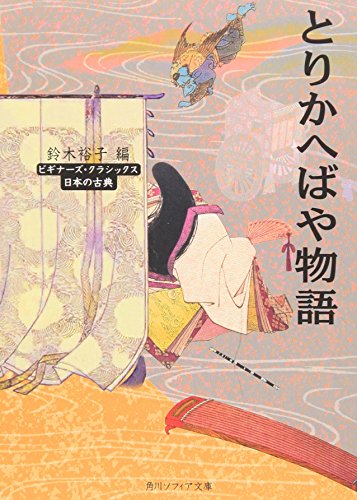
Torikaebaya

Translated by Rosette F. Willig


Breaking the Binary
pruffolo@middlebury.edu
The Torikaebaya is a classic piece of Japanese literature that explores transgenderism and cross dressing in classical Japan. Two versions of this text were written: the earlier version being a more satirical and humorous take on the subject, and the later text, which is what I will be reviewing, that takes a more serious, introspective ... read more

The Torikaebaya is a classic piece of Japanese literature that explores transgenderism and cross dressing in classical Japan. Two versions of this text were written: the earlier version being a more satirical and humorous take on the subject, and the later text, which is what I will be reviewing, that takes a more serious, introspective approach. It was written sometime between 1100-1170 C.E. and tells the story of two siblings, Chunagon and Naishi no Kami, and their struggle with their society’s standards for gender expression and personality.  From a young age, the two siblings each had the opposite personality expected of their gender – the male Chunagon was shy and submissive; the female Naishi no Kami was social and brash. In order to align them with prescribed gender roles, their father decided to make them swap genders at a young age. The Torikaebaya goes on to describe their story as they explore the challenges that arise from keeping their original gender a secret from their society and partners as they struggle to integrate into a conservative and unaccepting environment.

After having read other Japanese works of the time, the Torikaebaya stands out as one of the most progressive and unique texts of the era. Other readings of the time, such as the Konjaku Monogatari, tend to place focus on how the expected gender roles of men and women are stringent and mustn’t be broken. It is truly refreshing to be able to read a classical piece of literature that demonstrates the very real and human desire to break free from society’s prescribed gender binary. The reader gets a very personal view into the minds of two young people who simply wish to be able to freely express their personality. Instead, they are forced to conform to expected personality types based solely on their gender. Their repeated transitions between male and female demonstrate to the reader that the belief that certain qualities are inherently tied to gender is false. Chunagon is able to adopt a more submissive role when he transitions back to female, and Naishi no kami quickly learns how to play the flute before transitioning to male, which was considered an exclusively masculine instrument.

On top its progressive views on transgenderism, the Torikaebaya is simply an entertaining read. The tension in the story is often very tangible and leaves the reader wanting to keep turning the page. From the meddling Saisho’s love for both Chunagon and Naishi no Kami to Chunagon’s relationship with the beautiful Yoshino Princess, the reader is constantly engaged with the narrative. Unfortunately, this also leads to the one major shortcoming of the novel – the ending is relatively lackluster. Instead of some grand, climactic ending, the story simply skips ahead a few years and describes how the characters go on with the rest of their life. The reader, instead of having a satisfying ending that helps tie up loose ends, find themselves left wondering “is that it?”

Ultimately, the Torikaebaya is an important and unique piece of Japanese literature that is a must-read. Its complicated themes of gender identity and sexuality are certainly geared towards an older audience. It is an incredible story and is my personal favorite classical Japanese text that I have read thus far. Its themes, characters, and relationships are all profoundly deep - I continue to mull over the themes and issues presented in this text today, over a month after I finished reading it.

Total Votes : 0 Vote Up Edit Reply

Gender Expression and Reclamation in Heian Japan Through the Physical and Through Literature
mvalmyr@middlebury.edu
    a.     Teasley, Sarah. “Menswear, Womenswear: Distinctive Features of the Japanese Sartorial System,” Gender and Japanese History: Religion and Customs/ The Body and Sexuality. 1999. Osaka University Press,   Sarah Teasley’s essay suggests returning to ancient Japanese Heian culture to explore the origins of cross-dressing, “the wearing of clothes designed for the opposite sex,” ... read more


a.     Teasley, Sarah. “Menswear, Womenswear: Distinctive Features of the Japanese Sartorial System,” Gender and Japanese History: Religion and Customs/ The Body and Sexuality. 1999. Osaka University Press,


Sarah Teasley’s essay suggests returning to ancient Japanese Heian culture to explore the origins of cross-dressing, “the wearing of clothes designed for the opposite sex,” (Meriam-Webster) a term that, by nature, defines gender as clothing. Teasley looks at the most popular works of Heian Japan such as The Tale of Genji (1010) by Murasaki Shikibu, and The Changelings (1115-1170), author unknown. Beauty standards at the time were based off feminine beauty and “to be beautiful like a woman was an integral condition for male beauty in Heian aristocratic society; for a woman to be handsome like a man however, did not hold true.” (Teasley, 191) These shared beauty standards, and a “neutrally gendered aesthetic consciousness” (Teasley, 195) do not create gender. Instead, it is the way garments come together to form an outfit or silhouette that create the separation of gender. Teasley acknowledges transgender characters, stating that “for transvestitism to be even noticeable […] men’s and women’s clothing must show formal difference.” (204) This not only validates transgenderism, but it removes gender from sex entirely. It is simply a matter of cloth. Teasley’s analysis is one that encourages academics and those concerned with contemporary Japanese culture to reevaluate their ideas of clothing in this culture, awarding credit to what ends up being a liberal era of understanding gender.   


b.     Caswell, Ruth Avalon "My Son for my Daughter and my Daughter for my Son: Clothing, Gender, and Power in Heian Japan," 2009. Historical Perspectives: Santa Clara University Undergraduate Journal of History, Series II: Vol. 14, Article 6.


In this paper, Ruth Caswell uses The Changelings as an example of how gender and sex “regulate access to power” (Caswell, 2) in Heian court. Here, clothing defines gender and gender defines power, this tale mirroring societal views of gender and sex with a Heian Japan built off power structures like the aristocracy. Clothing’s ability to provide gender identity and remove one from their biological sex is crucial. In The Changelings, Caswell states that “the idea that one sex was innately less able to wield power did not seem to have existed,” (Caswell, 15) and though this seems to be contradictory to her further statements, it does illustrate the difference between biological sex and gender. This could allude to the concreteness of sex juxtaposed by the flexibility of gender as it can shift with the change of an outfit, making it ridiculous in its power to control women, but liberating for transgender identities. This article adds contextual importance and is one ideal for academics and scholars of Heian Japanese literature and art as a whole.


c.     Kahn, Alexander. “The Chick Lit of Heian Japan.” Confluence, 23 Sept. 2012,

https://confluence.gallatin.nyu.edu/sections/research/the-chick-lit-of-heian-japan


Looking at literature and authorship through a gendered gaze, Alexander Kahn dissects how literature for women became a form of resistance. The Heian literary scene was rife with resistant female authors such as Sei Shonagon and Murasaki Shikibu. They reclaim power loss in some aspects of their life by writing, using it to “look,” an objectifying device, in the same way it is done to them by men. Kahn describes “looking” as one party hiding behind a screen, and the other being seen through it. With that, it is an “architectural tool in an array of devices for preserving gender inequality.” This screen becomes a two-way mirror through Heian literature; the woman’s gaze gains enough power to be as violent as the males through authorship; “men should not get to see women without ever being seen themselves.” Whether feminist retaliation was intentional or not, however, remains unknown. Kahns dissection invites readers of all literary backgrounds to explore the form that feminism and female domination in literature can take.


d.     Wiener, James, and Lynne K Miyake. “Women Writers in Ancient Japan.” World History, 3 Mar. 2016, https://etc.worldhistory.org/interviews/women-writers-ancient-japan/


Professor Lynne K. Miyake describes literature in Heian culture as one of the first avenues for women to assert their individuality in a way that mattered. It was a “literary golden age dominated by women.” Women, in need of something more than what they were offered, could turn to writing. Miyake recognizes that freedom to write may not have been possible if things like marriage politics were different. Miyake claims that the socialization of womanhood instilled time for literature, as men were expected to tend to “social and official” activities while women had more “leisure time.” Women had a deciding hand in “creating the literary economies of the twentieth [century]” and they wind up painting exceedingly universal depictions of the human condition through novels like The Tale of Genji, much more expansive than the writings of their male counterparts, as these novels reveal themselves to be timeless as well. Miyake calls to both leisure readers and academics of Ancient Japanese writing to offer more complexity to the women read in these stories, and the authors who wrote them.

Total Votes : 0 Vote Up Edit Reply


pisaboke@middlebury.edu
In what ways do the presentations of gender in pre-modern Japan, overlap with modern day presentations of gender in modern day Japan.

ryin@middlebury.edu
Through Torikaebaya, I feel like we are able to get a more comprehensive understanding of the construction of gender in pre-modern Japan. It seems like that what mainly sets apart being a "man" and a "woman" deals a lot with the performative sphere, stuff like personality, temperament, and skills. On the other hand, it seems that there is an aspect of fluidity when comparing physical beauty. I often felt that descriptions of Chunagon and Naishi no Kami could easily be interchangeable. Furthermore, the way they are described are never strictly indicative of one gender over another. Would it be accurate to say that the construction of gender was less focused on physical appearance and more on how individuals conduct themselves?

ryin@middlebury.edu
While reading Torikaebaya, I was pretty disappointed that we only really got Naishi no Kami's perspective only after they had assumed Chunagon's identity. What are the implications of this omission?

fgruson@middlebury.edu

What does Saisho's grief at the end of the story show about how gender roles function in Torikaebaya monogatari?


fgruson@middlebury.edu

Does Torikaebaya monogatari function as an avenue of understanding Japanese Heian culture or serve as a counter-cultural work?


kngai@middlebury.edu
I find it interesting that this idea over time almost went backward in progressiveness; now we don't see as many success stories like Torikaebaya existing, with a more conservative Japanese society we know today. What were some of the factors that implemented this change, and when did this transition begin?

aplanting@middlebury.edu

1) On a darker note, but one I would like to ask about as I feel it is important to understand these things, was suicide common amongst transgender people during these times?

2) Towards the end of the reading, the two siblings finally don their true identities and present themselves to their father. At first the father is taken aback, although he knew of their "unusualness" all along, but he quickly accepted their true identities. He said, "Your appearances, which should have been as they are now from the start, have been most peculiar until this time". Why didn't he just accept them for who they were when they were younger? Does acceptance stem from perceived value, meaning did he fear that they would not be seen as valuable members to society had they portrayed themselves in their true nature?

3) I was a little bit confused towards the end of the reading on page 230 regarding the Cloistered Princess. I understand that the Crown Prince took over the role of the Cloistered Princess as the Imperial Princess, but why did the Cloistered Princess have to retire to a nunnery after that? Why couldn't she have continued to serve in court?


xz2@middlebury.edu

Saisho is often portrayed as weeping and in tears. How does this add to the complexity of Saishō's character and blur the boundaries of gender norms? Saishō himself was aware that crying was considered "unmanly", as he said in tears to Chūnagon, "Whenever I see you I feel as weak as a woman and weep." It seems like Saishō's weeping is more than just expressing emotions. It also assists him in his love affairs with Yon no Kimi. "Since he wept, consumed with longing for Yon no Kimi, the weak-willed Saemon led him to her, night after night." Is Chūnagon I's weeping portrayed differently and does serve a different function?


xz2@middlebury.edu

Chūnagon was clearly aware of Saishō's lustful and fickle nature and once reproached Saisho for making Yon no Kimi so miserable. It's clear that Chunagon didn't see Yon no Kimi as a mere rivalry. This adds some complexity to Chūnagon’s character. How do we understand their response to Saishō's restless behaviors? Is it a mix of power and powerlessness, and in what way is it gendered?


xz2@middlebury.edu

The last commentary passage in Mumyozoshi was very interesting, in which the author compares Saishō and Yon no Kimi. "Yet Saisho does not realize that this is someone different, even though he sees him so clearly and directly. His situation is thoroughly helpless (246)." Does Saishō's shallowness make his gaze less powerful and intrusive in a way?


jenglish@middlebury.edu
We see a tremendous amount of reserve in Torikaebaya, of all different varieties. Chuunagon and Naishi no Kami are both notoriously reserved, and are lauded for being so. We also consistently see Chuunagon endure unpleasant things and obfuscate them, rather than share. We also see Chuunagon's patience with Saisho, even going so far as to extend him a great amount of empathy, despite Saisho having harmed him so. In what other ways do we see this reserve/patience? How does it manifest itself, and what does it reflect?
 In Torikaebaya Monogatari, we can see a connection between profound sadness/grief and illness and death. What is the relationship between emotions and illness/death that we see in Torikaebaya? In general, how are intense emotions portrayed and treated?
Does the tale end on a happy note? What questions is the reader left with?

kmacalintal@middlebury.edu
 

In the Torikaebaya monogatari, Naishi no Kami and the Emperor have a very disturbing and troubling sexual encounter (196-197). In these passages it states that "even if someone did hear her and, suspecting something, came in, nothing could be done, the Emperor being who he was." Based on the cultural norms at the time, if a man of lower rank was interacting with Naishi no Kami in this manner would something have been done? Would this encounter have played out differently? 


mzhong@middlebury.edu
In light of the numerous asterisks that come with stating whether or not Genji was bisexual or not, are there similar footnotes to keep in mind when discussing Torikaebaya as a queer story? How is it viewed by scholars and by the common Japanese public?
I was going through my presentation article and the author pointed out that the verbs accompanying a certain gender almost always suggest change rather that statis. For example, we may see verbs like “becoming, changing into, spending time as, getting used to being” male/female, rather than simply *being* a certain gender. This is an interesting connection to our previous discussions on the relationship between classical Japanese gender theory and Judith Butler’s theory of gender performativity, but I would like to also mention a thought — it seems that, in classical Japan, it is the audience’s reception of a gendered performance that determines ones gender, rather than the actual identity of the performer. For example, the third gender Kylie’s article last week mentioned the Wakushu, whose diversity of sexual appeal and flexibility of performance (ie able to do both traditionally male and female cultural activities) made them a third gender. The same article also referenced the fact that only men were allowed to be kabuki actors (including female roles) which can be interpreted as gender performativity taking precedence over self-identification and/or AGAB. Is this hunch about audience over performer true? Or is it just a product of a society very concerned with outward appearance?

aubriannaw@middlebury.edu
During this reading, I was reminded of Judith Butler's idea of performative gender. Butler shares that the concept of gender identity is founded on performative acts that society genders based on stereotypes. Connecting to Chunagon and Naishi no Kami's experiences, is there was a distinction between biological gender assigned at birth, gender identity, and gender expression? We see in the book many references to the brother and sister not acting how they should like the boy is acting like a girl and the girl is acting like a boy. Does this story support that someone's gender identity dictates their actions or more so a Butler approach that actions dictate gender identity?

aubriannaw@middlebury.edu
Something that kept standing out to me while reading was the recurring belief that men are more privileged and therefore if one has a choice, they would prefer to live life like a man than a woman. We see this in Chunagon being saddened by the idea of condoning himself indoors as Saisho’s wife (97). Even Saisho supports that it would “be hard for him to become a woman now that he has become accustomed to mingling in society” (102). I am curious about the elaboration of this gender privilege that Naishi no Kami brings up when she says, “now that I have taken on this masculine appearance I see no reason why I should have to stay indoors like the woman I was before'' (137). This rationale feels as though Japanese tradition believes female-presenting individuals should be hidden and male presenting people may roam free. Does this story promote a distinction between gender identity and gender expression in relation to societal gender roles/norms?

aubriannaw@middlebury.edu
We see the brother and sister both have deep connections with those higher up, such as the Princess and Prince. We see both the Princess and Prince portrayed in a positive and supportive light. Is this a depiction of how this story also aims to support imperial rule and the positives of those in power?

mgromero@middlebury.edu
 

I read a little of the translation introduction and since then realized Torikaebaya Monogatari is a Transgender tale and as I read it sparked a question if the theme of Transgenderness was either lost in translation in the original Japanese version or perhaps both versions never refer to the characters being transgender? Because as we read the father refers to both of his children as not normal and hoping for them to become aware of their "abnormality" and then wishing for their personalities to be switched, yet he ultimately allows them to switch gender roles in secret and while it is the reason of his worries for the fear of getting caught, he allows them to live their lives without forcing them to abide by their gender societal norms. Is it conveying the message of acceptance to identifying with neither monolithically gender constructions and because of it, it classifying as "inferior literature" or was reaffirming gender constructs the intended purpose of the tale?


mgromero@middlebury.edu
Why would Chunagon II want to rekindle that relationship and then have affections for her over the imperial princess who Chunagon II impregnated. I suppose my question would be is one of expectations of male assuming figures in court take responsibility over multiple women and what other new behaviors did everyone notice when the siblings switched assume according to their new gender role?

mgromero@middlebury.edu
As I read for this week, my dislike for Saisho has only grown for his self-entitled right to Chunagon and throughout Book II we see the relationship between the two switch drastically. Saisho no longer showing respect for Chunagon, examples we can see this is snatching a letter out of his hand, demanding marriage and a getaway, despite Chunagon showing more loathing for Saisho than love. Due to him being pregnant he feels as he "has to cling" to Saisho. We see more feminine characteristics and manners from Chunagon and male from Naishi no Kami, but was Chunagon's behavior a result of him being forced to lean on Saisho in fear of him revealing his identity or true to the intended goal of gender roles are absolute and everyone returns to their "natural" state eventually?

pruffolo@middlebury.edu
One line in particular that stuck out to me, when the emperor converses with Sadaijin about Naishi no Kami, he says "I'm sorry that I have not yet had a daughter, but I shall love Naishi no Kami in place of a daughter." He then goes on to sexually assault Naishi no Kami a few pages later, despite just likening her to a daughter. Is this just a turn of phrase, or do you think there is something deeper going on here? 

nzambranoromero@middlebury.edu
The first thing that I noticed is that we are able to engage more with the life of children during this period. Up to now, it has largely been an adult-centered narrative, and it was interesting to see how children tied into the culture and upbringing during this time. I found it really interesting that we were able to see how, even at such a young age, children are expected to conform to certain norms. Wherein boys have to act like boys and girls like girls. I am curious to see, however, how this may differ from a non-aristocratic upbringing.

nzambranoromero@middlebury.edu
It is noticeable that Saisho's respect toward Chunagon is not the best. I wonder if there is any implication to how Saisho thought about Chunagon, when it came to thinking about traditional gender roles. Did Saisho's perception of Chunagon's gender play into this? Moreover, I was curious about the way Naishi no Kami's transition back to male was depicted. While reading, it seemed almost as if it was this glorious thing, as it would detail everyone's reaction.

nzambranoromero@middlebury.edu
I am wondering what the practicality of Torikaebaya would have been. From our perspective, it is in a sense entertaining, but during the Heian period was it used for its writing style or for its message? If it is for its message, seeing as it breaks from aristocratic norms, how was it received and interpreted by readers?

aarong@middlebury.edu
What sort of complications come about from the translation/use of gendered pronouns in the Japanese and English versions of the text?

jlegido@middlebury.edu

Like some of my classmates, I also found the topic of virginity intriguing. It made me wonder about the idea of virginity in Japanese culture/society and Buddhism? How do the consequences, if any, of a woman losing her virginity compare to that of a man?


nnunez@middlebury.edu

Although Chūnagon seemed to fit the masculine role more, there was no clear indication that he (as gendered in the book) wanted to be gendered as one. Moreover, it seemed that Chūnagon and Naishi no Kami had trouble coming in terms with the gender that they were assigned by their parents. Were Chūnagon and Naishi no Kami considered transgender because their parents introduced them to society as the opposing gender(due to their ability to fill the roles of the opposing gender)? 


mvalmyr@middlebury.edu
In the beginning of this novel hear Chunagon say multiple times that he does not want to/think he should live any longer, which I interpret as suicidal ideation. Would he really take his own life? And if so, what is the Buddhist view on suicide? Is it similar to other religions?

nleung@middlebury.edu
This reminded me of "The Rose of Versailles" by Riyoko Ikeda. In The Rose of Versailles, Oscar is raised as a man albeit a woman. In this way, Oscar is similar to Chunagon. However, although I know that Sadaijin would've wanted his son to be a man and ahis daughter to be a woman, now that he has accepted his son being a woman and his daughter being a man, did he ever think about what their futures would be? I understand that having a feminine son and a masculine daughter at that time was probably embarassing, but it would be inevitable that their genders be revealed, so why making the decision to switch genders in the first place?

nleung@middlebury.edu
I think it is inevitable that the secret of their identities would be revealed at one point or another. Did any of the characters put any thought into that? It seemed as if the father decided to switch the gender of his children because maybe it would be embarrassing that his son was seen with feminine qualities while his daughter having such masculine qualities. 

nleung@middlebury.edu
After reading Book Three, the fact that Senji chose not to say anything when she thought the Princess was pregnant stood out to me. I wonder if servants and ladys-in-waiting often overhear or accidentally see something they shouldn't and choose not to say anything. As a result, would there be cases in which the emperor is not informed on something that may be important?

axzou@middlebury.edu

Reading Torikaebaya Book I reminded me of our earlier discussion on power and marginalization. In this case, the power dynamics experienced by Chūnagon and Naishi no Kami put them in increasingly difficult positions, making it harder for them to conceal their secrets. As their situations grow more complicated, they become more marginalized as it affects their individual sense of identity. It seems that their father, Sadaijin, and their mothers speculate that Chūnagon and Naishi no Kami are more comfortable identifying as the opposite sex, based on their behavior and interests. However, this raises an important question: is this assumption truly reflective of how the children feel, or is it a projection from their parents, whose rank in society forced them to place their children in roles that require them to adopt the identities of the opposite sex? 


axzou@middlebury.edu

The part where Naishi no Kami and Chunagon switched back to their original identities reminded me of how, in historical Chinese dramas, female characters often disguise themselves by putting on men's clothing, making it so that no one recognizes them. This is typically done when female characters want to sneak out of their homes alone or travel freely, using the disguise both as a form of protection from men and to break free of societal restrictions in certain situations. The scene where Naishi no Kami cuts her hair and puts on menswear to search for Chunagon also reminded me of this. However, I continue to wonder how successful this method was in real life. Would there be suspicion or would people just believe that they are a man just with feminine features? 


axzou@middlebury.edu

I found it surprising that Saisho never found out what happened to Chūnagon I. I felt as though there were enough clues for him to put the pieces together or even suspect that Naishi no Kami II was Chūnagon I. Nevertheless, the ending was not what I would have guessed and it seemed that most of the main characters were satisfied with their lives at the end of the book. I thought it was interesting how Chūnagon II took on the role of matchmaker for Naishi no Kami II and the Emperor as well as Saishō and the younger Yoshino Princess. Given the many complex relationships portrayed in this story, how common was it in classical Japan for children born from extramarital affairs to be raised by others who were not their biological parents?


rpessah@middlebury.edu
 

Saisho says that "If our union has produced a child, do, as I asked from the first, consider taking on the appearance of a woman so that we may be married. It's hard for both of us if you remain a man... So do as I ask and discard your pretense now" (97). I think this reflects a battle between love and societal perception. If Saisho truly loves Chunagon, then wouldn’t he be willing to embrace this change to be together openly?


rpessah@middlebury.edu
 

Sadaijin states that ‘He realized that this child too, like the other, was not normal,’ and that he couldn’t be presented in court. This brings me back to our class discussion about power and its limitations because it shows how those in power have the authority to define what is ‘normal’ or ‘acceptable’ during the Heian period. Sadaijin’s realization reflects the weight of social perceptions in determining who fits within accepted norms. It shows that power involves shaping these perceptions, but it also exposes its limitations—what happens when these norms and perceptions exclude those who don’t fit conventional expectations?


jcruzmendez@middlebury.edu
After reading the text, I was wondering about people's reaction to when the tale first appeared? The text itself touches on the societal expectations of gender; what is considered appropriate for women and men. In the tale, the gender of the characters (Sadaijin's children) is disguised, but how would society during this time react if it wasn't? Would the people try to force them to become nun/priests like how the Sadaijin was considering?

jcruzmendez@middlebury.edu
I found it intriguing how people did not notice Chūnagon was pregnant. Was this perhaps because the style of clothing could hide Chūnagon's pregnancy bump? Perhaps because he was a man that people ignored the signs or was it the author's intent to make the story progress?

jcruzmendez@middlebury.edu
I found the ending of the story surprising. I thought Saishō was definitely going to find Chūnagon I, either from seeing her around court, the inconsistent details about Chūnagon II, or from the Uji boy. I was also quite surprised about the Young Yoshino Princess and Emperor's response to learning about the Uji boy. While reading this, I was wondering if there are many instances where a wife would willingly take on a motherly role for a child that is not biologically theirs or would they be obligated to do so?

tjwang@middlebury.edu
 

Reading the Torikaebaya, I found it interesting as this is the first reading where we see what some people can describe as being the opposite of the sex they were born as. For example this quote from the reading really emphasis this point. "As the children matured, the boy became surprisingly shy. ... Always hidden behind curtains, he painted, played with dolls, and was absorbed with such games as matching seashells. ... the daughter was already quite mischievous by this time and was outside constantly playing kickball and shooting arrows with the young male attendants." This quote addresses the tension between individual identity and societal expectations regarding gender roles. In traditional society norms, there are activities and behaviors that can be seen as masculine or feminine. This book really displays the restrictive nature of gender stereotypes. A question that I had was how did gender norms influence the roles that were available to men and women?


tjwang@middlebury.edu
 

Reading the book "Torikaebaya", I came across multiple moments that highlight gender fluidity and the crossing of traditional gender roles. The one that stood out the most to me was when Naishi no Kami decided to take on her "true" male appearance to search for her brother Chunagon. This highlights a moment of gender fluidity and how Naishi is acting "man-like" and reflects a shift in her perceived gender role from female to male. Having discussed about similar mythical analogies where we see similar themes, this one reminded me of the Egyptian mythology. About how Isis, Osiris' sister, embarks on a journey by herself to find Osiris' body after it was scattered across Egypt.


tjwang@middlebury.edu
 

Reading "Torikaebaya III," I found it perflexing how no one really noticed the difference between Naishi no Kami and Chūnagon. The person who stood out to me well reading this was Naishi no Kami. The thing that stood out the most to me was her struggle between fulfilling her society duties and pursuing her own personal desires. Looking into Naishi no Kami’s experiences in the royal court displays the profound emotional and personal sacrifices that her duty comes with. For example, a quote that stood out to me that displayed her feelings but also how she was altered by being a man for a little was “Naishi no Kami felt there was nothing she could say, and she was silent for a while, lost in thought. However, since she had grown used to being a man, she was accustomed to reasoning things out and pondered what ought to be done. If she claimed that she had not even known about the Princess, the Princess would be very sad.” (179). We can see Naishi no Kami fighting internally with her society duties and her personal desires are most evident in her relationship with the Imperial Princess. Her duty to provide support contrasts sharply with her empathy towards the Princess's vulnerable state. A question that I had was or more of something I thought about was why Naishi no Kami wouldn’t help the princess when she had done things such as become her brother and yet is not willing to go against society norms to help the princess.


ipentony@middlebury.edu
This story is extremely interesting so far but has left me with a lot of questions about its historical context as well as what is yet to come in the remainder of the story. One thing I am especially curious about is how the story was received by the audience of the time period. Were topics surrounding gender identity normalized, or did this story break the norm in any way? What were the author's intentions in writing this story? Was it to promote acceptance of those in similar situations to Chūnagon and Naishi no Kami, or will we see a different message play out in the remainder of the story?

ipentony@middlebury.edu
I am curious about the motivation behind the author's decision to have Chunagon and Naishi no Kami transition back to their original gender identities, becoming Naishi no Kami II and Chunagon II. In book 1, I interpreted the story as being a positive message of acceptance for those like Chunagon and Naishi no Kami who identify with a different gender than the one they are born with. Why then, would the author choose to make them transition back to those genders that they do not identify with? Is it because the message of the story is not the accepting and uplifting one that I originally interpreted? Or is there more to come in book 3 that will reveal the true reasoning behind the author's decision?

pauls@middlebury.edu
After reading book one of The Changelings, I was intrigued by the notion of the father deciding the fate of his two children that he obviously cared very much about. The text notes that he waited until they were older to see if there was going to be a switch in personalities naturally, but without a specific timeline, we were left in the dark about how long he waited until deciding to switch them. This makes me wonder: when did the switch occur (in years), and what about Japanese society at the time allowed for such a (seamless?) transition.

pauls@middlebury.edu

This relates to both Torikaebaya I and II. Does Saisho rape Naishi no Kami? (It says she resisted him so I'm not sure). If not, what was stopping him? In the case of Yomi no Komi, who was perceived to be just as womanly as Naishi no Kami, Saisho simply goes ahead and does as he likes, regardless of her resistance. On the complete other hand, Saisho also goes to rape Chunagon, who he believes to be a male, but ends up a female. If it was how Saisho thought his victim was (male or female), why was Naishi no Kami able to resist him? It ends up that only the female born characters became victims of sexual violence, which leads me to suspect that something is either missing in translation, or this entire thing has been created as part of an author's imagination. 


Also, when does Chunagon become pregnant from Saisho? In their first encounter Saisho discovers Chunagon is really a women, but later in page 95 it says "While the two were going about their lives in this manner, sometime after the tenth month...". Ten months is longer than a pregnancy, so is it can't have been 10 months since Saisho discovered Chunagon was a woman or raped him (if he did during that first encounter). If he didn't, what does "in this manner" mean? Additionally, on the next page it says Chunagon languished until the twelfth month.


pauls@middlebury.edu
When the Emperor visits Naishi no Kami II and discovers that she is not a virgin, would this count as an act of sexual violence? The author mentions how it was important that Naishi no Kami II, as Chunagon I, could not escape Saisho even when she was behaving as a man. However, Chunagon II, who was acting as a woman as Naishi no Kami I, could resist Saisho. Are there really no cases of sexual violence being perpetrated by a man on another man (biologically), and is this novel a special case which allows us to make the distinction (a least in the case of other Japanese literatures)? It's an interesting take on the portrayal of sexual violence in these novels.

lmcnamara@middlebury.edu
 

I found the unique position of the father, Sadaijin, to be interesting. Although not an emperor, he still holds a powerful position in the grand scheme. From the first instance in the book, where he comments on the difference in behavior between the two children to the ultimate switching of roles, I was intrigued by the power he held in the court and if his position would be in jeopardy if people found out. Was there a position or title that a person could hold that would be exempt from the scrutiny that might arise from something like this?


lmcnamara@middlebury.edu
I found it interesting how Naishi no Kami was able to impersonate a man/Chunagon so easily when going out to look for him. She even justified her disappearance, saying that it wasn't likely that Sadaijin would notice that she was gone for a few days (she ended up being away for much longer since she could say she wasn't feeling well and just remained in her chambers. Suppose women were able to recluse themselves so easily, and a man's disappearance (Chunagon's) was noticed so strongly. How could they both remain in the Yoshino Prince's estate for so long and transition back to Naishi no Kami II and Chunagon II? It feels a little unbelievable, too, even though I know that in the last class, some people brought up the possibility of this novel being based on a true story.

lmcnamara@middlebury.edu
 

Throughout the three books, I noticed a recurring theme of Heian anxieties about impermanence and longing. For example, does the Emperor's frustration at being kept from Naishi no Kami for so long reflect broader cultural anxieties about impermanence? How does the poetry connect with this idea in general? The stories are filled with a preoccupation with fleeting beauty and lost opportunities. A strong narrative and theme is the Emperor's need to "seize" her beauty before it fades. Lastly, I'm curious about how Buddhist impermanence ideals are woven throughout this story in ways we haven't discussed in class.


as5@middlebury.edu

After reading the Torikaebaya, I was initially shocked at the fact that very few people suspected anything at all between Chūnagon and Niashi no Kami besides their radiance and beauty, and the fact that something like this can even occur. It then came to me its most likely due to the power the Emperor holds, that he manages to have each child be able to represent the opposite sex without too much tension. 

One thing that caught my eye, a rather insignificant part of the story, was when Saishō told Chūnagon that whenever he sees him, he feels "as weak as a woman and weep[s]" on page 81. This made me come back to the discussion about gender and society. Saishō seems to be attributing the outward display of emotions to women, or simply showing "frailness or weakness to women. I find this so interesting as we see this in other characters such as the Emperor from The Tale of Genji, another male character of high status who finds himself displaying deep emotions as if they shouldn't be. It makes me wonder, why is displaying such emotions by men viewed with such a negative connotation in comparison to women? Are women regarded as that lower or less than men, to the point where behaviors displayed commonly by women are seen as a hindrance, to the point where men are expected to avoid or not display such disdainful behaviors?

as5@middlebury.edu

I love how the story comes back to the idea of when Sadaijin claimed something along the lines of how such beauty and radiance from someone doesn't typically come without misfortune or without a long life. Chūnagon perfectly represents this thought throughout this section as he continues to struggle to live as a man, especially after his guise has been discovered and after having given birth. With that being said, is there really some truth behind that statement, or was it simply inevitable in this specific case that such beauty met a fate of misfortune because of the way Chūnagon had to live his life?

Also, on page 149, Sadaijin has a dream where a priest tells him that the affairs between Chūnagon and Naishi no Kami are resolved; "in previous lives their paths were crossed, and in retribution a goblin changed the boy into a girl, the girl into a boy, and caused you no end of sorrow." It then mentions because Sadaijin has been on the path of the Buddha for years, that the situation has been completely remedied. Based on this information, is it believed that if one were to encounter such an unfortunate situation that causes someone years of grief and sorrow, it most likely would have been caused by a supernatural being/cursed spirit, which could be solved through devout studying of the Sutras, for example? On this page, the word "goblin" is referred to in the footnotes as well. However, the footnotes speak on Tengus rather than a goblin. So was it a Tengu that caused this situation being referred to as a goblin in the reading for some reason?

as5@middlebury.edu
After reading the Torikaebaya Book III I was slightly confused about one thing. On page 197, the Emperor was with Naishi no Kami and to his shock and disappointment, realized that she was not a virgin. However, further in the reading, he ends up getting intimate with her and she becomes pregnant. I'm curious as to why, despite the Emperor knowing the information he knows, continued his intimacy with Naishi no Kami. He argues that only 2 or 3 people knew the details about Naishi no Kami's affair, but does his intense love for her really justify being intimate with her and having her be Empress?

mgamez@middlebury.edu
This reading reminded me of our discussion of marginalization and power, and sort of flipped it on it's head. Last class we discussed margins and who or what lies at the center of the margins and the power that they hold. This reading showed people living with power and stature in society, yet they were marginalized by the very norms that gave them their status. Despite their high rank, Chūnagon and Naishi no Kami struggle to fit within societal expectations. This shows that power does not always equate to freedom or acceptance. It challenges the idea that those with privilege are immune to marginalization and instead suggests that societal norms can impose limitations on everyone. How does this flip on power and marginalization change our understanding of societal structures and who holds real power?  

mgamez@middlebury.edu
The siblings going back to their original gender identity in my opinion highlights the societal pressures that force individuals to conform to gender norms. I think that this raises questions about autonomy and whether they ever had the power to truly define their own identities in such a structured society. This ending leaves me wondering: does this shift back to their birth genders represent a personal defeat

mgamez@middlebury.edu
After finishing Torikaebaya Book III, I found myself thinking about the emotional consequences of Chunagon and Naishi no Kami's forced return to their original genders. One thing that stands out to me is the lack of exploration into how Chunagon feels about transitioning back to living as a woman after spending so much of her life as a man. I wonder if Chunagons return to womanhood was inevitable based on sociteal pressure, or if the text suggests that gender fluidity is unsustainable in the Heian period.

gnadecki@middlebury.edu
I found it interesting how majority of the story focuses on Chunagon and his experiences, which is interesting as the beginning of the story is set up as of both him and Naishi no Kami will be equally focused on. I'm curious as to why this is and whether or not we will see more of Naishi no Kami's perspective? I also found the discussion of clothes, particularly robes, to be interesting. After the rape/start of the affair, Yon no Kimi often hides in her robes as a form of protection and concealment from her embarrassment and shame. We can also see the role of clothing as protection of Chunagon. His clothes are often discussed in great detail, often more so than the others, which is important as they conceal the secret of his biological body. Additionally, at the end of the story when Saisho visits Chunagon, Chunagon's robes are "scattered about" and he is only wearing a thin kimono and pants. This represents how his guard is off when Saisho rapes him and discovers his secret, again empthasising the use of clothes/robes as protection.

gnadecki@middlebury.edu
I found the themes from both readings for this week surrounding karma to be quite interesting. The religious buddhist undertones are quite interesting in the idea of how the siblings came to be. Last class we discussed how it was their karma from their past lives that forced them to be trapped in bodies that they don't necessarily identify with. However, now it is still said karma that forces them to switch back their genders. How much of the negative events of life were blamed on the past? How could past karma both force them to be in bodies they don't identify with but also then have to switch back gender roles? How can they accept that the cause of this is karma? Is there any way in the conext of their society for Chunagon and Naishi no Kami to live freely and happily?

gnadecki@middlebury.edu
Something I found interesting in connecting this reading with Torikaebaya was the ideas of agency and conforming to society. The lady in this story was not compliant to the norms of Heian Japan and felt that she had much agency over her life, while Chunagon and Naishi no Kami were trapped into societal gender norms that prevented their agency. Additionally, the ability to be ones self versus hide is also reflect of agency. I wonder how people of Heian Japan received these stories and what they thought of the themes of agency discussed in these stories and how they felt about the connections between rejecting societal norms with agency?

sgosnell@middlebury.edu
It is intriguing to see how Chunagon’s transition into a woman makes him realize the plight of womanhood during the Heian period. He certainly seems to be aware of how suffering the injustice, jealousy and forsakenness by men associated with womanhood was the punishment he had to endure for being ‘unusual’ – he even claims “how wretched it is to have become the woman I now am. Even the Buddha claimed woman is sinful” (page 143). It is also interesting to finally get a glimpse of nuanced understandings of how men and women feel about their gendered positions, as exemplified through Naishi no Kami and Chunagon. Is there something to be said about this story serving as a commentary on the differences and perhaps injustices present between the roles assigned to men and women during the Heian period?

dennisl@middlebury.edu
Sadaijin starts to notice that his son is showing "feminine" traits because he is playing the flute but when the narrator is describing his daughter's "masculine" hobbies one of the activities listed is her rushing to play the flute and koto with them. I am wondering why music is considered feminine when his son is doing it and why it is considered masculine when his daughter is doing it?

dennisl@middlebury.edu
I thought it was interesting when the Emperor confronted the Empress about him suspecting the Uji boy was her son and the conversation seemed to end simply because she blushed. I was wondering why the Emperor did not press the matter further and if he found out the truth what would he have done?

jfabre@middlebury.edu
From the ending of the first section, a few things caught my attention. Now that Saishō knows that Chunagon is a biological woman, why would he not want to reveal Chunagon to the court as a 'fraud'? I had assumed that, as rivals of sorts, Saishō would be furious to discover that Chunagon, who had (in his eyes) denied him two lovers and was of a very high rank, was secretly a 'woman' and therefore not fit to serve in court as he was doing. By revealing Chunagon, he could likely have taken Yon no Kimi as a wife and assumed perhaps a higher rank in court. However, instead he immediately switched his mindset of viewing Chunagon as a man to viewing him as a woman, and fell in love? I find it odd that he was able to switch his view so easily - or does he view loving Chunagon post-discovery as loving a man?  

I think it's unfortunate that in the end, the two siblings return to their "original" genders despite having been quite assured in their identities prior to being led to believe they were "unusual." Had Chunagon I never been forced to marry Yon no Kimi, and Naishi no Kami I never been forced to present herself at court, they could have lived quite freely and without worries about their "unusualness." At the same time, I can't really declare this to be anti-trans text, because while the author does seem to think they are better suited to their "proper" genders, Chunagon I and Naishi no Kami I were both still exceptional in their appearance and skills despite being of the "wrong" gender. Would a truly anti-trans text not be more likely to make a fool of them for attempting to live switched lives?

While it might be a little sad the Saishō never found out where the lady of Uji (Naishi no Kami II) went, it's also kind of deserved... I wonder if it can be read as a kind of punishment for always longing for / seeking out more lovers when he'd already made vows to several women without marrying them. I also find it odd that Saishō and Chunagon II were able to become close enough for Chunagon II to pair him with the younger Yoshino princess. Given Saishō's character and how much he longed for the lady of Uji, I really expected him to attempt to 'seize' Chunagon II as well, only to be shocked to find he is actually male-bodied this time.


pruffolo@middlebury.edu

Caswell, Ruth Avalon. “My Son for My Daughter and My Daughter for My Son: Clothing, Gender, and Power in Heian Japan.”                            Historical Perspectives: Santa Clara University Undergraduate Journal of History, II, 14 (2009).                                                                    https://scholarcommons.scu.edu/historical-perspectives/vol14/iss1/6.                 

            Written by Ruth Avalon Caswell, this journal article is an excellent analysis on how clothing and gender affected power in the Heian court system. This theme is starkly present throughout the Torikaebaya narrative; Caswell’s input provides the reader with a new lens with which to view how the siblings’ transitions between masculine and feminine affect the power and respect they receive within society. The themes of gender in Torikaebaya are often complicated and hard to pin down after just one reading of the text—the siblings transition twice, and each time their societal roles change in such drastic ways that it will certainly take multiple readings to understand the true significance of those decisions. Luckily, Caswell’s article provides great insight into these issues, and would be a beneficial read to anyone who wants to dig deeper into Torikaebaya. The single shortcoming of the article is that while the insight into the division of power based on gender is extremely valuable, Caswell’s argument that clothing is the major contributing factor to this structure often falls flat, as it is often based on speculation without much textual evidence.


Imai, Kazuhiko. “An Analysis of Torikaebaya Monogatari:  The Heuristic Potential of Judith Butler’s Performative Gender.” University                of British Columbia, 2020. Electronic Theses and Dissertations (ETDs) 2008+. http://dx.doi.org/10.14288/1.0390308.

            This text is a Graduate candidate’s thesis from the University of British Columbia. One notable aspect about this writing is that it was published in 2020, making it one of the more modern texts analyzing the Torikaebaya. Considering the major advancements gender studies has made in the last decade, the author provides a refreshingly progressive and insightful insight into how the societal gender norms are challenged in the ancient Torikaebaya text. At the beginning of the thesis, Imai explains how “insufficient are terms like ‘heterosexual’ and ‘homosexual’ in explicating the Heian period”, which is an excellent approach to tackling the complicated themes of sexuality and gender that are presented in the Torikaebaya. Most articles written a decade or more ago regarding the Torikaebaya attempt to explain these complicated topics through the use of a sexuality binary: homosexual and heterosexual, and a gender binary: male and female – which are too restrictive to properly describe the changes Chunagon and Naishi no Kami undergo.


Pflugfelder, Gregory M. “Strange Fates. Sex, Gender, and Sexuality in Torikaebaya Monogatari.” Monumenta Nipponica 47, no. 3                       (1992): 347–68. https://doi.org/10.2307/2385103.

            This journal article, written by Gregory Pflugfelder, is an excellent entry point for anyone who just finished reading the Torikaebaya for the first time or anyone who wants to gain a general understanding on the wide array of themes presented in the text before diving into the story. The author divides his article into three main sections: gender identity, alternate examples of gender divergence in other Japanese tales, and homosexuality. The author presents solid arguments in each of the three sections, including a particularly interesting view on how the Buddhist notion of fate helped confirm the siblings’ gender changes as destined to be. One of the major weaknesses of this article arises on the very first page; the author immediately states that he will only be referring to gender in terms of male and female and does not consider the exploration of genders outside of that binary. This is simply an effect of the time in which it was written, and it would be interesting to see how the author’s viewpoints would change after gaining knowledge on gender nonconformity.


Yukari, Fujimoto, Linda Flores, Kazumi Nagaike, and Sharalyn Orbaugh. “Transgender: Female Hermaphrodites and Male                                      Androgynes.”  U.S.-Japan Women’s Journal, no. 27 (2004): 76–117. http://www.jstor.org/stable/42771920.

             This journal article, translated from the written work of Fujimoto Yukari, focuses less on the Torikaebaya itself and more so on how the perception of gender identity, cross dressing, and sexuality in Japanese literature evolved over several centuries. The author focuses on how shojo manga tackles similar topics to those in the Torikaebaya. Many of these tales focus on the psychology and societal acceptance of cross dressing and transgenderism, themes also found in the Torikaebaya. This article is certainly a worthwhile read for anyone who wishes to see how Japanese fiction has portrayed gender identity through the past several centuries. One major shortcoming of this article is that it is clear that the author did not have the tools and knowledge regarding the complexities of gender identity that would be known by modern authors writing the same topic. There are several instances where the author portrays the transitioning of gender as a simple choice in order to achieve some social goal, which result in some shallow analysis near the end of the article.


gnadecki@middlebury.edu

Adler, Joseph A. 2006. "Daughter, Wife, Mother or Sage, Immortal, Bodhisattva? Women in the Teaching of Chinese Religions." ASIANetwork Exchange: Teaching about Asia 14(1): 11-16.


Joseph A. Adler’s essay offers valuable insights into gendered religious practices within Heian Japan Buddhist practices. Adler examines the interplay of Confucianism, Daoism, and Buddhism, particularly focusing on the restrictions and opportunities afforded to women. He highlights the tension between Mahayana Buddhism's philosophical framework, which theoretically denies gender distinctions, and the patriarchal cultural contexts that imposed limitations on women.

A key example is the Five Obstructions doctrine (A buddhist belief that sensual desire, ill will, sloth and torpor, restlessness and worry, and doubt act as obstacles not only to mindfulness but also to achieving nirvana), the ultimate state of liberation and freedom from suffering in Buddhist philosophy, which asserts women must be reborn as men to attain enlightenment, reflecting broader societal biases. Adler also emphasizes the ways through which women subverted these limitations, such as joining nunneries or embodying compassion through figures like Avalokitesvara, who became feminized in Chinese and Japanese contexts. These dynamics were mirrored in Heian Japan (794–1185), where Buddhist doctrines both marginalized and empowered women, allowing for roles as patrons, devotees, and even unofficial leaders in religious spaces.

Adler’s analysis enriches understanding of Heian Buddhism by situating it within the broader Mahayana framework and exploring the roles women played in navigating gendered religious structures. His perspective emphasizes how the passage of Buddhism from China impacted its interpretation in Japan, illustrating shared values and practices.


Ambros, Barbara R. 2021. The Heian Period: Women in Buddhism and Court Ritual. New York: NYU Press.


Barbara R. Ambros’s Women in Japanese Religions explores the roles and status of women in Buddhism and court rituals during Japan’s Heian period (794–1185). This chapter highlights significant changes in women’s religious participation and social standing. Early Buddhism in Japan was relatively inclusive of women, but Heian society introduced greater restrictions. Aristocratic women retained some autonomy due to uxorilocal marriage customs, which kept them tied to their natal families and allowed them to inherit property. However, these privileges coexisted with practices like polygyny, which fostered female jealousy and resentment, often metaphorically represented as demonic in literature.

Although women were excluded from formal religious offices, many engaged in Buddhism through private ordinations, pilgrimages, and devotional practices. Elite women served as patrons of Buddhist institutions, sponsored temple construction, and participated in rituals, such as relic worship. The decline of state-sponsored convents, along with Buddhist doctrines emphasizing male spiritual superiority, limited women’s religious roles. Yet, some women found empowerment in religious pursuits, using practices like spirit possession to express grievances or gain agency within patriarchal structures. Ambros’s analysis illustrates the complex interplay between gender, religion, and societal norms in Heian Japan.


Ogoshi, Aiko. 1993. "Women and Sexism in Japanese Buddhism: A Reexamination of Shinran’s View of Women." Japan Christian Review 59: 19-25.


Aiko Ogoshi’s essay, Women and Sexism in Japanese Buddhism, examines the patriarchal structures within Japanese Buddhism, particularly focusing on Pure Land Buddhism and Shinran's teachings. Ogoshi highlights how Buddhist concepts like the Five Obstacles and Three Obediences framed women as spiritually inferior and dependent on men. Despite some claims that Buddhism transcends gender distinctions, Ogoshi argues that Japanese Buddhism perpetuated systemic discrimination, excluding women from temples and reducing their religious roles to supporting male clergy.

The essay critiques Shinran, the founder of Jōdo Shinshū (True Pure Land Buddhism), for reinforcing androcentric ideas. Shinran reinterpreted Kannon (Avalokiteśvara), the bodhisattva of compassion, as embodying maternal and sexual qualities. In his vision, Kannon could appear as a woman to save men from their desires by acting moth sexually and maternally, merging the Christian concepts of Eve and Mary into one. While this seemed to elevate women’s spiritual status on the surface, it reinforced their role as objects of male need as maternal caretakers and sexual partners, tying their salvation to their service to men. The essay concludes by calling for feminist reevaluations of Buddhist traditions and institutional reforms to address gender inequality.

Linfamy. 2022. "The Buddhist Practice of CHANGING Women into Men (for Enlightenment)." Youtube. Accessed December 14, 2024. https://www.youtube.com/watch?v=lhdzo_dbmNs. 


Linfamy's video about Buddhist practices surrounding gender highlights the many beliefs surrounding women’s ability to achieve enlightenment. Many Buddhists believed women could not reach enlightenment as females and needed to transform into men or be reborn as one. This belief was tied to the idea that the Buddha possessed 32 unique features, including an internalized penis symbolizing his self-control. Since women lacked this feature, they were deemed incapable of Buddhahood. However, others argued that gender was impermanent, like all things, and that spiritual qualities, such as intelligence and courage, mattered more than biological sex.

Women in Buddhism were often viewed as obstacles to spiritual progress. Some monks preached that women were impure, lustful, and dangerous, warning others that weakness toward women, likened to snakes, was the worst weakness. Even mothers were seen as needing salvation, which monks sought to achieve by performing religious acts to reduce their mothers' bad karma. A more public-facing belief depicted women as lesser beings, born female due to accumulated bad karma from past lives. Women were encouraged to perform good deeds, like copying Buddhist scriptures, to be reborn as men and eventually achieve enlightenment.


Despite these views, there were some slightly more progressive interpretations and practices. Some Buddhists believed gender was a state of mind, not body, allowing women to transcend their gender through spiritual growth and display of manly qualities such as intelligence and courage. Buddhist nuns rejected the notion of women’s impurity entirely and focused on figures like Empress Komyo, who spread Buddhist teachings and demonstrated that women could play meaningful spiritual roles without changing who they were.


jfabre@middlebury.edu

TOPIC: Queer/LGBT themes in Heian texts and society; understanding queerness in both fictional and nonfictional examples 

Durante, Daniele. “Cross-Gender Female Same-Sex Love as Women’s Solidarity in Torikaebaya monogatari and Ariake no wakare.” In Pathways in Civilizations of Asia and Africa I: Doctoral Studies Notebooks at Sapienza, 2:37-56. Sapienza University Press (2021). https://iris.uniroma1.it/retrieve/e383532e-c5c2-15e8-e053-a505fe0a3de9/Durante_Cross-gender_2021.pdf. 


In her 2021 doctoral study, Daniel Durante takes up the Torikaebaya Monogatari (late 11th century) and Ariake no Wakare (circa 1200) in order to analyze romantic love within cross-gender female same-sex relationships, namely that of Torikaebaya’s Chunagon and Yon no Kimi, while questioning the absence of female same-sex eroticism. Under the notion that affection is, like gender, a phenomenon shaped by cultural and historical context, Chunagon and Yon no Kimi’s relationship is understood as a contrast to male-female affections in the same tale. They are repeatedly said to have an intense emotional bond and share emotions, cherishing each other in a truly unique way. Durante posits that this relationship is a contrast to the messy, often imbalanced dynamics of male-female relationships. Her dissertation serves as a useful introduction to the ambiguity of Torikaebaya by carefully defining the terms used in analysis, explaining unique Heian  (794–1185)  courting rituals, and outlining important plot points so readers unfamiliar with the text can follow along. It would pair well with Gregory Pflugfelder’s article, “Strange Fates,” which focuses on gender rather than love. 


Gamberton, Lyman. 2018. “‘No Reason to Fear Her Karma’: Gender Variance in Japanese History and Culture.” Ox.ac.uk. April 18, 2018. https://torch.ox.ac.uk/article/no-reason-to-fear-her-karma-gender-variance-in-japanese-history-and-culture.


Lyman Gamberton’s blog post, posted to the Oxford Research Centre for the Humanities, is an excellent piece for casual learning about Japan’s history with gender. Unlike dissertations and journal articles, Gamberton writes a short, condensed history and analysis of a variety of works and gender dynamics without going into anything too deeply. The section on Heian period  (794–1185)  texts includes examples from Buddhist tales and well-known monogatari alike, and then goes on to comment on how stark these ideas are in contrast to contemporary Japan’s generally conservative outlook on gender. This small inclusion of modern ideals adds depth to the short post, although it does potentially leave readers wondering how contemporary Japan came to be so conservative, when in the past these sorts of transgender tales were relatively common. Gamberton also does well in mentioning how readers of the Heian period would have perceived these texts – less as accepting recollections of genderqueer individuals and more as something humorously unusual – and noting that literary works do not necessarily reflect true stories or true people. This piece would make an excellent full-length journal article, but as an introduction to the topic, readers can appreciate its conciseness and objectivity.


Heldt, Gustav. “Between Followers and Friends: Male Homosocial Desire in Heian Court Poetry.” U.S.-Japan Women’s Journal, no. 33 (2007): 3–32. http://www.jstor.org/stable/42771965.


While most scholars concern themselves with the innumerous examples of heterosexual love poems made by the Heian Court (794–1185), Gustav Heldt instead shifts to the fewer, more complex examples of male homosocial poetry exchanges. While many of these exchanges use a pretense of patronage and allyship, there is nonetheless an undertone of desire, both physical and emotional, laced between the characters. Using poems by the chief editor of the Kokinshū, Ki no Tsurayaki (872–945), Heldt outlines the uniqueness of the language used in poetry between men, and challenges modern readers not to take ‘friendly’ poem exchanges at face value. While the article does frequently use Japanese phrases, they are adequately translated and defined so that most readers could understand the significance. To scholars already in tune with Heian allusions and natural allegories, it might seem almost too descriptive, but by explicitly detailing why a certain poem can be read a certain way, new readers will also come to understand and appreciate the ambiguous nature of poems, and find interest in a less spoken-of genre of Heian poetry and how homosocial and, on occasion, homosexual relations were interwoven into ‘friendly’ exchanges. 

Jackson, Reginald. “Translation Fantasies and False Flags: Desiring and Misreading Queerness in Premodern Japan.” In A Proximate Remove: Queering Intimacy and Loss in The Tale of Genji, 1st ed., 2:31–63. University of California Press, 2021. http://www.jstor.org/stable/j.ctv2rb75rb.6.


While the Tale of Genji (early 11th century) by Murasaki Shikibu precedes the Torikaebaya, considered to be the most famous Heian text regarding sexuality and gender, it is foolish to decide that there aren’t important, underlying examples of atypical dynamics in Genji. Using a more conceptual approach to the idea of queerness, Reginald Jackson discusses not only the queerness of gender and sexuality in Genji, but also the queerness in atypicality from society, and disruption of hierarchies and status, often thought of as ‘deviance.’ While modern queer scholars might be able to find reason to view certain scenes in Genji as homosexual/romantic, Jackson cautions how translations and differing cultural expectations may influence how we read into scenes to find underlying meanings. Jackson takes up the issue of Genji and how it reflects Japanese culture and society on the global scale, and how some Japanese scholars later on considered what were normal behaviours in the Heian period as scandalous or perverse due to the shifting perspectives on things such as male emotionality. While this text does discuss gender, sexuality and atypicality, it may be more hypothetical and societal than is useful to one seeking to learn about definite homosexual depictions from the Heian period, due to the use of ‘queer’ as a way to say different from society, including labelling things like Prince Genji’s illegitimacy as ‘queer.’  Still, discussions about masculinity and femininity may prove useful to understanding the text.

Pflugfelder, Gregory M. “Strange Fates. Sex, Gender, and Sexuality in Torikaebaya Monogatari.” Monumenta Nipponica 47, no. 3 (1992): 347–68. https://doi.org/10.2307/2385103.


Cited by many scholars since its publication in 1992, Gregory Pflugfelder’s “Strange Fates” article has been a cornerstone for analysis of queerness and ambiguity in the Torikaebaya Monogatari (late 11th century). In particular, his rejection of the diagnosis of Torikaebaya’s characters as homosexual and perverse led future scholars down a more fluid and adapted path, encouraging them to take into account the inherent differences between modern, Western concept of queerness and that of the Heian period (794–1185) , rather than trap the text under the label ‘homosexual literature.’ While the content may be considered dense by some, Pflugfelder takes care to create a digestible yet complex analysis on interpretations, language use, and sexual and social dynamics within the text, as well as taking into consideration the various influences that may have affected the author and intended audience, such as Buddhist attitudes and other texts that take ‘gender-mixing’ as a comedic endeavor. This article read in conjunction with the Torikaebaya would prove insightful and entertaining to any scholar adjacent to Heian literature, gender and sexuality studies, and Japanese culture. 


mvalmyr@middlebury.edu

Gender Expression and Reclamation in Heian Japan Through the Physical and Through Literature


Gender expression and performance in Heian Japan (794-1185) manifests in the physical, that being clothing, and through literature and authorship. Clothing allows for liberal explorations of gender for transgender identities, but it can also solidify harmful and gendered power dynamics. Literature then acts as a retaliation, an expression of the female gender, and a reclamation of power loss at the hands of Heian men.


a.     Teasley, Sarah. “Menswear, Womenswear: Distinctive Features of the Japanese Sartorial System,” Gender and Japanese History: Religion and Customs/ The Body and Sexuality. 1999. Osaka University Press,


Sarah Teasley’s essay suggests returning to ancient Japanese Heian culture to explore the origins of cross-dressing, “the wearing of clothes designed for the opposite sex,” (Meriam-Webster) a term that, by nature, defines gender as clothing. Teasley looks at the most popular works of Heian Japan such as The Tale of Genji (1010) by Murasaki Shikibu, and The Changelings (1115-1170), author unknown. Beauty standards at the time were based off feminine beauty and “to be beautiful like a woman was an integral condition for male beauty in Heian aristocratic society; for a woman to be handsome like a man however, did not hold true.” (Teasley, 191) These shared beauty standards, and a “neutrally gendered aesthetic consciousness” (Teasley, 195) do not create gender. Instead, it is the way garments come together to form an outfit or silhouette that create the separation of gender. Teasley acknowledges transgender characters, stating that “for transvestitism to be even noticeable […] men’s and women’s clothing must show formal difference.” (204) This not only validates transgenderism, but it removes gender from sex entirely. It is simply a matter of cloth. Teasley’s analysis is one that encourages academics and those concerned with contemporary Japanese culture to reevaluate their ideas of clothing in this culture, awarding credit to what ends up being a liberal era of understanding gender.   


b.     Caswell, Ruth Avalon "My Son for my Daughter and my Daughter for my Son: Clothing, Gender, and Power in Heian Japan," 2009. Historical Perspectives: Santa Clara University Undergraduate Journal of History, Series II: Vol. 14, Article 6.


In this paper, Ruth Caswell uses The Changelings as an example of how gender and sex “regulate access to power” (Caswell, 2) in Heian court. Here, clothing defines gender and gender defines power, this tale mirroring societal views of gender and sex with a Heian Japan built off power structures like the aristocracy. Clothing’s ability to provide gender identity and remove one from their biological sex is crucial. In The Changelings, Caswell states that “the idea that one sex was innately less able to wield power did not seem to have existed,” (Caswell, 15) and though this seems to be contradictory to her further statements, it does illustrate the difference between biological sex and gender. This could allude to the concreteness of sex juxtaposed by the flexibility of gender as it can shift with the change of an outfit, making it ridiculous in its power to control women, but liberating for transgender identities. This article adds contextual importance and is one ideal for academics and scholars of Heian Japanese literature and art as a whole.


c.     Kahn, Alexander. “The Chick Lit of Heian Japan.” Confluence, 23 Sept. 2012,

https://confluence.gallatin.nyu.edu/sections/research/the-chick-lit-of-heian-japan


Looking at literature and authorship through a gendered gaze, Alexander Kahn dissects how literature for women became a form of resistance. The Heian literary scene was rife with resistant female authors such as Sei Shonagon and Murasaki Shikibu. They reclaim power loss in some aspects of their life by writing, using it to “look,” an objectifying device, in the same way it is done to them by men. Kahn describes “looking” as one party hiding behind a screen, and the other being seen through it. With that, it is an “architectural tool in an array of devices for preserving gender inequality.” This screen becomes a two-way mirror through Heian literature; the woman’s gaze gains enough power to be as violent as the males through authorship; “men should not get to see women without ever being seen themselves.” Whether feminist retaliation was intentional or not, however, remains unknown. Kahns dissection invites readers of all literary backgrounds to explore the form that feminism and female domination in literature can take.


d.     Wiener, James, and Lynne K Miyake. “Women Writers in Ancient Japan.” World History, 3 Mar. 2016, https://etc.worldhistory.org/interviews/women-writers-ancient-japan/


Professor Lynne K. Miyake describes literature in Heian culture as one of the first avenues for women to assert their individuality in a way that mattered. It was a “literary golden age dominated by women.” Women, in need of something more than what they were offered, could turn to writing. Miyake recognizes that freedom to write may not have been possible if things like marriage politics were different. Miyake claims that the socialization of womanhood instilled time for literature, as men were expected to tend to “social and official” activities while women had more “leisure time.” Women had a deciding hand in “creating the literary economies of the twentieth [century]” and they wind up painting exceedingly universal depictions of the human condition through novels like The Tale of Genji, much more expansive than the writings of their male counterparts, as these novels reveal themselves to be timeless as well. Miyake calls to both leisure readers and academics of Ancient Japanese writing to offer more complexity to the women read in these stories, and the authors who wrote them.