Yotsuya Kaidan

Tsuruya Nanboku IV


Empower the Voiceless and Watch the World Burn
aubriannaw@middlebury.edu
Pleasure inflicts pain,  fear meets desire,  a repulsive attraction,  betrayed by beautiful evil,  births the rightful vengeance of  an abused and disfigured woman.  If the ideas in my cheesy poem intrigue you, you may be in the mood for a spooky tale saturated with erotic horror, feminine power, and a heartbreaking ghost. In 1825, Tsuruya ... read more

Pleasure inflicts pain, 

fear meets desire, 

a repulsive attraction, 

betrayed by beautiful evil, 

births the rightful vengeance of 

an abused and disfigured woman. 

If the ideas in my cheesy poem intrigue you, you may be in the mood for a spooky tale saturated with erotic horror, feminine power, and a heartbreaking ghost. In 1825, Tsuruya Nanboku, a well-known kabuki playwright, wrote the famed ghost story, Yotsuya Kaidan. Inspired by the true horrors of early modern Japan, Nanboku tackled the intersections between betrayal, sex, murder, and greed in commoner life. The world of Yotsuya Kaidan lacks morals and justice, thus we see the empowering embrace of death restore our protagonist, Oiwa, in the afterlife. 

We follow Oiwa, a beautiful, kind young woman, who transforms into a vengeful ghost after the betrayal of her evil husband, Iemon. Iemon murder’s Oiwa’s father for not approving of their union and then, promises Oiwa he will find the murderer. Throughout the play, we witness Iemon treat Oiwa cruelly while pursuing another marriage request from his neighbor, Ito, who wants Iemon to marry his granddaughter, Oume. While Iemon is off canoodling with the neighbors, Oiwa receives what she thinks is a cure for her postpartum depression. But, in reality, it is a poison to disfigure her so that Iemon will abandon her for a new bride. After finding out about Iemon and Ito’s evil plans, Oiwa tragically dies and becomes a horrifying ghost. The rest of the play involves Oiwa enacting her vengeance on those who wronged her in life. 

Having only read excerpts from Act II of the roughly five act play, I have witnessed more than enough of Oiwa’s suffering to be moved to vengeance myself for the abuse she endured. Personally, I did not enjoy reading this play. It was more painfully depressing than terrifyingly engaging. As someone who is a hotline crisis advocate for people experiencing concerns related to interpersonal violence, this story depicts a survivor of many forms of abuse that is unable to find safety in life. I wish to share a content warning of this piece regarding sexual assualt, dometic violence, and abuse targeted to those experiencing postpartum depression and with disabilities. I would also add that we see Oiwa experience many forms of systemic oppression within the abuse inflicted. I do appreciate the representation of a voiceless character regaining their voice against those who have wronged them. I imagine reading the play versus watching it in a theatre would be a very different experience. For the kabuki theatregoers back in the day, this story may have been a cathartic tale of restoratiation for the oppressed female common class and a terrifying warning for the abusive males in power. Nanboku’s artistry is truly powerful. He does a captivating job moving us to utterly despise the awful men in the story while breaking our hearts for the pain Oiwa endures. Within what feels like a span of a minute, her husband tells Oiwa he no longer cares about her, wants to remarry and for her to take their brat of a baby with her and to top if off, he wants to steal the the item closest to Oiwa’s heart, her mother’s comb, and give it to his new wife (Act II). 

Ultimately, I admire this play's emphasis on empowering those who have been silenced although I do not know if I truly believe revenge is justice. Perhaps the only person who can answer this question is Oiwa herself. In her afterlife, she is able to fully listen to her needs and express her emotions unapologetically. I did not enjoy the reading but I am grateful for the messages it promotes. Oiwa represents a collage of horrible experiences many women of this Japanese period endured and never were given the opportunity to regain their power and control. If you are interested in reading this piece, I would recommend it with the caveat that you engage however best feels supportive for you in the moment, listen to your needs if it’s best to put the reading down, and please do take care of yourself after. Yotsuya Kaidan is an important and masterful read, but a heavy one nonetheless.

Total Votes : 0 Vote Up Edit Reply

Kabuki Theatre
rpessah@middlebury.edu
  In connection to the previous text, in this video Trent Maxey, Associate Professor at Amherst College, discusses the cultural history of late Tokugawa Japan. Maxey explores how political, economic, and ecological crises created disorder across the shogunate and influenced cultural production, using woodblock prints, literature, and kabuki theater to show how these disruptions shaped ... read more


In connection to the previous text, in this video Trent Maxey, Associate Professor at Amherst College, discusses the cultural history of late Tokugawa Japan. Maxey explores how political, economic, and ecological crises created disorder across the shogunate and influenced cultural production, using woodblock prints, literature, and kabuki theater to show how these disruptions shaped artistic expression. I found this lecture valuable for understanding the social and economic context behind the flourishing of woodblock art. Maxey links political upheaval and economic crises to the cultural landscape, highlighting how artists responded to societal turbulence. This connection is especially useful for our class discussions of love, sex, and death in Japan, where we focus on how personal relationships and societal expectations are shaped by cultural norms throughout the texts we have read. Maxey’s lecture expands this by showing how political power and instability also influenced artistic forms of expression. A particularly insightful moment comes at the 37-minute mark, when Maxey discusses kabuki and the concept of "pleasure," revealing how entertainment reflected social and political tensions. If one is interested in getting a “crash course” on how political and social forces shaped artistic expression in late Tokugawa Japan, I highly recommend this video.

Total Votes : 0 Vote Up Edit Reply


aplanting@middlebury.edu

When Iemon returns to Oiwa after visiting the mansion, he has a cruel conversation with her. Among the horrible things we says, the line "go find someone else who has the time to waste on vendettas. Vendettas make me sick" caught my attention. From my understanding, samurai only had the responsibility of remaining loyal to their master/carrying out their master's vendettas. Were samurai also expected to be loyal to their wives/carry out their vendettas? If so, what would the consequences have been had if a samurai was not loyal to his wife/her vendetta as in the case Iemon?


xz2@middlebury.edu

In what ways does the play rebel against traditional moral codes?


jenglish@middlebury.edu
In much earlier readings, one can see frequent archetypes of women as vengeful spirits, or women transforming into other supernatural creatures. How what we see here in  Yotsuya Kaidan differ from earlier Japanese texts?

aubriannaw@middlebury.edu
Many of the papers I have read about Oiwa's story emphasized the justice narrative of this oppressed and voiceless woman who in her death seeks revenge in an uplifting and cathartic way for the audience to witness. From only reading a portion of the play, near the beginning, does the rampage of vengeance Oiwa journeys through the end of the play truly feel empowering?

mzhong@middlebury.edu
Last class we drew parallels between the loyalty of a samurai and their daimyou and that of a samurai's wife and the samurai. One thing we noticed was that there was an expectation for putting their devotion above their physical well-being -- a samurai killing themselves to admonish their lord, for example. From our reading about Iemon and Oiwa, what parallels can we draw between the relationship and expectations in a samurai-wife relationship and a samurai-daimyou one? Is a vengeful samurai spirit haunting a cruel daimyou conceivable?

mgromero@middlebury.edu
I was wondering about the power spirits have, especially when it comes to haunting people, as we can see in multiple readings grudges are held for long periods if time. We also see a heavy presence of rats in the story and I was wondering if there is any reason why? We see one of the characters kill himself after he kills his sister, why? Especially considering he pursued her romantically and killed her husband for it?

jlegido@middlebury.edu

I watched the anime episodes and wondered about vengeance even in death. Is this a common concept in Japanese culture, to continue to seek vengeance rather than to be at peace after death? or will peace only be attained once one has avenged themselves? 


snaseer@middlebury.edu
 

I find it interesting that in most of these plays we read, women are portrayed as evil on the outside whereas men who do evil things never have their appearances change. In this case, it would be the disfigurement of Oiwa paralleled to the heinous actions of Iemon. Although Oiwa did not do anything evil in her living days, she ends up being the one who looks like the monster she inevitably becomes. However, Iemon who has done various villainous acts (including killing Oiwa's father then cheating on her and condoning her death), his actions are never reflected on his physical character. It's almost as if there's a bias towards men being displayed as figures that should be sympathized with until the end.


snaseer@middlebury.edu
https://www.youtube.com/watch?v=W4JPZonR9po I ended up watching a video on Youtube analyzing the aesthetics of evil and it brought up this very interesting point about evil being reflected on the outside and then seeping into its surroundings. Everything will succumb to the evil, hence the revenge of Oiwa spreading to the families which plot against her. The video uses the example of the anime "Monster" written by Naoki Urasawa. (The video explains it in one minute I recommend watching that section!) He explains how every story's villain outwardly encompasses the type of evil they will end up carrying out. In Oiwa's case, her morphed brutal appearance, is exactly how she wished to kill her enemies. Hence, the death by rats for some and nails for others.

jcruzmendez@middlebury.edu
It was interesting to see the different perceptions of ronin in the plays.  In the Chushingura, there was a focus on loyalty and honor whereas in the Yotsuya Kaidan, we see the opposite. In the Yotsuya Kaidan, Iemon murders multiple people, sees no issue in dishonesty, brutality, and focuses on his own personal desires. I wonder if people's opinion about ronin/samurai changed with this play?

ipentony@middlebury.edu
"Yotsuya Kaidan" was a fascinating tale of supernatural revenge. I found the gender dynamics particularly interesting, as we got to see an instance where a woman was able to enact vengeance against a man who wronged her. It was also interesting to me that it was not only Lemon who suffered as a result of Oiwa's revenge, but the people around him as well. What does this signify about the values of the Japanese people of this time? Was merely being associated with someone who committed the crimes Lemon did enough for them to deserve this type of revenge as well?

tjwang@middlebury.edu
 

Watching the anime I found it interesting. The part where they killed the father in law and a guy that the servant fought with was interesting. Something else I thought about was how the father in law had samurai swords even though he was a beggar at that point and that he didn't sell it. Also how the guy begin to lose interest in his "wife" after she got pregnant as if he didn't have anything to do with it. The question I had that I was uncertain about was the ending and if he poisoned his wife or something?


pauls@middlebury.edu
In Ayakashi: Samurai Horror Tales, the “Yotsuya Kaidan” arc shows Oiwa dying a horrible death after being poisoned by her cheating husband, which turns her into a vengeful ghost. How does this mix of betrayal, death, and revenge reflect cultural fears about relationships and morality in old Japan? Why do you think themes like love and betrayal make the horror feel more personal and haunting in Japanese ghost stories?

as5@middlebury.edu
I was specifically intrigued and wondering about the symbolism behind the mouse in episode six, particularly because it had blood all over its face. I was left wondering, what's the symbolism of the rat here? I'd like to note that the entrance of the mouse was interesting because it only appeared after the black cat (which is considered a predator of mice), and with blood on it. Based on this specific sequence of events, I interpreted this scene as a representation of the Ito household and Iemon, and Oiwa herself. I think the black cat may have represented the Itō household, whereas the mouse portrayed Oiwa. Considering how the black cat, being the natural predator of mice and holding a somewhat sinister symbolism, I would attribute it to the Itō household as they are of higher status and above Oiwa, committing heinous actions (hence their portrayal of a black cat), while Oiwa is portrayed as a mouse, because of her lower status and her disgusting features (after having her face disfigured), and mice are typically viewed with disgust and are seen as pests, which would be fitting in this scenario. The kicker here, though, is how the mouse came in after the cat with blood on it as if it had shredded the cat to pieces. I perceived this as directly foreshadowing what's to come for Iemon and those of the Itō household: the bloodshed caused by Iemon himself to the Itō household. I saw it very amusing to see someone of lower status who is held in a lower regard get their back on someone much more revered and wealthy. Then again, I may be completely wrong, but I'm still curious to see if there's an actual correct interpretation of this scene and the symbolism of the mouse.

dennisl@middlebury.edu
I was shocked that "Yotsuya Kaidan" was such a dark story with prominent themes of death and suffering. I am wondering what the purpose of this genre of play is. Is it meant to teach a moral lesson, or simply for entertainment, kind of like how we watch horror movies for fun?


aubriannaw@middlebury.edu

Schmid, Sarah Rebecca. “Rotting Bodies: Sex, Gender, and Horror in Tōkaidō Yotsuya Kaidan .” The Polish Journal of Aesthetics, vol. 55, Apr. 2019: 9–26. https://doi.org/10.19205/55.19.1 .  

Sarah Rebecca Schmid’s article, “Rotting Bodies: Sex, Gender, and Horror in Tokaido Yotsuya Kaidan" dives into how gender and sexuality play important roles in the horrors of this Japanese tale through the intersection of women, ugliness, and ghosts, the role of mother and wife, and the depiction of female jealousy. Schmid intertwines relevant historical context (within kabuki, “beauty and goodness are intertwined”) with critical analysis (Iemon’s “sexual fantasy” turns “horror show”) (14, 16). Schmid shares how the scope of Oiwa’s gender limits her actions, and yet, in death, allows her to take back power on those who abused her as she is in a less feminine space (16, 21). This piece aims to support a reader who wants to think deeply about this play and analyze it through  critical gender and sexuality lenses. Though it does provide vital cultural context and a brief summary, Schmid’s language and in-depth references may feel at times confusing and too academic for someone just looking for a light read. Ultimately, Schmid unveils how Oiwa represents the abuse women often suffer in silence, yet in the afterlife, Oiwa reclaims agency and seeks justice in a terrifyingly beautiful way (24). 


Doherty, Niina. “From Edo Gothic to J-Horror: A Brief Look at the Ghost Story of Yotsuya.” Diabolique Magazine, 4 Mar. 2019, https://diaboliquemagazine.com/from-edo-gothic-to-j-horror-a-brief-look-at-ghost-story-of-yotsuya/.  

A short, yet informative summary with modern context and relevant adaptations, in “From Edo Gothic to J-Horror: A Brief Look at the Ghost Story of Yotsuya” Niina Doherty does exactly that. She provides readers with a succinct look at the tale of Oiwa while illuminating the theatrical elements and history of the kabuki stage, providing readers with a deeper understanding of the performance to increase imagination while reading the play. Doherty then transitions to shedding light on numerous film and TV adaptations of the famous Japanese horror, which may be of interest to prospective readers who wish to absorb this tale through media other than text. This piece acts as a useful source of resources, providing numerous artistic renderings, such as those by Katsushika Hokusai, and various media adaptations like the “1959 glorious technicolour version by Nobuo Nakagawa simply titled Yotsuya Kaidan.” Doherty also focuses on the cathartic theme in Oiwa’s story of the oppressed and voiceless regaining power in death and seeking justice from those who betrayed them. In conclusion, Doherty’s brief piece would be informative to any prospective reader of Yotsuya Kaidan, especially those searching for other artistic interpretations of the famous Japanese horror story.  


Shimazaki, Satoko. “The Ghost of Oiwa in Actor Prints: Confronting Disfigurement.” Impressions, no. 29 (2007): 76–97. http://www.jstor.org/stable/42598014. 

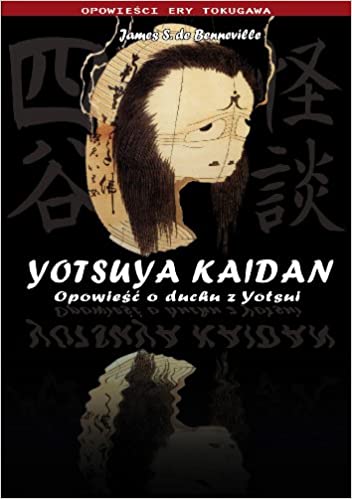
Overflowing with rich artistic interpretations of the text, Satoko Shimazaki’s “The Ghost of Oiwa in Actor Prints: Confronting Disfigurement'' gifts readers with provoking imagery of Tôkaidô Yotsuya Kaidan, while discussing preproduction playbills and prints, the lantern scene, the quick-change scene at the onbo canal, and the ghost actor. Not only does Shimazaki provide visuals of the story, she also shares historical context that makes reading the play that much more engaging. She reveals that Oiwa is based on a real woman, Iwa, who was disfigured “by smallpox and betrayed by her husband” (80). This piece is for a reader whose imagination wants help in making the world of Tokaido Yotsuya Kaidan come to life as they read the play. Shimazaki also explains the technical aspects of kabuki theatre which provides readers with a deeper understanding of the on-stage and back-stage elements of this performance (81). This piece extensively looks at actor prints and the historical theatrical elements of production, thus it is not very helpful to understand the plotline, but more so to see the story play out in a reader’s mind. I recommend at least scrolling through the paper to appreciate the thought-evoking images.  


Matsuura, Thersa. “Yotsuya Kaidan (The Ghost of Oiwa) Story Time (Ep. 42).” Uncanny Japan Podcast, 7 Oct. 2021, https://www.uncannyjapan.com/yotsuya-kaidan-ghost-of-oiwa-story-time/. Accessed 30 Nov. 2021.  

Thersa Matsuura’s spooky and entertaining podcast episode, “Yotsuya Kaidan (The Ghost of Oiwa) Story Time (Ep. 42),” gives listeners a taste of the bone chilling tale, leaving those wanting more. Her shortened retelling of the story of Oiwa impressively catches glimpses of the play’s captivating qualities. Matsuura does a phenomenal job bringing the story of Oiwa to life as she clearly guides listeners through a terrifying journey, even taking on the role of Oiwa in the last line as she concludes to Iemon, “You will never be free of me.” This podcast will not only provide you with a helpful summary of the Yotsuya Kaidan tale, but also send goosebumps down your spine, mastering the art of theatrical storytelling that rightfully encapsulates the horror of the play itself. This piece would be most informative for a prospective reader who wants a taste of what reading the kabuki play, but not quite sure if it’s the story for them. Lastly, Matsuura shares the historical knowledge that the story of Oiwa is believed to be cursed, which heightens the spooky-level immensely. 

rpessah@middlebury.edu


Similar to the work mentioned above, this article is an excellent resource for anyone interested in understanding gender roles in performance or learning more about traditional Japanese theatre, as I am. Gabrovska's work explores the representation of women in traditional Japanese theatre, particularly “all-male performing arts and masculine heroes in the traditional, predominantly male Japanese theatre kabuki” (2). From this article, one can learn how the depiction of women in kabuki serves as a commentary on societal norms and expectations. This source offers a new and exciting perspective on the text by challenging conventional understandings of gender representation in a male-dominated art form through its detailed examination of the historical evolution of the practice of male actors portraying female characters (onnagata) from the medieval to the Edo period. Its relevance to the topic of "Power and Desire in Early Japanese Works: Gender, Sexuality, and Social Hierarchies in Edo and Tokugawa Literature and Performance" lies in its analysis of how kabuki not only mirrors but also critiques the social hierarchies and gender dynamics of its time. 


rpessah@middlebury.edu

In connection to the previous text, in this video Trent Maxey, Associate Professor at Amherst College, discusses the cultural history of late Tokugawa Japan. Maxey explores how political, economic, and ecological crises created disorder across the shogunate and influenced cultural production, using woodblock prints, literature, and kabuki theater to show how these disruptions shaped artistic expression. I found this lecture valuable for understanding the social and economic context behind the flourishing of woodblock art. Maxey links political upheaval and economic crises to the cultural landscape, highlighting how artists responded to societal turbulence. This connection is especially useful for our class discussions of love, sex, and death in Japan, where we focus on how personal relationships and societal expectations are shaped by cultural norms throughout the texts we have read. Maxey’s lecture expands this by showing how political power and instability also influenced artistic forms of expression. A particularly insightful moment comes at the 37-minute mark, when Maxey discusses kabuki and the concept of "pleasure," revealing how entertainment reflected social and political tensions. If one is interested in getting a “crash course” on how political and social forces shaped artistic expression in late Tokugawa Japan, I highly recommend this video.